Will Pakistan's New Budget Help the Country's Poorest?
Pakistan's coalition government has set an ambitious tax collection target in its new budget.

Pakistan's coalition government has set an ambitious tax collection target in its new budget. But how far does it go to help the nation's poor who have been struggling to make ends meet?Pakistan wants to achieve economic growth of 3.6%, the country's Finance Minister Muhammad Aurangzeb said on Wednesday while presenting his first budget to lawmakers.
Aurangzeb emphasized the need to expand Pakistan's tax base as a strategy to prevent overburdening existing taxpayers. The goal of his budget is to ensure equitable distribution of tax responsibilities while meeting revenue targets.
Aurangzeb also said inflation had dropped to 12% per year. Pakistan has been grappling with soaring inflation amid its worst economic crisis in decades. At one point in 2023, inflation went above 40%, sparking angry protests as Pakistanis struggled to afford essential items.
"Now we are moving towards the right direction," Aurangzeb said, adding that Pakistan is setting a challenging target of collecting 13 trillion rupees ($44 billion, €41 billion) in taxes — 40% more than in the current fiscal year.
But Pakistan faces significant tax-collection challenges. A large part of its economic activity remains informal and unregistered — impacting its fiscal stability and growth.
Struggles of a single mother
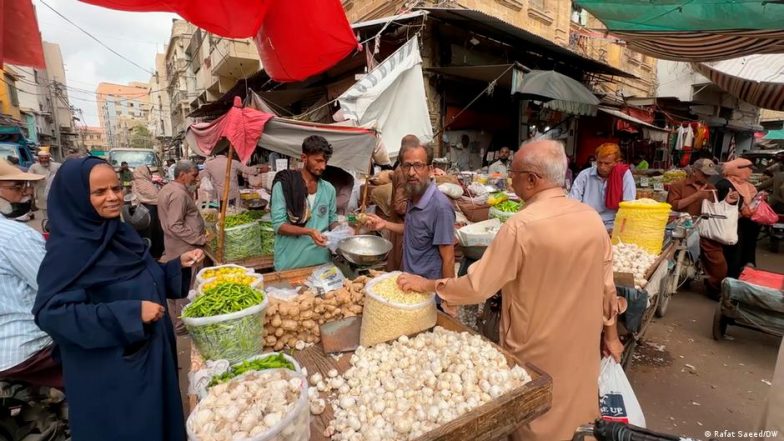
Amid the soaring costs of essential goods, many ordinary Pakistanis remain doubtful that the budget will deliver meaningful change.
Shahnaz Akhter, a domestic worker in the Pakistani capital Islamabad, told DW that the new budget will make life more difficult for her.
"The prices of the daily staple foods in the markets have been increasing every week and there is no regulation to control things and bring ease in common people lives," said the 45-year-old single mother who's raising six children.
Akhter expressed her frustration, stating that previous governments had not provided any relief for those struggling with poverty.
'Taxation heavy' budget
Some analysts echoed Akhter's sentiments about the budget offering little relief to ordinary Pakistanis.
"The budget will not bring ease in people's lives. It's taxation heavy," Safiya Aftab, an Islamabad-based economist, told DW, describing it as a difficult budget presented amid difficult times.
The economist told DW that she believed poor people have been crushed by successive governments in Pakistan.
"The items prices always increase in the budget with the burden of more taxes on the poor primarily the fuel prices and electricity tariffs."
Navigating economic challenges
As Pakistan grapples with the rising costs of basic necessities, the government's new budget proposal includes a salary increase for government employees. Simultaneously, negotiations with the International Monetary Fund (IMF) continue regarding a potential bailout.
Analysts highlight that the expanded budget — now approximately $68 billion, up from $50 billion in the previous fiscal year — aims to meet the criteria for securing a substantial IMF loan. The authorities hope to receive between $6 billion and $8 billion. This financial infusion is crucial for stabilizing the economy, especially after the near-default on foreign debt payments in 2023.
"Pakistan's budget will help in fiscal consolidation and is broadly in line with IMF guidelines," Mohammed Sohail, CEO of Topline Securities, a Karachi-based brokerage firm, told DW.
"Though the tax collection target is high, we believe that considering new taxation measures, Pakistan may be able to reach closer to the primary and fiscal deficit estimates."
Pakistan's informal economy
Only a small percentage of people contribute to Pakistan's budget, partly due to corruption among tax authorities and businesses.
Out of every 100 rupees collected in taxes, only 38 rupees reach the government, while the remaining 62 rupees are divided among taxpayers, tax collectors and tax practitioners, according to an article in The Express Tribune — resulting in significant unrealized tax income.
Analyst Aftab stressed that the strategy of imposing higher taxation on a few groups while leaving large parts of the economy untaxed is not a good one.
"People will either evade taxes or will take their legitimate businesses 'underground' or in the informal economy," said Aftab.
Economic revival?
Pakistan is looking to revive its economy, which has faced a long term recession in the past years following political instability.
The country narrowly avoided default last year, as the value of the rupee plummeted against the dollar and the country's foreign exchange reserves dwindled so low that imports were heavily restricted.
"This budget is not for economic stability, this is to show the IMF the government resort and commitment that it can actually bring economic policy reforms," remarked Suleri.
"It's basically one agenda point to start negotiation with the IMF program for the next extended fund."
The success of Pakistan's budget will depend on its effective implementation and addressing challenges related to tax collection, the informal economy and economic stability.
Edited by: Keith Walker
Before you leave: Every Friday, the DW Asia newsletter delivers compelling articles and videos from around the continent right to your inbox. Subscribe below.
(The above story first appeared on LatestLY on Jun 13, 2024 08:10 PM IST. For more news and updates on politics, world, sports, entertainment and lifestyle, log on to our website latestly.com).