
Business News | CBIC Plans Uniform, Time-bound AEO Processing to Ease Compliance for Traders
Get latest articles and stories on Business at LatestLY. The Central Board of Indirect Taxes and Customs (CBIC) is considering measures to simplify and speed up processing under India's Authorised Economic Operator (AEO) Programme, including a uniform procedure across customs zones, time-bound processing and a single-deficiency approach for applicants, the Finance Ministry said on Wednesday.

New Delhi [India], September 16 (ANI): The Central Board of Indirect Taxes and Customs (CBIC) is considering measures to simplify and speed up processing under India's Authorised Economic Operator (AEO) Programme, including a uniform procedure across customs zones, time-bound processing and a single-deficiency approach for applicants, the Finance Ministry said on Wednesday.
The proposed changes include a unified Standard Operating Procedure for processing across zones, a clear checklist for applicants and Zonal AEO Programme Managers, copying deficiency communications to applicants, clarification on financial solvency requirements and strengthening dedicated Client Relationship Managers and trained validators.
Also Read | UK High Court Rules in Favour of Interfaith Couple Over Unlawful Separation in Detention.
The proposals have emerged from discussions at the annual Customs Consultative Group meeting in Kolkata and representations received from trade, according to CBIC Member (Customs).
The Member said Customs administration has shifted from a transaction-centric approach to a risk-based and trust-oriented model since the current AEO framework was introduced through Circular No. 33/2016-Customs.
Also Read | Adidas Layoffs: Over 350 Employees Impacted As Gurgaon Tech Hub Cuts Nearly Half Its Workforce.
CBIC Chairman Vivek Chaturvedi also outlined five focus areas for the next decade of the programme - technology-driven facilitation, greater inclusion of MSMEs, seamless inter-agency coordination, expanded Mutual Recognition Arrangements and greater synergy across indirect tax verticals.
He also announced the launch of a structured feedback response form on the AEO portal to allow AEO entities and other stakeholders to provide continuous inputs.
The ministry said the AEO Programme has become an important part of India's trade facilitation system by promoting voluntary compliance, strengthening supply-chain security and enabling faster and more predictable movement of goods across borders.
CBIC also highlighted the Eligible Manufacturer Importer (EMI) Scheme as a pathway for compliant businesses to move towards higher AEO tiers.
In a separate compliance-easing step, documentation requirements under the EMI Scheme have been reduced from 10 documents to three through Circular No. 39/2026-Customs dated September 3. The revised requirement came into effect from September 15.
As of date, 5,967 entities, including importers, exporters, manufacturers, customs brokers, logistics operators and warehouse operators, have been certified under the AEO Programme across T1, T2, T3 and LO categories.
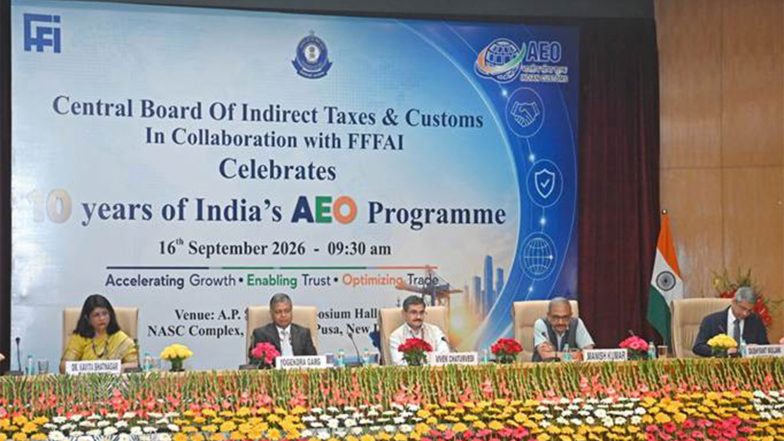
CBIC marked 10 years of the AEO Programme at an event in New Delhi, where it also launched a commemorative publication and announced a stakeholder feedback survey to guide future reforms.
The programme has expanded its coverage across the logistics chain, digitised application processes, set up dedicated AEO Cells and introduced special facilitation measures for MSMEs. (ANI)
(The above story is verified and authored by ANI staff, ANI is South Asia's leading multimedia news agency with over 100 bureaus in India, South Asia and across the globe. ANI brings the latest news on Politics and Current Affairs in India & around the World, Sports, Health, Fitness, Entertainment, & News. The views appearing in the above post do not reflect the opinions of LatestLY)
DISCLAIMER: This article is strictly for informational and educational purposes to raise awareness about the said topic. LatestLY DO NOT host, distribute, or provide links to sexually explicit content, leaked videos, or pirated material. Any search terms or keywords mentioned are solely for the purpose of explaining the viral trend and its associated dangers. We strongly condemn the circulation of non-consensual intimate imagery (NCII) and advise all readers to refrain from searching for or sharing such content, as doing so may lead to severe legal consequences.