
Business News | Commerce Secretary Co-chairs India-Brazil 8th Trade Monitoring Mechanism Meeting; Commits Early Finalisation and Greater Market Access for Indian Pharmaceuticals
Get latest articles and stories on Business at LatestLY. Commerce Secretary Rajesh Agrawal co-chaired the India-Brazil 8th Trade Monitoring Mechanism meeting in Brasilia, where India and Brazil committed to early finalisation of key trade terms and greater market access for Indian pharmaceuticals, according to the Ministry of Commerce & Industry.

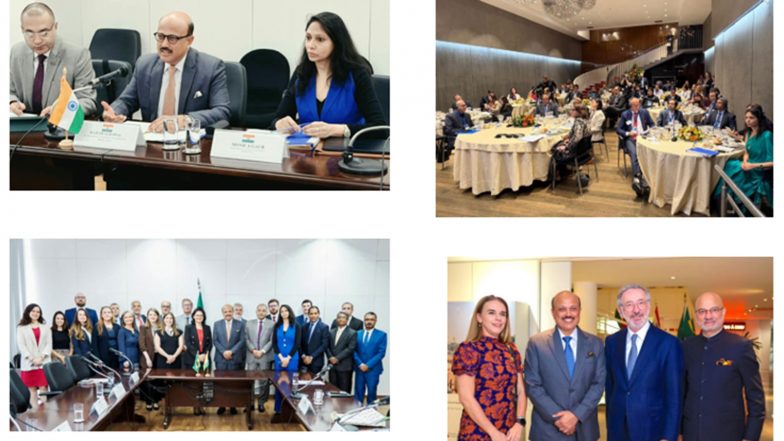
Brasilia [Brazil], August 31 (ANI): Commerce Secretary Rajesh Agrawal co-chaired the India-Brazil 8th Trade Monitoring Mechanism (TMM) meeting in Brasilia, where India and Brazil committed to early finalisation of key trade terms and greater market access for Indian pharmaceuticals, according to the Ministry of Commerce & Industry.
Co-chaired alongside Brazil's Secretary of Foreign Trade, Tatiana Lacerda Prazeres, the meeting reviewed bilateral trade performance, which reached USD 15.07 billion in 2025-26. Both nations reaffirmed their target to expand trade to USD 30 billion by 2030, identifying pharmaceuticals, chemicals, engineering goods, and machinery as core areas for diversification.
Also Read | Priyanka Chopra and Nick Jonas Vibe to 'I Want It That Way' at Backstreet Boys' Vegas Show.
Agrawal also held talks with Brazil's Minister of Development, Industry, Commerce and Services, Marcio Elias Rosa, to explore deeper investment cooperation.
Both delegations reviewed progress on the India-MERCOSUR Terms of Reference to expand and modernise the existing Preferential Trade Agreement, following bilateral trade with the MERCOSUR bloc reaching USD 20.84 billion in 2025. Both sides committed to an early conclusion of these terms.
Also Read | Nicolas Maduro Shares 1st Prison Pics Since Arrest Amid US-Venezuela Oil Deal, Check What He Wrote in Post.
Discussions placed specific emphasis on pharmaceutical trade facilitation, anchored by the CDSCO-ANVISA memorandum of understanding signed in February 2026. The Indian delegation noted that the framework provides an institutional base to improve market entry.
"India emphasised the need for supporting more predictable regulatory pathways and facilitating greater market access," the Ministry noted, highlighting that "India can contribute to the availability of affordable, quality medicines and strengthen efforts towards more accessible healthcare."
In agriculture, the discussions advanced technical evaluations regarding priority phytosanitary requests to enable reciprocal concessions within a fixed timeframe. The two sides noted progress on mutual recognition of Electronic Certificates of Origin and agreements on micro, small, and medium enterprises, entrepreneurship, and crafts to lower cross-border procedural barriers.
On the multilateral front, both nations reaffirmed coordination under the World Trade Organization, G20, and BRICS frameworks. India recognised Brazil's participation in the Strategy for BRICS Economic Partnership 2030 and the GVC Action Plan 2026-2030, while Brazil acknowledged Indian initiatives such as the BRICS Startup Knowledge Hub and the BRICS Business Incubator.
Alongside official negotiations, an India-Brazil High Level Business Reception took place in Brasilia. Agrawal led an Indian business delegation of more than 25 corporate entities, including representatives from Kirloskar Group, UPL, and Aditya Birla Group, to evaluate joint ventures in critical minerals, renewable energy, digital services, logistics, and advanced manufacturing. Both sides also welcomed the establishment of the ApexBrasil office in New Delhi to facilitate direct investment inflows.
Brazil is India's largest trade partner in the Latin America region, with bilateral trade of USD 15.21 billion in 2025. Indian exports to Brazil stood at USD 8.35 billion in comparison to imports worth USD 6.86 billion from Brazil. The trade balance was in India's favor by USD 1.49 billion.
Over the past ten years, trade relations between India and Brazil have demonstrated a cyclical pattern of growth and contraction, strongly influenced by global factors, changes in commodity prices and economic crises (such as the COVID-19 pandemic and the 2015 economic crisis in Brazil). (ANI)
(The above story is verified and authored by ANI staff, ANI is South Asia's leading multimedia news agency with over 100 bureaus in India, South Asia and across the globe. ANI brings the latest news on Politics and Current Affairs in India & around the World, Sports, Health, Fitness, Entertainment, & News. The views appearing in the above post do not reflect the opinions of LatestLY)