
Business News | New CAS May Reduce ETF Tracking Error but Poses Challenges for Arbitrage Funds: Report
Get latest articles and stories on Business at LatestLY. India's new Closing Auction Session (CAS) mechanism is expected to improve execution for exchange-traded funds (ETFs) by reducing tracking error, but it has also created unintended challenges for arbitrage fund investors due to wider divergence between cash and futures closing prices, according to an Invesco Mutual Fund report.

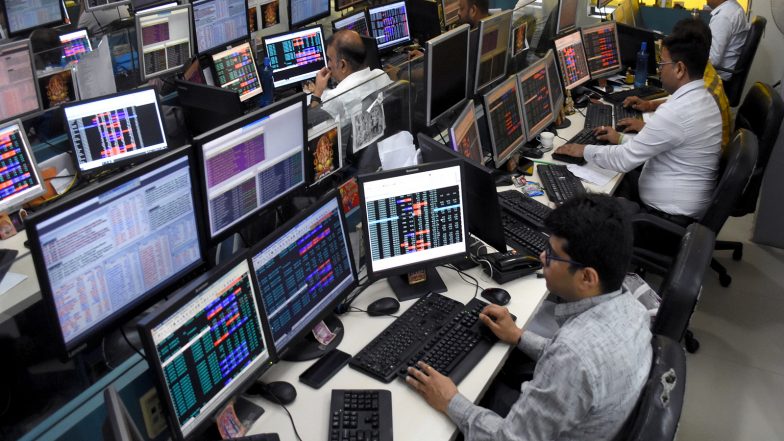
Mumbai (Maharashtra) [India], August 6 (ANI): India's new Closing Auction Session (CAS) mechanism is expected to improve execution for exchange-traded funds (ETFs) by reducing tracking error, but it has also created unintended challenges for arbitrage fund investors due to wider divergence between cash and futures closing prices, according to an Invesco Mutual Fund report.
ETFs are investment funds that track the performance of an index or a basket of securities, while an arbitrage fund is a type of mutual fund that makes money by buying a stock in the cash (spot) market and selling it at a higher price in the derivatives (futures) market at the same time.
The report said the new closing-price mechanism has replaced the earlier system under which closing prices in the cash market and futures and options (F&O) market were determined using the last 30-minute volume weighted average price (VWAP).
Under the revised framework, normal trading in the cash market for F&O stocks ends at 3:15 pm, followed by a closing auction that determines the stock's equilibrium price, which becomes the official closing price. Futures, however, continue trading until 3:40 pm, with their closing prices still based on the last 30-minute VWAP.
Also Read | Pawan Singh's 'Wanted' Producer Jaswant Kumar Arrested in INR 78 Lakh Fraud Case.
According to the report, this difference in price discovery has led to wider divergence between cash and futures closing prices, particularly in the final minutes of trading, as arbitrageurs are unable to intervene effectively because of uncertainty over execution price and quantity during the auction session.
"While CAS is expected to reduce ETF tracking error, it seems to have had an unintended negative impact on arbitrage funds. It is now imperative to refine the framework in a manner that preserves the benefits of CAS without adversely affecting arbitrage fund investors," the report said.
The report added that while arbitrage spreads are likely to remain stable during most of the trading day, they can widen significantly in the final trading hour. It said proprietary arbitrage desks are largely insulated from such movements, but investors in arbitrage funds may be affected because purchases and redemptions are executed at net asset values (NAVs) derived from closing prices.
It also noted that equity fund investors could experience gains or losses if underlying stock prices move sharply during the final minutes of trading.
Looking ahead, Invesco said market participants are expected to gradually adapt to the new mechanism, which could moderate volatility in cash-futures spreads over time.
However, it added that such divergence is unlikely to be eliminated entirely under the current framework and suggested that the methodology for determining futures closing prices may need to be revisited to better align with the new cash market closing mechanism. (ANI)
(The above story is verified and authored by ANI staff, ANI is South Asia's leading multimedia news agency with over 100 bureaus in India, South Asia and across the globe. ANI brings the latest news on Politics and Current Affairs in India & around the World, Sports, Health, Fitness, Entertainment, & News. The views appearing in the above post do not reflect the opinions of LatestLY)