
Business News | UPI MDR Could Hit Small Traders, Raise Costs for Consumers: Surat Textile Traders
Get latest articles and stories on Business at LatestLY. Surat textile traders have raised concerns over the introduction of Merchant Discount Rate (MDR) on UPI transactions, saying the levy could impact small traders and workers who rely heavily on digital payments for transactions ranging from salaries and advances to purchases of textile-related materials, while potentially pushing some businesses back towards cheque payments and passing additional costs on to consumers.

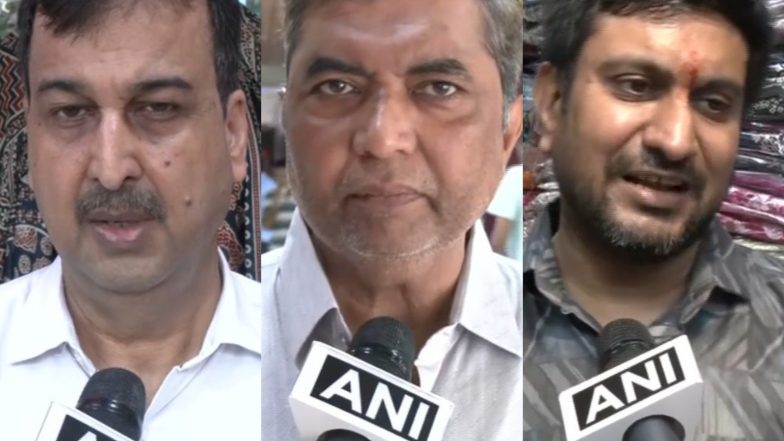
Surat (Gujarat) [India], September 16 (ANI): Surat textile traders have raised concerns over the introduction of Merchant Discount Rate (MDR) on UPI transactions, saying the levy could impact small traders and workers who rely heavily on digital payments for transactions ranging from salaries and advances to purchases of textile-related materials, while potentially pushing some businesses back towards cheque payments and passing additional costs on to consumers.
Speaking to ANI, Rangnath Sharda, Joint Secretary, Surat Textile Market, said UPI has become widely used for small payments in the textile market, including salaries, worker advances, cutting and packing charges, and purchases of other materials.
Also Read | Will Neymar Jr Play in Atletico Mineiro vs Santos CONMEBOL Sudamericana 2026 Match?.
“When it comes to small payments, we use UPI to pay salaries or advances to the workers who work with us,” he said, stressing, “If the government is introducing charges in this manner, it should apply them at different stages. If a 0.4 per cent charge or different charges are imposed on monthly payments of Rs 1 lakh, it will affect all the small traders in Surat’s textile market.”
For salaries, we would then start paying by cheque. Small payments would also be made by cheque. But with cheques, what often happens is that a trader says, ‘I am busy right now, come and collect the cheque later.’ This would disrupt their work.
Also Read | Delhi Bans Idol Immersion in Yamuna, Other Water Bodies During Ganeshotsav, Durga Puja.
Sharda said the levy could push traders back towards cheque payments for salaries and other small transactions, potentially causing delays for workers.
“If we have to pay them by cheque, it would take time to issue the cheque, get it cleared and then for the worker to send the money to their village. Therefore, any change to this system could have a significant impact on Surat’s textile market,” he noted.
Businessman Chetan Agrawal said small traders in Surat’s textile market typically make purchases ranging from Rs 10,000 to Rs 1 lakh, with nearly 99 per cent of payments currently received through UPI.
“Transactions in our business are generally worth Rs 20,000, Rs 30,000, Rs 50,000 or up to Rs 1 lakh, and almost all of these payments are received online,” he said, adding, “If further charges are imposed, the burden will ultimately be passed on indirectly to consumers. That is for sure.”
Likewise, Vikram Kapadia, a saree trader, noted his small traders and customers also use UPI, while payments for packing materials, saree-related transactions and salaries to workers are largely made through the digital payment system.
Kapadia expressed concern that additional charges on UPI transactions could financially impact both traders making the payments and those receiving them.
“If charges are imposed on these UPI payments, it will cause losses for us as well as for the other party receiving the payment. So, this will affect all of us, and I request that this matter be reconsidered.” (ANI)
(The above story is verified and authored by ANI staff, ANI is South Asia's leading multimedia news agency with over 100 bureaus in India, South Asia and across the globe. ANI brings the latest news on Politics and Current Affairs in India & around the World, Sports, Health, Fitness, Entertainment, & News. The views appearing in the above post do not reflect the opinions of LatestLY)
DISCLAIMER: This article is strictly for informational and educational purposes to raise awareness about the said topic. LatestLY DO NOT host, distribute, or provide links to sexually explicit content, leaked videos, or pirated material. Any search terms or keywords mentioned are solely for the purpose of explaining the viral trend and its associated dangers. We strongly condemn the circulation of non-consensual intimate imagery (NCII) and advise all readers to refrain from searching for or sharing such content, as doing so may lead to severe legal consequences.