Can There Be Solar for All, Everywhere by 2030?
Prominent climate leaders have called on governments, businesses, institutions and the public to make a push for solar power before the decade is out, repowering the world with cheap, clean energy.

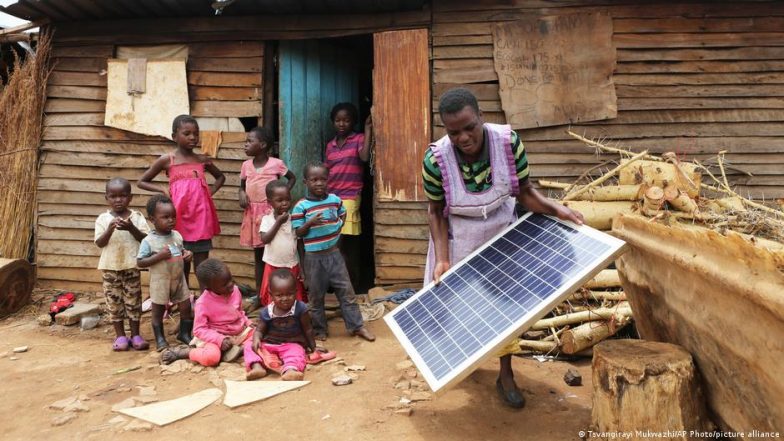
Prominent climate leaders have called on governments, businesses, institutions and the public to make a push for solar power before the decade is out, repowering the world with cheap, clean energy. Is that possible?In a world set ablaze by war and global warming, with ever worsening climate disasters such as wildfires in Europe and collapsing glaciers in Nepal, solar energy provides the solution of clean, affordable power, prominent climate leaders wrote in an open letterpushing for more solar.
Signed by prominent climate figures such as author Bill McKibben, former UN Climate Secretary Christiana Figueres and Canada's former Minister of Environment and Climate Change Catherine McKenna, the letter makes a clear call. It urges governments, businesses, institutions and the public to come together to provide clean, affordable energy to "everyone, everywhere by 2030" — from the close to one billion people who still lack access to reliable electricity, to the billions more who pay too much for dirty fossil fuels.
Also Read | India News | "Serving People, Fostering Development is Our Resolve": Rajasthan CM Bhajanlal Sharma.
With just a little over three years to go until the decade is out, how realistic is this push?
"It's an ambitious target, but we've blown away in terms of where we thought we would be on solar and renewables," McKenna told DW. "So let's just keep on going."
Where are we currently with solar?
According to global energy think tank Ember,solar power has grown at its highest rate in eight years. In 2025, it increased by a record 30% over the previous year and has risen more than tenfold since 2015.
Solar is the cheapest form of electricity in the history of the world, said McKenna, who founded the climate advisory firm Climate and Nature Solutions, and the global coalition Women Leading on Climate.
"It is scaling way faster than anyone ever imagined."
As is battery technology used to store excess renewable energy.
"The cost of batteries have as well come down as the cost of solar modules," said Eicke Weber, a physicist and former director of Germany's Fraunhofer Institute for Solar Energy Systems who went on to found the European Solar Manufacturing Council, among other things.
"We have the technologies available and we have enough money to finance it," he said, of a transition to widespread solar access.
In 2025, for the first time in 100 years, renewable energy sources overtook coal power in the global electricity mix, Ember's most recent analysis showed.
Where do we need to get to with solar?
At the moment, installed solar capacity around the world stands at 3 terawatts. 1TW equals 1000 gigawatts, and a single nuclear power plant has a capacity of 1GW.
Currently, the world produces about 1TW of new photovoltaic capacity each year, most of it in China. Weber says in order to fully change global energy supply to renewables, we would need about 50TW, adding that "we have more production capacities than we are selling."
Roughly 655 million people still lack accessto electricity.
"The pace of electrification in Sub-Saharan Africa has to triple to achieve universal access by 2030," McKenna said, pointing out how quickly this gap could be closed with solar.
Areas without electricity have the opportunity to leapfrog straight into clean technologies, she says, bypassing the fossil fuels that are heating the planet. Rising global temperatures are fueling extreme weather events such as drought, storms and flooding around the world.
"And there's a misunderstanding, which is often propagated intentionally by fossil fuel companies, that it's expensive, it's hard, it's unreliable. And that just isn't the case anymore," she said. "To be honest, the most unreliable thing is if you're trying to pass fossil fuels through the Strait of Hormuz."
Is solar for all, everywhere really doable in that short amount of time?
Hans-Josef Fell is used to the argument that certain things cannot be done. Widely known as a pioneer of renewable energy, he drafted Germany's Renewable Energy Sources Act which established feed-in tariffs that catalyzed clean energy growth at home and beyond.
"The Renewable Energy Sources Act unleashed exponential growth that shattered every assumption about what was achievable. It overturned the scenarios and projections that policymakers and experts had considered realistic. In the end, reality outperformed all expectations," said Fell, who now heads the think tank Energy Watch Group.
Fell, who has lived off grid for five years, says achieving a global energy transition requires political and societal will that is "currently lacking around the world because public debate is dominated by fossil fuel interests."
According to calculations by his think tank, if global energy demand were met entirely by renewables, solar energy would account for roughly 60-70% of the supply. The rest would come from wind power, and other sources, such as bioenergy and hydropower.
Where to go from here?
Countries like China and Pakistan have already pushed ahead.
"It is in our hands right now in the year 2026 to say we drop everything, we concentrate on this problem. We don't need to wait for new research," Weber said.
"It is possible to achieve this, but it would require a very kind of moonshot program," he added, saying it would need serious political backing.
He says while it might be possible for Germany to pull off such as transition in two or three years, if the political will were there, it would likely take longer to achieve on a global scale. "We would need probably till 2040 to say that we have a goal of a worldwide 80%, 90% electricity from renewables."
"I would sum it up this way: if we as a global society tackle this properly, we might actually be able to make it happen," Fell said. "And even if we achieve only 90% of that goal, it would still be a remarkable accomplishment."
McKenna points to the need for blended finance, calling on governments, the World Bank, the African Development Bank and the private sector to put in money.
"What is irrational is continuing down the road of fossil fuels," she said. "That's irrational on the costs, the risks, the impacts. It's an old technology."
Edited by: Tamsin Walker
(The above story first appeared on LatestLY on Oct 02, 2026 07:40 PM IST. For more news and updates on politics, world, sports, entertainment and lifestyle, log on to our website latestly.com).