India, Japan Unveil 16-Point Roadmap on Economic Security, AI, Energy Resilience at Annual Summit
India and Japan on Thursday elevated their Special Strategic and Global Partnership with a 16-point roadmap unveiled at the 16th India-Japan Annual Summit, setting an ambitious agenda spanning economic security, artificial intelligence (AI), energy resilience, critical technologies, mobility, clean energy and people-to-people exchanges.

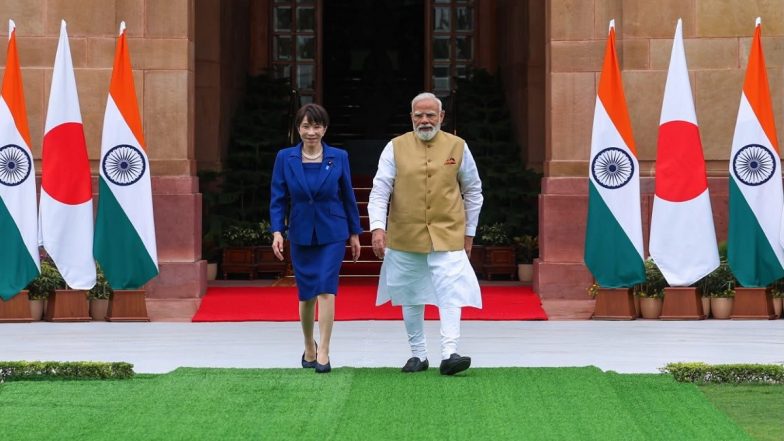
New Delhi, July 2: India and Japan on Thursday elevated their Special Strategic and Global Partnership with a 16-point roadmap unveiled at the 16th India-Japan Annual Summit, setting an ambitious agenda spanning economic security, artificial intelligence (AI), energy resilience, critical technologies, mobility, clean energy and people-to-people exchanges. Prime Minister Narendra Modi and Japanese Prime Minister Sanae Takaichi, following their delegation-level talks in the national capital, unveiled three key policy documents - the India-Japan Joint Declaration on Economic Security, the Joint Statement on Cooperation in the Field of Artificial Intelligence, and the Joint Statement on Energy Resilience.
Alongside these, both countries announced agreements covering batteries, pharmaceuticals, critical minerals, mobility, biotechnology, financial services, internet governance and AI. According to a release from the Ministry of External Affairs, the India-Japan Joint Declaration on Economic Security identifies economic security as a foundational pillar of bilateral ties and seeks to elevate cooperation through project-based collaboration in five priority sectors - semiconductors, critical minerals, information and communication technology (ICT), clean energy and pharmaceuticals. Japan PM Sanae Takaichi Experiences Indian Culture, Tries Playing Santoor Musical Instrument (Watch).
The declaration states that the partnership is "underpinned by mutual trust, shared values and aligned interests" and recognises that the "prosperity, security and economic futures of the two sides are deeply intertwined." Both countries expressed concern over economic coercion, arbitrary export restrictions and non-market practices that disrupt global supply chains, particularly for critical minerals and strategic industries.
In semiconductors, the two sides agreed to diversify supply chains, deepen cooperation in manufacturing, research, design and skill development, and encourage greater participation of Japanese companies in India's Semiconductor Mission 2.0. On critical minerals, they will promote technical cooperation between the Geological Survey of India and JOGMEC while developing an ecosystem for e-waste recycling to improve recovery of critical minerals.
ICT cooperation will focus on 5G Advanced, Open RAN, data centres, submarine cables, AI infrastructure and standards for beyond-5G and 6G technologies. They also agreed to establish a Track 1.5 Economic Security Dialogue involving governments, industry and experts. India and Japan also elevated AI cooperation into a strategic research and development partnership, committing to build a safe, secure, trustworthy, inclusive and human-centric AI ecosystem. Would Work Together for 'Viksit Bharat', Strong Japanese Economy, Says Japan's Press Secy Toshihiro Kitamura.
The two countries agreed to cooperate across the entire AI technology stack, including secure digital infrastructure, semiconductors, GPUs, compute resources, multilingual and open-source AI models, AI governance, cybersecurity and AI applications for public good. Key agreements include collaboration between IIT Bombay's BharatGen Technology Foundation and Japan's National Institute of Informatics (NII) on multilingual scientific large language models, Sarvam AI and Preferred Networks on foundational AI models, and an MoU between the IndiaAI Mission and METI to support AI startups and innovation.
Recognising India's AI talent, both countries reaffirmed their goal of bringing 500 highly skilled Indian AI professionals to Japan by 2030, while expanding joint research, internships and industry partnerships. India and Japan also adopted a Joint Statement on Energy Resilience aimed at strengthening cooperation on strategic petroleum reserves, crude oil stockpiling, maritime energy transport and clean energy.
The two sides agreed to share best practices on stockpiling systems, emergency response mechanisms and reserve management, while exploring joint investments across maritime energy transport value chains. The summit also marked the launch of the India-Japan Cooperative Biogas for Growth (CBG) Initiative, under which Japan will support the establishment of 1,000 biogas and organic fertiliser plants across India using dairy cooperative networks.
Both countries also agreed to promote hydrogen and ammonia projects, including the landmark clean ammonia project in Odisha, strengthen battery supply chains, encourage cooperation in solar and nuclear energy, and enhance collaboration in international carbon credit trading. The summit further witnessed the signing of several agreements across emerging sectors. India and Japan signed an MoC on batteries to build trusted and resilient battery supply chains, while another agreement on pharmaceuticals seeks to strengthen supply chains for Active Pharmaceutical Ingredients (APIs) and Key Starting Materials (KSMs).
An agreement on geology and mineral exploration will deepen cooperation in upstream exploration of critical minerals. The Next Generation Mobility Partnership aims to accelerate cooperation in railways, automotive, aviation, shipbuilding, logistics, ports and urban infrastructure while promoting India as a manufacturing hub for global exports. In biotechnology, India's Centre for Cellular and Molecular Platforms (C-CAMP) and Japan's RIKEN agreed to collaborate in deep-tech and life sciences, while NCBS-TIFR and RIKEN will undertake joint research in biology and neuroscience.
The National Internet Exchange of India (NIXI) and the Japan Network Information Center (JPNIC) signed an agreement covering internet registry operations, IPv6 adoption, internet security and capacity building. India's International Financial Services Centres Authority (IFSCA) and Japan's Financial Services Agency (FSA) also agreed to strengthen cooperation in financial regulation, including FinTech and RegTech. To commemorate 75 years of diplomatic relations, both governments announced that 2027 will be celebrated as the India-Japan Year of Shared Horizons.
The year-long programme will include cultural festivals, youth exchanges, business roadshows, academic collaborations, sports initiatives, Buddhist heritage events, science and technology partnerships, including activities related to the LUPEX Lunar Polar Exploration Mission, and expanded state-prefecture cooperation. The summit outcomes underscore the expanding strategic convergence between India and Japan, with both countries placing economic security, resilient supply chains, advanced technologies, clean energy and Indo-Pacific cooperation at the centre of their evolving partnership.
This comes as part of Takaichi's three-day official visit to India from July 1 to July 3 at the invitation of Prime Minister Modi, during which she participated in the 16th India-Japan Annual Summit, where both leaders reviewed the full spectrum of bilateral cooperation and discussed regional and global issues of mutual interest. Takaichi also took part in the India-Japan Business Forum alongside PM Modi.
(The above story is verified and authored by ANI staff, ANI is South Asia's leading multimedia news agency with over 100 bureaus in India, South Asia and across the globe. ANI brings the latest news on Politics and Current Affairs in India & around the World, Sports, Health, Fitness, Entertainment, & News. The views appearing in the above post do not reflect the opinions of LatestLY)