
India News | Delhi HC Directs Income Tax Department Not to Process Judges' Tax Returns in Challenge to CBDT Clarification on Taxability of Judicial Allowances
Get latest articles and stories on India at LatestLY. The Delhi High Court has directed that the Income Tax Department shall not process or proceed with the income tax returns of Supreme Court and High Court judges until further orders in a petition challenging a CBDT Office Memorandum that allegedly denies tax treatment available to certain judicial allowances under the new tax regime.

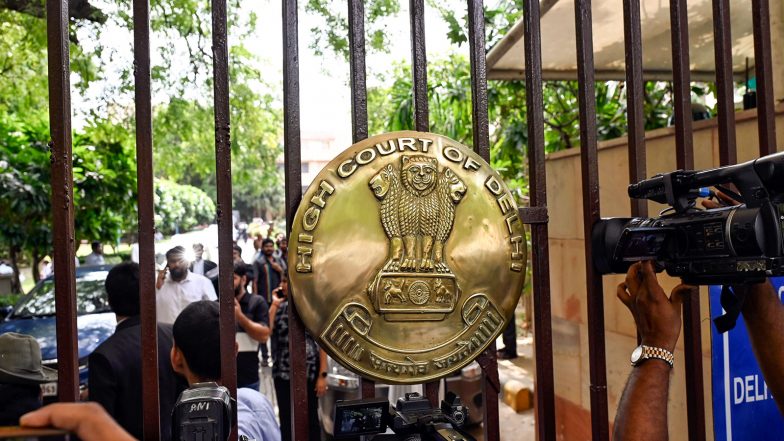
New Delhi [India], July 30 (ANI): The Delhi High Court has directed that the Income Tax Department shall not process or proceed with the income tax returns of Supreme Court and High Court judges until further orders in a petition challenging a CBDT Office Memorandum that allegedly denies tax treatment available to certain judicial allowances under the new tax regime.
The Court also permitted judges to file their income tax returns or revised returns by reflecting the allowances covered under the High Court Judges and Supreme Court Judges service laws as "receipts not in the nature of income" while filing returns.
A Division Bench of Justices Dinesh Mehta and Rajneesh Kumar Gupta passed the interim directions while hearing a writ petition filed by the Delhi Tax Bar Association, which has challenged the CBDT Office Memorandum dated September 12, 2025 relating to the tax treatment of allowances payable to High Court judges under Section 22D of the High Court Judges (Salaries and Conditions of Service) Act, 1954, in the backdrop of the new tax regime under Section 115BAC of the Income Tax Act, 1961 (corresponding to Section 202 of the Income Tax Act, 2025).
The Court directed that, in the meantime, all Supreme Court and High Court judges may file their income tax returns or revised returns by disclosing the allowances covered under Sections 22D and 23D of the 1954 and 1958 Acts under the caption "receipts not in the nature of income" through the "Exempt Income" section of the e-filing portal by selecting the category "other incomes" and the sub-category "receipts not in the nature of income." It further ordered that such returns shall not be processed until further orders. The matter has been listed for further hearing on September 3, 2026.
Also Read | Maharashtra FDA Staff Allege Double Shifts, Severe Work Pressure Amid Staff Shortage.
Recording its prima facie opinion, the High Court observed that the non-obstante clauses contained in Sections 22D and 23D appear to give those provisions overriding effect over the Income Tax Act, including Section 115BAC. The Bench further observed that the language of Section 22D places the specified allowances outside the computation of income under the head "Salaries", and therefore such amounts cannot be treated as deductions or exemptions prohibited under the new tax regime. The Court held that the issue requires detailed consideration.
During the hearing, Senior Advocate Sachit Jolly, appearing for the petitioner association, argued that Section 22D of the 1954 Act and Section 23D of the Supreme Court Judges (Salaries and Conditions of Service) Act, 1958 expressly provide that the value of rent-free official residence, conveyance facilities, sumptuary allowance and leave travel concession shall not be included in computing judges' taxable salary. He contended that the CBDT's Office Memorandum wrongly treats these benefits as exemptions or deductions unavailable under the new tax regime, whereas the statutes place them completely outside the scope of taxable income.
The petitioner also submitted that the Office Memorandum violates Articles 125 and 221 of the Constitution, which protect the salaries and allowances of Supreme Court and High Court judges from being varied to their disadvantage after appointment. It was further argued that the impugned clarification effectively curtails statutory benefits and amounts to interference with judicial independence. According to the petitioner, the current e-filing utility does not provide a mechanism to claim the statutory treatment of these allowances under the new tax regime, necessitating interim directions from the Court.
On behalf of the respondents, the Union of India sought time to file its response. The High Court granted two weeks' time to file the reply and permitted the petitioner to file a rejoinder within two weeks thereafter before issuing the interim directions. (ANI)
(The above story is verified and authored by ANI staff, ANI is South Asia's leading multimedia news agency with over 100 bureaus in India, South Asia and across the globe. ANI brings the latest news on Politics and Current Affairs in India & around the World, Sports, Health, Fitness, Entertainment, & News. The views appearing in the above post do not reflect the opinions of LatestLY)