
India News | SC Asks CBSE to Address Implementation Concerns over Three-language Policy
Get latest articles and stories on India at LatestLY. A bench of CJI Surya Kant and Justices Joymalya Bagchi and V Mohana was hearing a batch of pleas challenging the CBSE's three-language policy for Class 9 students under the National Education Policy (NEP) 2020.

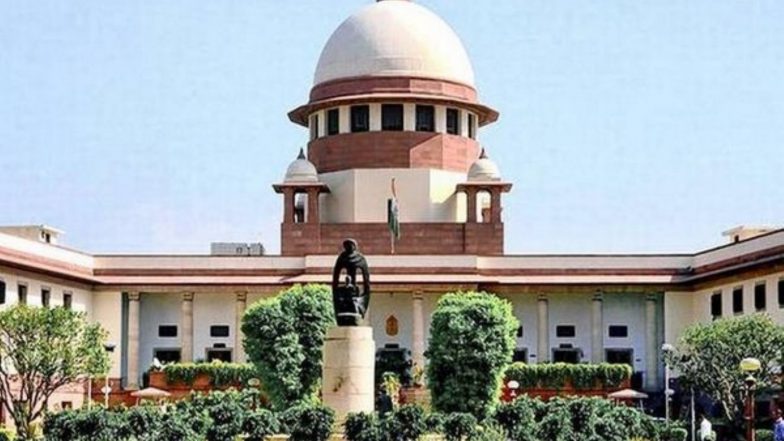
New Delhi [India], August 20 (ANI): The Supreme Court on Thursday questioned several aspects of the CBSE's three-language policy for students, including the availability of textbooks and teachers, the burden on students, and the manner in which the policy would be implemented across schools.
A bench of CJI Surya Kant and Justices Joymalya Bagchi and V Mohana was hearing a batch of pleas challenging the CBSE's three-language policy for Class 9 students under the National Education Policy (NEP) 2020.
The petitioners raised concerns that students were being required to learn two Indian "native" languages under the policy even when schools did not have the necessary textbooks, teachers, or infrastructure.
The Court was told that four months into the academic year, textbooks for the prescribed languages were still not available in some schools, affecting lakhs of students who are due to appear for examinations.
Also Read | Ayodhya Monkey Viral Video: Animal Refuses To Give Back Woman's INR 42,105, UP Police Try Banana Trick.
ASG Aishwarya Bhati, appearing for the CBSE and the Centre, said officials were present with the relevant material and offered to show the Court screenshots and other material on the availability of books.
Senior advocate Anand Grover, appearing for the petitioners, questioned how students could suddenly be expected to learn a new language without the basic learning material.
"How do I suddenly learn Punjabi, Tamil, or compound sentences? We have to start with the alphabet. See the books; they start with compound sentences," Grover submitted.
The Court, however, noted that the courses had not yet commenced and said the authorities would have a plan for implementing them.
"The courses have not yet started. I am sure they have a plan. Teachers will be there," Justice V Mohana observed.
Grover also submitted that the policy would put students under pressure if they were required to obtain passing marks in the newly introduced languages.
The ASG clarified that the scheme contemplated only internal assessment and that there was no question of holding back Class 9 students for not qualifying in the additional languages.
"The scheme contemplates only internal assessment. There is no holding back [failing] Class 9 students -- even if they don't qualify, they will go to Class 10," Bhati submitted.
The bench also examined whether students already learning foreign languages such as French would have to discontinue them because of the new mandate.
Grover submitted that a student who had already been learning French should be allowed to continue, particularly since learning a foreign language could provide educational and career opportunities. He argued that requiring a student from one state to learn the language of another Indian state could instead impose an additional burden without necessarily being feasible.
The CJI clarified that the policy did not require students to give up languages they were already learning.
"There is no question of boycotting languages taught earlier. They can continue," CJI Surya Kant said.
The CJI also questioned whether students should be discouraged from learning languages from other parts of the country.
"Is it not going to be good for the nation if North Indian students learn South Indian languages and South Indian students learn North Indian languages?" CJI Surya Kant asked.
"Let us, as an educational institution, suggest what modalities and suggestions can be brought in," the CJI said.
The Court said the objective should not be to create an impression that regional languages are inferior.
"Let us not have any impression of an inferiority complex when it comes to regional languages. Let us all respect all languages," the CJI said.
The bench also discussed the proposal that states should prescribe their own regional language to preserve local languages.
Advocate G Priyadarshini, appearing for a petitioner running regional schools and a former Rajya Sabha MP, submitted that every state should require students to learn the local language of that state.
"That is how we save our languages," Priyadarshini submitted.
The Court, however, questioned whether such an approach would amount to forcing students to learn a particular language.
"That is called forcing them. Even if you force someone to learn their mother tongue, they will have a problem," the Court observed.
The CJI also pointed out that internal assessment had been left to schools so that students would not be unnecessarily pressured.
The Court then turned to the question of teachers and whether schools had the necessary faculty to implement the policy.
Bhati referred to CBSE data and submitted that 99.19 per cent of schools were already compliant with the requirement of teaching two Indian languages, leaving around 235 schools that were not compliant.
She also submitted that the transition would be flexible for students in Classes 7, 8, and 9, and that the policy would initially be introduced at the foundational level to ensure greater uniformity.
The ASG also explained that different aspects of NEP 2020 were being rolled out at different points, and that the mother-tongue component was being introduced through the present exercise.
She submitted that the five-year period from Classes 5 to 10 would provide sufficient time for students to learn the languages.
The Court, however, questioned the availability of qualified teachers, particularly for languages such as Sanskrit.
"How many Sanskrit teachers are B.Ed. qualified in our schools?" Justice Bagchi asked.
Justice Bagchi also questioned the broader implementation of the policy, including its application to different categories of schools and the administrative compliance required from them.
He observed that the policy could potentially be introduced at a lower class, allowing parents greater room to make a call on the languages their children learn.
The Court also questioned the terminology used in the policy.
Justice Bagchi questioned how English could be categorised as a non-indigenous language and objected to the use of the expression "native", saying it had colonial origins.
"To what extent can English be considered a non-indigenous language? I have reservations about the expression 'native' because of its colonial origin. It should be 'indigenous'. The framers of the National Education Policy 2020 should have been conscious of the use of the word 'native'," Justice Bagchi said.
The Court said it would have to examine the constitutional aspect of whether English can be considered indigenous or non-indigenous in India.
"Whether English can be termed indigenous or non-indigenous, we have to see its constitutionality," Justice Bagchi said.
The bench also considered whether the difficulties emerging from the implementation of the policy could be addressed after it was put into practice.
The CJI said the policy could first be allowed to operate and the difficulties experienced by schools and students could then be assessed.
"Whatever has been introduced, let it be experienced. After experience, some difficulties will come, then we will examine," the CJI said.
He also suggested that unforeseen difficulties could eventually be examined by an expert committee or domain experts, who could recommend changes to the policy.
The Court further questioned whether students would immediately face examinations under the new language requirement.
The CJI said the language was being introduced this year without an examination and indicated that students should be allowed time to familiarise themselves with it.
The Court also asked the CBSE to consider how the policy could be streamlined in light of the concerns raised by the petitioners.
"These doubts you may revisit. How to streamline the policy? Yours is an expert body," the CJI said.
The Court indicated that the challenge involved both constitutional and practical questions, including the classification of languages, the availability of teachers and textbooks, the burden on students, and the manner in which the policy could be implemented across schools with widely differing linguistic circumstances. (ANI)
(The above story is verified and authored by ANI staff, ANI is South Asia's leading multimedia news agency with over 100 bureaus in India, South Asia and across the globe. ANI brings the latest news on Politics and Current Affairs in India & around the World, Sports, Health, Fitness, Entertainment, & News. The views appearing in the above post do not reflect the opinions of LatestLY)