UPI MDR From October 15: Who Will Pay 0.4% Charge? NPCI CEO Dilip Asbe Explains (Video)
National Payments Corporation of India (NPCI) Managing Director and CEO Dilip Asbe has sought to clarify concerns over the new Merchant Discount Rate (MDR) framework for UPI payments, saying there is "miscommunication and misinformation" surrounding the move.

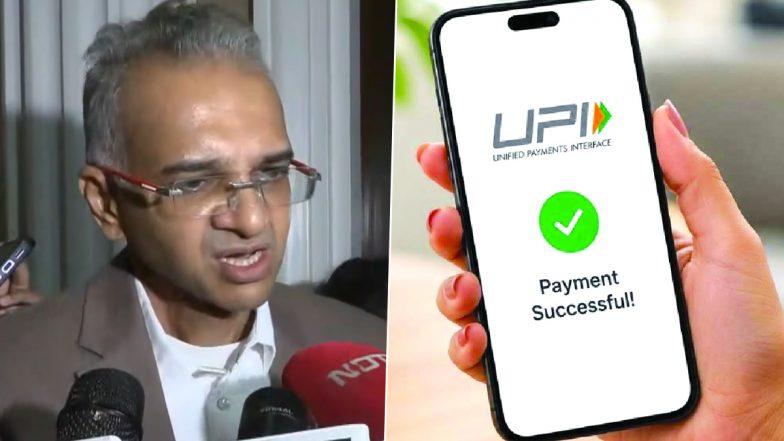
National Payments Corporation of India (NPCI) Managing Director and CEO Dilip Asbe has sought to clarify concerns over the new Merchant Discount Rate (MDR) framework for UPI payments, saying there is "miscommunication and misinformation" surrounding the move. Asbe said about 96% of UPI transaction volume will remain outside the MDR regime, while most of the value subject to the charge is expected to come from merchants that already accept credit cards.
The comments come after NPCI introduced a 0.4% MDR on specified person-to-merchant (P2M) UPI transactions above ₹2,000, effective October 15, 2026. The charge will be capped at ₹300 for transactions of ₹75,000 and above. UPI Payments New Rule Explained: What Happens to Payments Above INR 2,000 From October 15.
Dilip Asbe Says 96% UPI Volume Will Not Face MDR
Speaking in Mumbai on September 24, Asbe said around 75% of UPI merchants, out of approximately 60 million, have never recorded a transaction above ₹2,000. He said this means the new MDR framework would not affect the vast majority of UPI transactions by volume. According to Asbe, around 96% of UPI transaction volume will not touch MDR. The Finance Ministry has separately said approximately 96% of all P2M UPI transactions will remain unaffected under the new framework. All person-to-person UPI transactions will also continue to remain free irrespective of the amount transferred.
0.4% MDR on UPI Payments Above ₹2,000
Under the revised framework, a 0.4% MDR will apply to specified P2M UPI transactions above ₹2,000 from October 15. For example, a ₹10,000 merchant payment would attract an MDR of ₹40, while the maximum MDR will be capped at ₹300 for transactions of ₹75,000 or more. The MDR is a merchant-side charge within the payments ecosystem and is not a fee collected by the government or NPCI. The Finance Ministry has said the revenue will be distributed among ecosystem participants, including banks and payment service providers.
Credit Card-Accepting Merchants Expected To Account For Bulk Of MDR
Asbe said about 80% of the value affected by the new MDR could come from merchants that already accept credit cards. He noted that credit card transactions typically carry MDR rates of around 1.5% to 2.5%, meaning such merchants already operate with payment-processing charges. Asbe also said merchants that do not accept credit cards but could face MDR on higher-value UPI transactions account for roughly 10% of total transaction value. He acknowledged that the ecosystem would need to ensure such charges are not passed on to customers. New UPI Payment Charges 2026: What Will Remain Free and What Will Attract MDR?.
NPCI Says New MDR Won’t Hit Most Small Merchants
#WATCH | Mumbai, Maharashtra: On Merchant Discount Rate (MDR) transaction charges for UPI, MD and CEO of the National Payments Corporation of India (NPCI), Dilip Asbe, says, "I believe there is huge miscommunication and misinformation in the system. NPCI ecosystem, the government… pic.twitter.com/uDRXylA7Ck
— ANI (@ANI) September 24, 2026
Small Merchants And Low-Value UPI Payments Remain Exempt
The new framework keeps UPI payments up to ₹2,000 to merchants outside the MDR regime. Small merchants receiving up to ₹1 lakh per month through UPI QR codes under the specified small-merchant category will also continue to receive zero-MDR treatment. Person-to-person transactions remain completely free regardless of transaction value. The government has said these provisions are intended to protect street vendors, neighbourhood shops and other small businesses from additional payment costs.
AutoPay And Other Transactions Get Exemptions
Asbe also highlighted exemptions under the new framework, including AutoPay transactions. The MDR structure also provides special treatment for certain essential sectors. Payments above ₹2,000 involving railways, telecommunications, insurance, fuel and agricultural inputs will attract a flat ₹5 MDR, while specified capital-market transactions carry a lower 0.02% rate, subject to the applicable cap.
NPCI Says MDR Revenue Will Support UPI Ecosystem
Asbe said revenue generated through MDR or cost recovery would be reinvested in the payments ecosystem. According to his remarks, this could include merchant acceptance infrastructure such as soundboxes as well as consumer-facing technologies, including AI and voice-based payment systems. The Finance Ministry has similarly described the framework as a measure aimed at supporting the long-term sustainability and expansion of India's digital payments infrastructure.
Concerns Over UPI MDR Remain
Despite the exemptions, the new MDR framework has triggered concerns among some merchants and industry groups, particularly those that rely heavily on high-value UPI payments. Some merchants have reportedly started refusing UPI payments above ₹2,000 following the announcement. Petrol pump dealers in Maharashtra have also sought a complete exemption, arguing that the additional cost could affect businesses operating on regulated or narrow margins.
The government has said banks have been advised to ensure that the MDR is not passed on to customers. A monitoring mechanism has also been discussed to prevent merchants from transferring the cost to consumers. With the new rules set to take effect from October 15, the impact of MDR will depend largely on how merchants, banks and payment platforms implement the framework and how customers respond to higher-value UPI payments.
(The above story first appeared on LatestLY on Sep 24, 2026 03:52 PM IST. For more news and updates on politics, world, sports, entertainment and lifestyle, log on to our website latestly.com).