Gandhi Jayanti 2026: 7 Powerful Mahatma Gandhi Quotes From Historic Speeches
As Gandhi Jayanti is celebrated on October 2, Mahatma Gandhi's quotes from his speeches highlight his philosophy of truth and non-violence. Iconic calls like 'Do or Die' from the Quit India Movement, alongside his defense of ahimsa during the 1922 Great Trial, continue to define his enduring legacy in India’s freedom struggle.

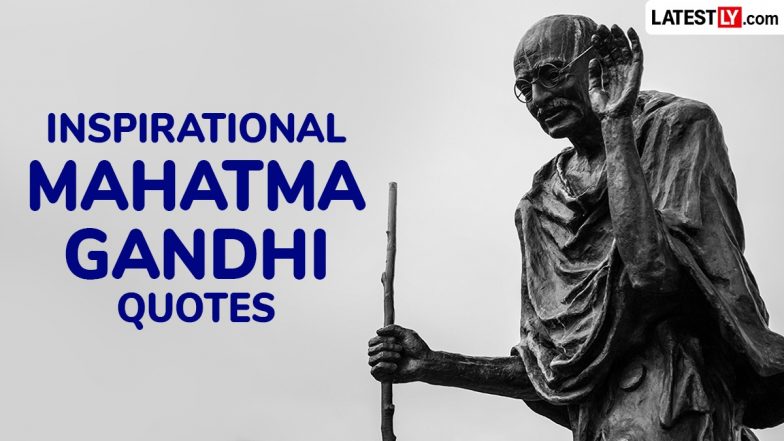
As India prepares to celebrate Gandhi Jayanti tomorrow, October 2, nationwide commemorations will mark the 157th birth anniversary of Mahatma Gandhi. Observances across educational institutions, government bodies, and civic organizations will feature prayer meetings, tribute services, and discussions focusing on Gandhi’s principles of non-violence (ahimsa) and truth (satyagraha).
Throughout the Indian independence movement, Gandhi delivered public addresses that mobilized millions and articulated the moral framework of his political philosophy. Transcripts and historical records preserve the speeches that marked critical turning points in the nation's journey toward sovereignty.
Here is a curated selection of seven verifiable quotes from Mahatma Gandhi's major speeches, contextualised within the historical events where they were delivered. Gandhi Jayanti 2026: Why We Celebrate Mahatma Gandhi’s Birthday.
The Call for Decisive Action: Quit India (1942)
On August 8, 1942, addressing the All India Congress Committee at Gowalia Tank Maidan in Bombay (now Mumbai), Gandhi launched the Quit India Movement. The speech set an uncompromising tone for immediate self-rule.
"Here is a mantra, a short one, that I give you. You may imprint it on your hearts and let every breath of yours give expression to it. The mantra is: 'Do or Die.' We shall either free India or die in the attempt; we shall not live to see the perpetuation of our slavery."
In the same address, Gandhi urged citizens to mentally reject colonial authority prior to its formal end: "Every one of you should, from this moment onwards, consider yourself a free man or woman, and act as if you are free and are no longer under the heel of this imperialism."
Defining Non-Violence at the Great Trial (1922)
Following the violent clashes at Chauri Chaura, Gandhi suspended the Non-Cooperation Movement and was subsequently arrested for sedition. On March 18, 1922, during his trial at the Ahmedabad Session Court, he declared his stance on non-violence before the judge.
"Non-violence is the first article of my faith. It is also the last article of my creed."
The trial statement highlighted Gandhi's position that ethical means were inseparable from political ends.
Principles of Non-Cooperation (1920)
At the official launch of the Non-Cooperation Movement in August 1920, Gandhi outlined the rationale for refusing to participate in British administrative, judicial, and educational structures.
"I can retain neither respect nor affection for a Government which has movingly demonstrated its capacity for doing evil... Non-cooperation with evil is as much a duty as is cooperation with good."
On the Eve of the Salt March (1930)
On March 11, 1930, one day before embarking on the 240-mile march from Sabarmati Ashram to Dandi to protest the British salt tax, Gandhi addressed thousands gathered on the banks of the Sabarmati River. He clarified his stance on non-violence versus passivity.
"Where the choice is only between cowardice and violence, I would advise violence... But I believe that non-violence is infinitely superior to violence, forgiveness is more manly than punishment."
Distinguishing Opposition from Hatred (1942)
During the A.I.C.C. proceedings on August 7, 1942, leading up to the Quit India resolution, Gandhi emphasized that resistance to British rule did not imply hostility toward British citizens.
"Ours is not a drive for power, but purely a nonviolent fight for India's independence... At a time when I may have to launch the biggest struggle of my life, I may not harbour hatred against anybody."
Final Public Addresses (1948)
In the final days of his life, Gandhi continued to hold public evening prayer meetings in New Delhi. On January 28, 1948, two days before his assassination at Birla House, he reflected on mortality and inner peace.
"If I am to die by the bullet of a madman, I must do so smiling. There must be no anger within me. God must be in my heart and on my lips."
Historical Context and Legacy
Gandhi’s speeches reflect a consistent strategy combining political pressure with ethical restraint. Historians note that his public addresses were crafted to remain accessible to broad audiences while communicating complex strategic goals to colonial officials. Stock Market Holiday: Are NSE and BSE Open on October 2 for Gandhi Jayanti?
As Gandhi Jayanti is observed across India and internationally as the International Day of Non-Violence, a designation established by the United Nations General Assembly in 2007, these historical statements remain central to academic and public discussions on peaceful resolution and civil resistance.
(The above story first appeared on LatestLY on Oct 01, 2026 11:04 AM IST. For more news and updates on politics, world, sports, entertainment and lifestyle, log on to our website latestly.com).