India Eliminated 100 Terrorists Across 9 Locations in Pakistan and PoK, Including 3 Linked to Kandahar Hijacking and Pulwama Attack, Says Armed Forces
A panel of senior defence officials on Sunday said that India has eliminated '100 terrorists across nine locations' in Pakistan as well as Pakistan-occupied Kashmir (PoK) including 'three high-profile operatives linked to the Kandahar hijacking and Pulwama attack'.

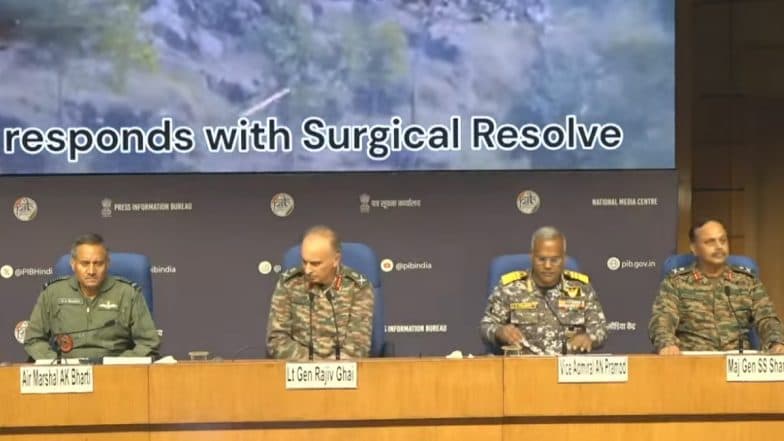
New Delhi, May 11: A panel of senior defence officials on Sunday said that India has eliminated “100 terrorists across nine locations” in Pakistan as well as Pakistan-occupied Kashmir (PoK) including “three high-profile operatives linked to the Kandahar hijacking and Pulwama attack”.
At a press briefing to shed light on the recent military engagements and counter-terror efforts, the panel comprising Lt General Rajiv Ghai, Vice Admiral AN Pramod, and Air Marshal Awadhesh Kumar Bharti offered critical updates on “Operation Sindoor”. Lt General Rajiv Ghai recounted the grim events of the April 22 Pahalgam attack, where 26 innocent lives were lost to a brutal act of terror. Operation Sindoor: Satellite Images Show Rawalpindi’s Noor Khan Base and Jacobabad Airbase in Pakistan Destroyed After India’s Precision Strikes.
In response, the “Indian Army swiftly executed precision strikes” on terrorist hideouts across “Pakistan and PoK”, delivering substantial damage to hostile elements. Detailing the “May 7 offensive”, Lt Gen Ghai stated that India eliminated “100 terrorists across nine locations" including “three high-profile operatives linked to the Kandahar hijacking and Pulwama attack”.
The operation, carefully executed, struck “Pakistan’s terror infrastructure” with decisive force. “The targets were only terrorists, that prevented collateral damage,” the senior military official said. Despite the understanding, Pakistan attempted retaliatory strikes on “Indian military bases” using “drones and missile systems”. However, Indian forces intercepted and neutralised these threats. In response, a “punitive countermeasure” was carried out, leading to “significant losses within Pakistan’s military ranks”, estimated at “35 to 40 personnel”. Operation Sindoor Update: India Releases Videos of Missile Impact on Terrorist Camps in Pakistan, Says Over 100 Terrorists Killed Including Those Involved in Pulwama Attack and Kandahar Hijacking.
The operation, however, also saw “five Indian soldiers laying down their lives in the line of duty”, the senior military officer said. Military officials reaffirmed that “Pakistan’s armed forces did not breach Indian territory”, and every Indian strike was aimed solely at neutralising “identified threats”. Air Marshal Bharti emphasised that India's focus remained on eliminating “terrorist operatives”, not engaging in direct combat with “Pakistan’s military”. Nevertheless, when “drone and UAV incursions” were attempted, India had no choice but to deploy its defensive arsenal.
Following the Pahalgam incident, strategic preparations intensified, including “combat drills in the Arabian Sea” and assessments of weapons systems. The “Indian Navy maintained persistent surveillance” over Pakistan’s naval fleet, ensuring comprehensive situational awareness and made the Pakistani navy to contain at harbour. Bharti highlighted the systematic destruction of incoming aerial threats in “Jammu, Udhampur, Pathankot, Dalhousie, and Phalodi”.
India’s “trained defense units” swiftly activated air defense measures, neutralising the “repeated intrusions” without sustaining damage. Operation Sindoor struck “Pakistan’s key military assets”, including “command and airbase structures in Chaklala, Rafiki, and Rahriyar Khan”. Officials underscored India’s firm stance — "aggression would not go unanswered”, and any escalation would meet with proportionate retaliation. “The response will be fierce and punitive,” Gen Ghai said. While emphasising India's superior “targeting capabilities”, military leaders urged Pakistan “not to escalate tensions further”. The Indian armed forces remain vigilant, ensuring national security while reaffirming their “commitment to maintaining peace”.
(The above story first appeared on LatestLY on May 11, 2025 11:03 PM IST. For more news and updates on politics, world, sports, entertainment and lifestyle, log on to our website latestly.com).