RBI in ‘Wait and Watch’ Mode Amid West Asia Crisis, Says Governor Sanjay Malhotra
Reserve Bank of India (RBI) Governor Sanjay Malhotra has indicated that the central bank is maintaining a 'wait-and-watch' mode regarding interest rates, citing the ongoing conflict in West Asia as a primary risk to India’s economic stability.

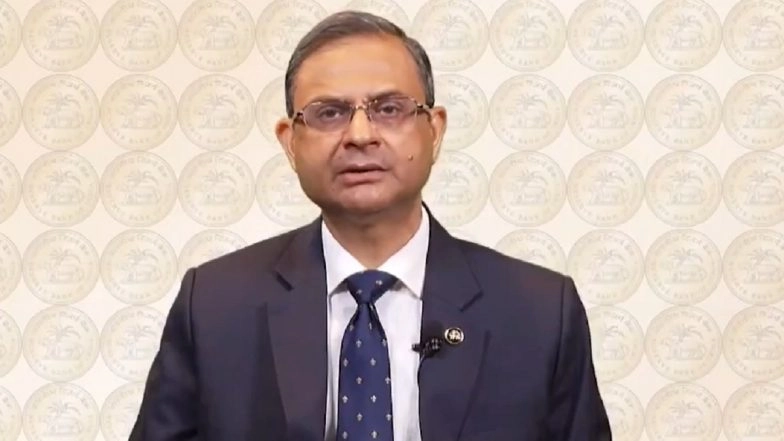
New Delhi, April 21: The Reserve Bank of India (RBI) is closely monitoring the fallout from the West Asia conflict and will not make firm commitments on the future path of interest rates, Governor Sanjay Malhotra has said, adding that prolonged supply disruptions risk embedding inflation into India's broader price level. In his speech at Princeton University in the US, Malhotra said the ongoing conflict poses a direct threat to the Indian economy given the region's outsized role in the country's trade.
Moreover, West Asia accounts for roughly one-sixth of India's exports, one-fifth of its imports, half of its crude oil imports, two-fifths of its fertiliser imports, and nearly two-fifths of inward remittances, according to him. RBI Lowers India GDP Growth for FY 27 to 6.9%; Inflation Hiked to 4.6% Due to West Asia Crisis and Spike in Crude Prices.
"Second-round effects are the real concern," he stated. The RBI Governor warned that what begins as a supply shock can become embedded in the general price level if disruptions persist. He signalled that the central bank was in no hurry to move on rates. "We are in a wait-and-watch mode," he said.
The monetary policy committee would remain data-dependent and would continuously reassess the balance of risks. The MPC has maintained a neutral stance since June 2025, following cumulative rate cuts of 125 basis points since February of that year. RBI Governor Sanjay Malhotra Sees ML and AI as Key Tool To Combat Money Laundering.
Malhotra defended the RBI's intervention in foreign exchange markets while stressing the bank had not committed to an "indefensible peg " on the Indian rupee, which depreciated over four per cent following the conflict's eruption in March.
In addition, India's foreign exchange reserves stand at $710 billion, covering more than 11 months of imports. Malhotra also highlighted the RBI's developmental agenda, citing progress on the Unified Lending Interface and the central bank's digital currency pilot.
On digital infrastructure and growth, the RBI Governor said the Unified Payments Interface (UPI) recorded over 22 billion transactions in March alone, adding that the central bank is now developing the Unified Lending Interface (ULI) to enable instant credit access for small farmers and business owners.
In addition, he said that the government’s fiscal deficit-to-GDP ratio had declined from 9.2 per cent in 2020-21 to 4.4 per cent in 2025-26. He said that India’s general government debt-to-GDP ratio at 81.1 per cent in 2024–25 was reasonable, noting that most of the world’s top 10 economies by nominal GDP in US dollar terms, except Germany and Russia, had higher debt ratios than India.
(The above story first appeared on LatestLY on Apr 21, 2026 10:55 AM IST. For more news and updates on politics, world, sports, entertainment and lifestyle, log on to our website latestly.com).