Vande Mataram Row: Congress Reaffirms 1937 Stand, Says Only First Two Stanzas Will Be Sung
The Congress Working Committee (CWC) has reaffirmed the party's decades-old stand to sing only the first two stanzas of Vande Mataram at official party programmes. The decision, discussed during a CWC meeting on Wednesday.

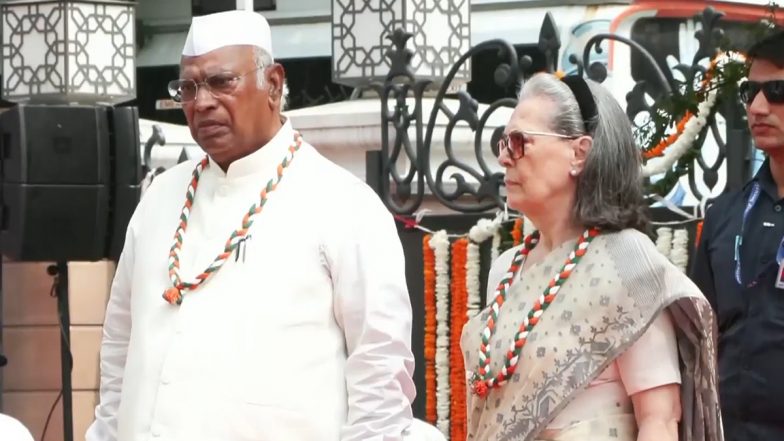
The Congress Working Committee (CWC) on Wednesday reaffirmed its 1937 position on Vande Mataram, deciding that only the first two stanzas of the national song will be sung at party programmes. The decision comes amid a fresh political dispute with the BJP over the Congress's approach to the song and after party president Mallikarjun Kharge faced criticism for singing only its opening stanzas at a public event in Goa, India Today reported.
The Congress said its position is rooted in a resolution adopted by the party in October 1937, when it decided that the first two stanzas were appropriate for national gatherings. ‘Vande Mataram’ Mix-Up at Thane Event: Lata Mangeshkar Version Played, Eknath Shinde Apologises (Videos).
Congress Reaffirms 1937 Resolution
The issue was discussed at the CWC meeting on Wednesday, with several party leaders reiterating the historical decision. According to the Congress, the 1937 resolution was aimed at ensuring that Vande Mataram could be used at gatherings representing people from different religious and cultural backgrounds.
The party has maintained that the first two stanzas focus on the motherland, while later portions contain religious and mythological references that were considered unsuitable for inclusive national gatherings. Sonia Gandhi Vande Mataram Row: BJP Alleges Objection, Congress Says She Wanted Chair for Mallikarjun Kharge (Video).
Why Does Congress Sing Only Two Stanzas?
Vande Mataram was written by Bankim Chandra Chattopadhyay and later published in his novel Anandamath. The complete composition contains several stanzas.
The debate over which portions should be used at national gatherings intensified in the 1930s. Congress leaders consulted Rabindranath Tagore, who advised that the opening two stanzas could be treated separately because they offered a broader expression of devotion to the motherland.
The later verses contain religious imagery, including references associated with Hindu deities. The Congress subsequently adopted the first two stanzas for public and national gatherings in 1937.
Kharge's Response to BJP Criticism
The latest decision follows criticism from the BJP after Mallikarjun Kharge sang the first two stanzas of Vande Mataram at a Congress event in Goa on Monday.
Defending the rendition, Kharge said the version had been used by several national leaders, including Mahatma Gandhi, Jawaharlal Nehru, Sardar Vallabhbhai Patel and Atal Bihari Vajpayee.
Kharge also questioned why the Congress should be criticised for following a practice that, according to him, has continued for decades. The BJP has accused the Congress of restricting the song and questioned the party's commitment to the national song.
Political Row Intensifies
The disagreement is the latest development in a political controversy that began around Independence Day.
The BJP had earlier accused former Congress president Sonia Gandhi of objecting to the full rendition of Vande Mataram during a party event. Congress rejected the allegation, saying Gandhi was asking for a chair for Kharge and had not objected to the song.
Union Home Minister Amit Shah subsequently criticised the Congress over the episode and demanded an apology, while the Congress accused him of attempting to divert attention from other issues.
Historical Context
The Congress's 1937 decision has remained politically contentious because the complete composition includes religious imagery in its later verses.
The first two stanzas, by contrast, are centred on descriptions of the motherland. This distinction was a key factor behind the Congress's decision to use only those portions at national gatherings.
In 1950, Vande Mataram was accorded the status of the National Song of India, while Jana Gana Mana was adopted as the National Anthem. The Constituent Assembly said Vande Mataram, which had played a significant role in the freedom struggle, would be honoured equally with the National Anthem.
Congress Says Vande Mataram Is Above Politics
Congress leaders have rejected the BJP's criticism and said Vande Mataram belongs to the country rather than to any political party. Goa Congress chief Girish Chodankar said the song has been sung by leaders from different political backgrounds and described it as a national symbol beyond party politics.
The latest CWC decision, however, makes clear that Congress programmes will continue to follow the party's 1937 position and use only the first two stanzas. The political debate over the song is expected to continue as both the Congress and BJP use its history and symbolism to reinforce their respective positions on nationalism and the freedom movement.
(The above story first appeared on LatestLY on Aug 19, 2026 08:26 PM IST. For more news and updates on politics, world, sports, entertainment and lifestyle, log on to our website latestly.com).