Why Are Bank Employees Going on Strike on September 11?
The United Forum of Bank Unions (UFBU) has called a nationwide bank strike on September 11 over delayed five-day banking, the government's performance-linked incentive scheme and pending pension demands. The unions have also threatened a three-day strike from September 28 and an indefinite strike from October 26 if their demands remain unresolved, potentially disrupting banking services.

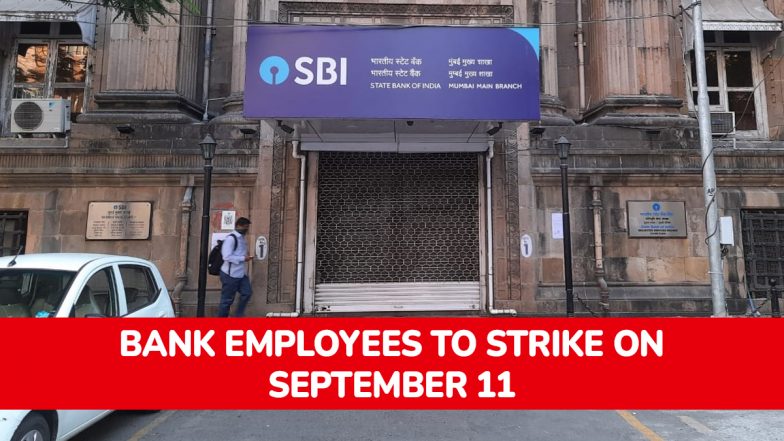
The United Forum of Bank Unions (UFBU) has decided to go on a nationwide strike on September 11 over the delay in implementing five-day banking, differences over the performance-linked incentive scheme, and several pending demands, including pension-related issues. If the strike materialises, banking services, especially in public sector banks, would be impacted for four days in many parts of the country.
September 11 is a Friday, and the subsequent two days are bank holidays. September 14 is a holiday in some states for Ganesh Chaturthi. UFBU, an umbrella body of seven bank employees' and officers' unions, has also threatened a three-day subsequent nationwide strike beginning September 28, coinciding with the half-yearly closure, PTI reported. HDFC Bank Opening Bell Updates: CEO Exit, Global Cues Weigh on Shares.
Why Are Bank Employees Going On Strike?
The unions' main concerns include the delay in implementing five-day banking, differences over the government's performance-linked incentive (PLI) scheme and unresolved pension-related demands.
They have also decided to go on an indefinite strike from October 26 onwards if their demands fall on deaf ears of the government and bank management. The proposed September 11 strike could therefore be the first of a series of industrial actions planned by the banking unions.
Five-Day Banking Proposal Still Pending
On five-day banking, the Indian Banks' Association (IBA) had agreed to the proposal as part of the 12th Bipartite Settlement/9th Joint Note signed on March 8, 2024. Under the agreement, working hours would be increased by 40 minutes from Monday to Friday.
The proposal was subsequently recommended to the government, but has remained pending for more than two years, All India Bank Officers' Confederation (AIBOC) general secretary Rupam Roy said while addressing media here. The unions have made implementation of the five-day workweek one of their key demands.
Dispute Over Performance-Linked Incentive
The unions have also objected to the government's PLI scheme for bank officers in Scale IV and above. They said it differs from the understanding reached with the IBA that performance-linked incentive would be linked to the overall performance of individual banks and would be uniform for employees and officers up to Scale VII.
Under the government's scheme, officers in Scale IV and above could receive PLI of up to 365 days of basic pay based on individual performance. Workmen employees and officers up to Scale III would receive a maximum of 15 days' basic pay plus dearness allowance.
PLI Issue Before Labour Authorities And Court
The issue of PLI is currently under conciliation before the Chief Labour Commissioner (CLC) following the strike call issued by the UFBU and is also pending before the Delhi High Court, All India Bank Employees' Association (AIBEA) general Secretary C H Venkatachalam said.
He alleged that despite the pendency of conciliation proceedings and its offer to hold bilateral discussions with the IBA, the Department of Financial Services (DFS) has advised banks to implement the government's performance-linked incentive scheme.
Crediting of performance-linked incentive under the DFS scheme has now actually commenced in the banks, alleging that this was in violation of the status quo obligation during conciliation proceedings, Vekatachalam claimed.
He argued that the present PLI scheme suggested by the DFS would disproportionately benefit a small section of officers and undermine the principle of uniformity in incentives across cadres.
Pension-Related Demands Remain Unresolved
The unions are also seeking action on several residual pension-related demands.
These include updation and improvement of pension, a uniform dearness allowance formula for all pensioners and an option for employees covered under the National Pension System (NPS) to switch to the old pension scheme (OPS).
The unions have said these issues remain unresolved and are part of the demands behind the proposed industrial action.
What Happens If The Strike Goes Ahead?
If the September 11 strike takes place, customers could face disruption to banking services, particularly at public sector banks.
The timing could extend the impact beyond the strike day because September 12 and 13 are bank holidays, while September 14 is a holiday in some states for Ganesh Chaturthi.
The UFBU has also threatened a three-day nationwide strike from September 28. If the demands remain unresolved, the unions have said they could proceed with an indefinite strike from October 26.
The planned actions reflect continuing differences between bank unions, the government and bank management over working arrangements, incentive structures and pension-related matters.
(The above story first appeared on LatestLY on Sep 02, 2026 01:56 PM IST. For more news and updates on politics, world, sports, entertainment and lifestyle, log on to our website latestly.com).