Will UPI Still Be Free? What FM Nirmala Sitharaman Said After Parliament Cleared Taxation Bill (Video)
Parliament on Monday passed the Taxation and Other Laws (Amendment) Bill, 2026, following approval from the Rajya Sabha via a voice vote. The legislation, which was cleared by the Lok Sabha last week, introduces key amendments to statutory framework governing taxation and digital payment systems.

- Read in
- हिंदी
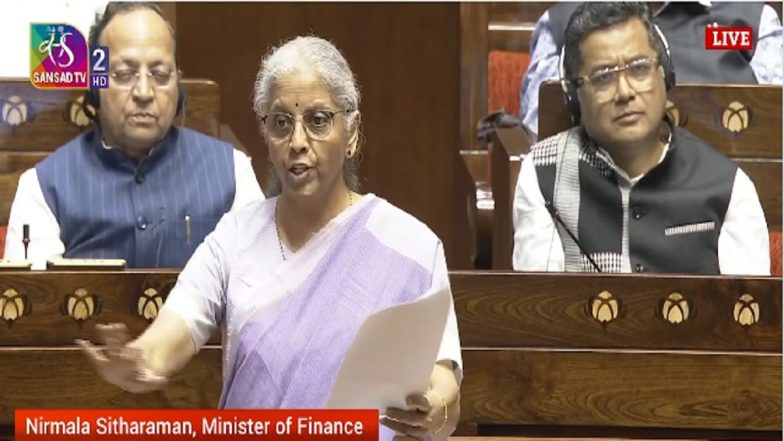
Parliament on Monday passed the Taxation and Other Laws (Amendment) Bill, 2026, following approval from the Rajya Sabha via a voice vote. The legislation, which was cleared by the Lok Sabha last week, introduces key amendments to statutory framework governing taxation and digital payment systems. Addressing concerns raised during parliamentary discussions, Union Finance Minister Nirmala Sitharaman assured the public that the new bill does not levy any tax or fee on consumers using the Unified Payments Interface (UPI), confirming that person-to-person (P2P) digital payments will remain entirely free.
Clear Framework for Digital Payments and Consumer Protections
During the parliamentary debate, Finance Minister Sitharaman addressed speculation regarding potential digital payment charges. She clarified that the legislation does not impose any transaction fees or taxes on end-users making everyday UPI payments. Parliament Passes Bankers' Books Evidence Bill to Recognise Digital Banking Records as Legal Evidence.
"The legislation does not propose any tax or transaction charge on UPI," Sitharaman stated in the Upper House, emphasizing that routine consumer payments—including P2P transfers and small merchant transactions—will remain unaffected.
The clarification came after opposition members questioned whether amending payment statutes would increase the cost of digital transactions for the general public.
Amendment to the Payment and Settlement Systems Act
The core shift within the new legislation involves an update to Section 10A of the Payment and Settlement Systems Act, 2007. Previously, this section strictly prohibited banks and payment service providers from levying any fees on prescribed electronic payment modes.
The newly passed bill creates an enabling framework, decoupling payment regulations from rigid tax provisions and granting the government flexibility to notify specific rules in the future. This amendment allows regulatory bodies, such as the National Payments Corporation of India (NPCI) steering committee, to evaluate whether a nominal Merchant Discount Rate (MDR) could be permitted solely for commercial entities in specific transaction brackets. Will UPI Transactions Be Charged? Nirmala Sitharaman Explains MDR Rule.
FM Sitharaman Confirms Free UPI Transactions for Users
Small merchants remain central to the Government's commitment to financial inclusion & UPI’s inclusive growth.
The vast majority of merchant transactions - including ordinary, low-value transactions, will continue to remain free.
Any future MDR will apply only to a limited… https://t.co/Gk6QyRx7h9
— Nirmala Sitharaman Office (@nsitharamanoffc) August 10, 2026
Rationale Behind Enabling Merchant Discount Rate (MDR)
Explaining the necessity of the statutory flexibility, the Finance Minister highlighted the need for long-term financial sustainability across India’s digital payments infrastructure.
With UPI volume surpassing billions of monthly transactions, maintaining servers, enhancing cybersecurity, and preventing fraud require significant ongoing capital expenditure. Permitting a prospective, capped MDR on large merchant transactions would help banks and fintech companies reinvest in technology, server resilience, and system innovation.
Ministry officials confirmed that any future MDR implementation would apply exclusively to large commercial merchants—likely restricted to transaction values exceeding ₹2,000—and would remain significantly lower than standard credit or debit card processing fees. Small neighborhood retailers and general consumer transfers will remain exempt from these charges.
Context and Economic Impact
The Taxation and Other Laws (Amendment) Bill, 2026, forms part of a broader effort to streamline direct and indirect tax provisions, attract foreign direct investment, and support domestic technology infrastructure. By modernizing digital payment laws, the government aims to ensure that India’s public payment rail remains resilient while providing market players with a sustainable economic model to expand digital banking into semi-urban and rural areas.
(The above story first appeared on LatestLY on Aug 10, 2026 06:42 PM IST. For more news and updates on politics, world, sports, entertainment and lifestyle, log on to our website latestly.com).