Mamata Banerjee Refuses To Resign: What Happens if the Chief Minister Declines To Step Down?
The 2026 West Bengal Assembly elections have sparked a constitutional standoff. Despite the BJP winning a 207-seat majority, Mamata Banerjee has stated she will not resign. This report analyzes the legal implications of a Chief Minister refusing to step down, the Governor’s pivotal role in government formation, and the constitutional protocols that ensure a democratic transition of power.

- Read in
- हिंदी
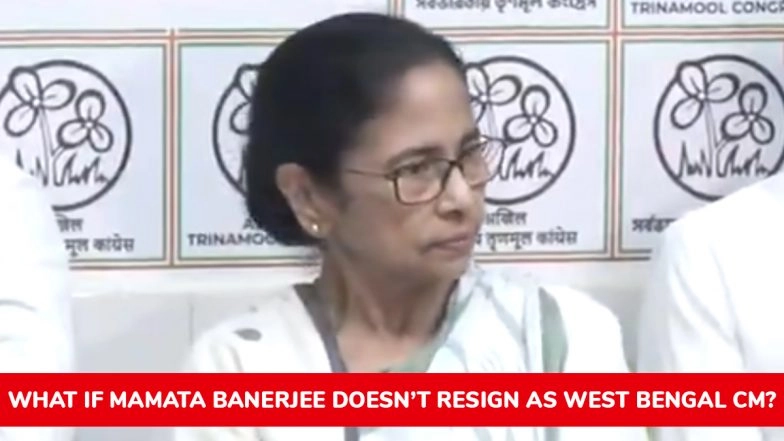
A significant political and constitutional crisis has emerged in West Bengal following the 2026 Assembly election results. Despite the Bharatiya Janata Party (BJP) securing a decisive majority with 207 seats, incumbent Chief Minister Mamata Banerjee has stated she will not resign. With the Trinamool Congress (TMC) reduced to just 80 seats, the refusal has shifted the state’s focus from the ballot box to the legal frameworks governing the transition of power.
Under India’s parliamentary democracy, a Chief Minister’s authority is derived entirely from the confidence of the Legislative Assembly. While the TMC formerly held the majority, the new electoral mandate has fundamentally altered the house's composition. Consequently, the focus now turns to the Governor’s office to mediate a transition that aligns with constitutional mandates. Amit Shah and JP Nadda Appointed As BJP’s Observers for West Bengal and Assam After Assembly Election Wins.
Mamata Banerjee Refuses To Resign as West Bengal CM
#WATCH | Kolkata: West Bengal CM Mamata Banerjee says, "I will not resign, I did not lose, I will not go to Raj Bhavan...The question doesn't arise. No. Now, I also want to say that we didn't lose the election. It is their attempt to defeat us. Officially, through the Election… pic.twitter.com/AKKFvQ2gvq
— ANI (@ANI) May 5, 2026
What if Mamata Banerjee Doesn’t Resign As West Bengal CM?
The Indian Constitution is built on the principle that a government must command a majority in the House to remain in power. Legal experts note that while a Chief Minister may physically remain in office post-election, their functional authority ceases the moment a new mandate is declared.
In practical terms, the numbers inside the Assembly determine the right to govern. Once the results are officially notified, an incumbent government that lacks the numbers effectively loses its legal standing to make policy decisions or exercise executive power. West Bengal Election Results 2026: BJP Set To Form Government With Two-Thirds Majority.
The Governor as Constitutional Referee
In a situation where an outgoing leader refuses to step aside, the Governor of West Bengal assumes a critical role. As the state's constitutional head, the Governor is responsible for ensuring that a government with a valid mandate is sworn in.
Typically, the Governor follows a three-step protocol: requesting the resignation of the incumbent, inviting the leader of the majority party to form the government, and, if necessary, ordering a floor test. If the outgoing Chief Minister resists, the Governor possesses the authority to dismiss the Council of Ministers to facilitate the new administration.
The May 10 Deadline
The current situation is further complicated by the impending dissolution of the existing Assembly. The present term is set to expire on May 10. Once the new Assembly is constituted, the TMC will no longer be the majority party, and the Governor is legally bound to recognize the new legislative reality.
Historical precedents in India show that while transitions can occasionally be delayed by political disputes, the judiciary and the Governor's office have consistently upheld the "rule of numbers." No Chief Minister in India’s history has successfully retained power after losing the legislative majority on the floor of the House.
Next Steps for Government Formation
The path forward for West Bengal is largely procedural. The BJP legislature party is expected to meet to elect its leader, who will then stake a formal claim to form the government.
Should the defiance from the CMO continue, the matter will likely be resolved through a formal floor test or direct constitutional intervention. Ultimately, the Constitution ensures that power flows from the elected representatives, meaning a government cannot persist without the verified support of the Assembly.
(The above story first appeared on LatestLY on May 05, 2026 05:58 PM IST. For more news and updates on politics, world, sports, entertainment and lifestyle, log on to our website latestly.com).