Can Data Centres Lead to Water Crisis? Know How Much Water Data Centres Consume Every Day
Data centres face scrutiny as AI demands drive massive freshwater consumption for cooling. With some facilities using 5 million gallons daily, the industry's reliance on evaporation and fossil-fuel-based electricity strains local aquifers, prompting calls for liquid cooling and renewable energy.

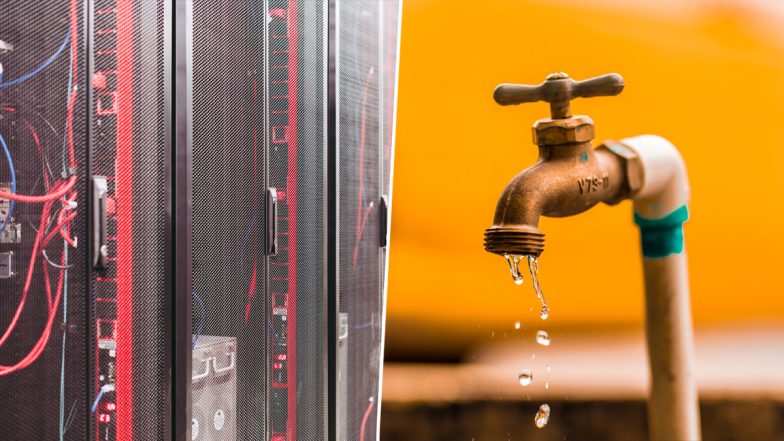
As the global demand for artificial intelligence and cloud computing surges, a hidden environmental cost is becoming increasingly apparent: the massive volume of water required to sustain data centres. While these facilities are often associated with energy consumption and carbon emissions, their reliance on local freshwater resources to cool high-density processor chips is placing significant pressure on municipal supplies and regional ecosystems.
Large data centres can consume up to 5 million gallons of water daily, a volume comparable to the daily usage of a town with a population between 10,000 and 50,000. As per a post by Environmental and Energy Study Institute (EESI), a medium-sized facility can utilise roughly 110 million gallons annually. Experts warn that as these centres expand in size and complexity to meet the compute-heavy requirements of AI, this thirst for water is expected to rise in tandem with their electricity demands. Thane Amazon Data Centre Protest: Balkum Residents Rally Against Proposed 53-Acre Project (Watch Video).
Data Centre Water Usage Cycle
The environmental footprint of a data centre is multifaceted, encompassing direct on-site water usage, the water required by power plants supplying electricity to the grid, and the water-intensive processes involved in manufacturing semiconductors. Cooling remains the primary driver of on-site consumption. Most facilities rely on evaporative cooling towers, where water is evaporated to shed heat, effectively removing it from the local freshwater supply.
The industry utilises a metric known as Water Usage Effectiveness (WUE) to track efficiency, which measures the total water consumed in litres per kilowatt-hour of energy used. While technical standards vary, the constant need to prevent server overheating means that even with efficient designs, the cumulative impact of over 5,000 data centres across the United States remains a concern for water-stressed regions.
Data Centre Community Impact and Resource Strain
The strain is already visible in regions such as Northern Virginia, which serves as a major global hub for data infrastructure. Local water authorities in areas with high cluster densities have reported significant increases in annual consumption, leading to debates over whether potable water should be prioritised for residents or industrial cooling. Furthermore, because a significant portion of the electricity powering these sites is still generated by fossil fuel power plants, the indirect water usage, needed to produce steam for turbines, further inflates the total environmental toll.
Path Toward Sustainable Cooling
Industry developers are exploring innovative strategies to mitigate these impacts. Technologies such as direct-to-chip liquid cooling and immersion cooling, where hardware is submerged in a non-conductive dielectric fluid, offer paths to drastically reduce water dependency. These methods allow for heat dissipation without the large-scale evaporation required by traditional cooling towers. Data Centre Protests in US Held Across 125 Locations Against Rapid Expansion; Check Key Reasons.
Transitioning toward renewable energy sources also provides a solution, as wind and solar power generation requires negligible water compared to coal or natural gas plants. As the industry looks toward 2030, analysts suggest that adopting closed-loop systems and utilising non-potable or reclaimed water will be essential to ensuring that the digital expansion of AI does not compromise access to life-critical freshwater for local communities.
(The above story first appeared on LatestLY on Jul 18, 2026 09:34 PM IST. For more news and updates on politics, world, sports, entertainment and lifestyle, log on to our website latestly.com).