Science
August 12 Skywatching: Six-Planet Alignment, Solar Eclipse, New Moon and Perseid Meteor Shower on Same Day
Skywatchers around the globe are in for a rare astronomical display on August 12, 2026, as a celestial alignment brings together four major sky events within a single 24-hour window. The day's lineup features a pre-dawn six-planet alignment, a total and partial solar eclipse, the arrival of a new moon, and the peak of the annual Perseid meteor shower.

Skywatchers around the globe are in for a rare astronomical display on August 12, 2026, as a celestial alignment brings together four major sky events within a single 24-hour window. The day's lineup features a pre-dawn six-planet alignment, a total and partial solar eclipse, the arrival of a new moon, and the peak of the annual Perseid meteor shower. While individual occurrences of these astronomical events are common, their simultaneous arrival on the same calendar date presents an unusually packed schedule for observers.
Pre-Dawn Six-Planet Alignment
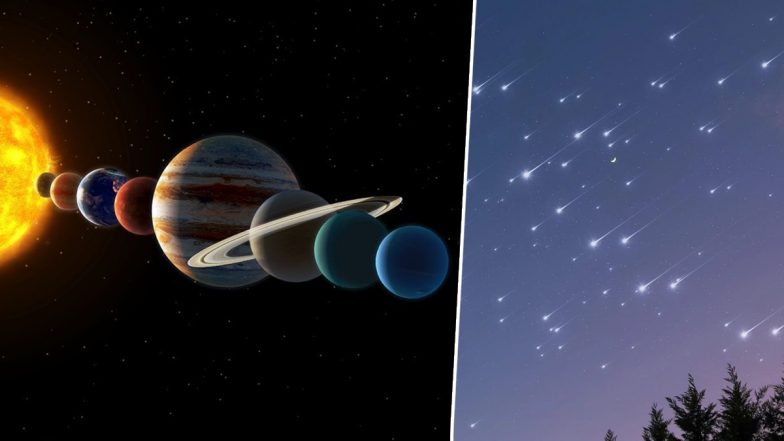
The day begins before sunrise with a multi-planet parade stretching across the early morning sky. Six planets - Mercury, Venus/Jupiter, Mars, Saturn, Uranus, and Neptune - will align in a wide sweep from east to west.
Mars, Saturn, and Jupiter will be easily discernible with the naked eye under clear conditions, while viewing Uranus and Neptune will require binoculars or a telescope, reported ScienceDaily. Observers are advised to look toward the horizon roughly 30 to 60 minutes before local sunrise for the clearest views.
Total and Partial Solar Eclipse
As the day progresses, a solar eclipse will take center stage. The path of totality - where the Moon completely covers the face of the Sun - will sweep across Greenland, Iceland, Arctic Russia, northern Spain, and a small tip of Portugal. In parts of Europe, this marks the first total solar eclipse visible from the mainland since 1999. Total Solar Eclipse 2026: Date, India Time and How To Watch NASA Live Streaming.
Regions outside the narrow line of totality, including broader portions of Europe, Canada, the northern United States, and northwestern Africa, will witness a partial solar eclipse. Astronomers emphasize that viewers must use certified ISO-compliant eclipse glasses or proper solar filters to observe the partial phases, as viewing the Sun without protection can cause permanent eye damage.
Ideal Dark-Sky Conditions for the Perseids
The timing of the eclipse coincides directly with the new moon phase, creating an unusually dark canvas for the evening's main event: the peak of the Perseid meteor shower. Total Solar Eclipse 2026 on August 12: Will It Be Visible From India? Check Details.
Because the new moon leaves the night sky free of bright lunar light, viewing conditions for the Perseids will be optimal. Under dark, unpolluted skies, observers can expect to see up to 100 meteors per hour. The Perseids, which originate from debris left behind by Comet Swift-Tuttle, are known for producing bright fireballs and long-lasting light streaks.
Global Visibility and Observation Tips
While all four events fall on August 12, visibility will vary significantly depending on geographic location and local timing. For instance, while viewers in North America and Europe can witness partial or total phases of the eclipse, observers in regions like India will not see the eclipse directly, though they can still catch the pre-dawn planetary parade and the night-time meteor display.
Astronomers note that no specialized equipment is required to enjoy most of the day's events, aside from protective solar viewing glasses for the eclipse and basic optics for the fainter distant planets. Observers seeking the best views of the meteor shower are advised to find locations away from city lights and allow 20 to 30 minutes for their eyes to adapt to the dark.
(The above story first appeared on LatestLY on Aug 07, 2026 08:12 AM IST. For more news and updates on politics, world, sports, entertainment and lifestyle, log on to our website latestly.com).