Total Solar Eclipse 2026: Date, India Time and How To Watch NASA Live Streaming
On August 12, 2026, a total solar eclipse will pass over Greenland, Iceland, Spain, and Portugal, with partial views across Europe and North America. The event occurs at night in India (9:02 PM to 1:28 AM IST on Aug 13), making it invisible locally. Space fans worldwide can watch live coverage streamed by NASA on its official platforms.

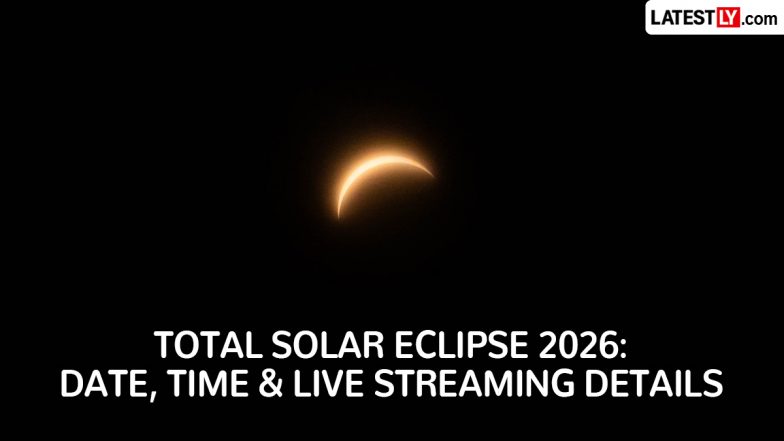
A total solar eclipse (Surya Grahan) will occur on Wednesday, August 12, 2026, marking the only total solar eclipse of the year. The celestial event will trace a path of totality across parts of Greenland, Iceland, northern Russia, Spain, and a small region of northeastern Portugal. While millions across Europe and North America will witness varying phases of the eclipse, the event will take place during the night in India, making it invisible from the Indian subcontinent. To bring coverage to a global audience, the National Aeronautics and Space Administration (NASA) will host an official live stream of the phenomenon. NASA Mars Pic Sparks Fresh Debate Over ‘Walking Man’ Seen by Spirit Rover.
Solar Eclipse 2026: Key Date and Timings in India
In Indian Standard Time (IST), the astronomical event (Surya Grahan) will begin late on the evening of August 12, 2026, and conclude in the early hours of August 13:
- Partial Eclipse Begins Globally: 9:02 PM IST (August 12)
- Total Eclipse Begins Globally: 10:23 PM IST (August 12)
- Maximum Eclipse (Peak): 11:16 PM IST (August 12)
- Total Eclipse Ends Globally: 12:08 AM IST (August 13)
- Partial Eclipse Ends Globally: 1:28 AM IST (August 13)
The maximum duration of totality, the period when the Sun is entirely obscured by the Moon, will last up to 2 minutes and 18 seconds near Greenland and Iceland.
Total Solar Eclipse 2026: NASA Trailer
Visibility in India and Cultural Impact
Because the peak phase occurs when the Sun is well below the horizon across South Asia, no part of the eclipse will be visible from India.
As the event is not visible locally, traditional astronomical observations such as Sutak Kaal (an inauspicious period observed prior to an eclipse in Hindu tradition) will not apply in India. Religious institutions will operate under standard schedules, and no traditional restrictions are required. NASA’s Curiosity Rover Discovers Vast Field of Honeycomb-Like Textures on Mars (See Pics).
Path of Totality and European Significance
The Moon's shadow, known as the umbra, will form a corridor approximately 190 miles (305 kilometers) wide:
- Path of Totality: Originates in remote regions of northern Russia, skims eastern Greenland, skims western Iceland, crosses the North Atlantic Ocean, and enters northern and eastern Spain before clipping northeastern Portugal.
- Partial Eclipse Zones: Observers across Canada, the northern United States, the United Kingdom, Western Europe, and northwestern Africa will witness a partial solar eclipse.
- Historical Context: This eclipse marks mainland Europe's first total solar eclipse since 1999 and the first over mainland Spain since 1905. In parts of Spain, totality will occur low on the western horizon near sunset.
How To Watch NASA's Official Live Stream
With the eclipse taking place during nighttime hours in South Asia, online broadcasts offer the primary viewing option for audience members in India.
NASA will stream the event live across its official website, YouTube channel, and NASA TV platforms. The broadcast will feature live telescopic feeds from observation posts in Iceland and Spain, expert scientific commentary, and updates from high-altitude balloon and aircraft research experiments deployed during totality.
August 12 Total Solar Eclipse Live Streaming by NASA
Scientific Background and Eye Safety
A total solar eclipse occurs when the Moon passes directly between Earth and the Sun, blocking the Sun's bright disk and casting a temporary shadow on Earth. This positioning reveals the Sun's outer atmosphere, known as the corona, providing scientists with an opportunity to measure solar magnetic activity and atmospheric changes.
For observers traveling to locations along the path of totality, astronomers emphasize that direct viewing requires certified ISO 12312-2 solar viewing glasses during all partial phases. Solar glasses may only be removed during the brief minutes of complete totality.
(The above story first appeared on LatestLY on Aug 06, 2026 10:27 AM IST. For more news and updates on politics, world, sports, entertainment and lifestyle, log on to our website latestly.com).