NASA Names 4 Astronauts for Artemis III Moon Mission Support Roles (Watch Video)
NASA announced that astronauts Randy Bresnik, Luca Parmitano, Frank Rubio and Andre Douglas will serve in critical operational positions as preparations continue for Artemis III Moon Mission aimed at returning humans to the Moon.

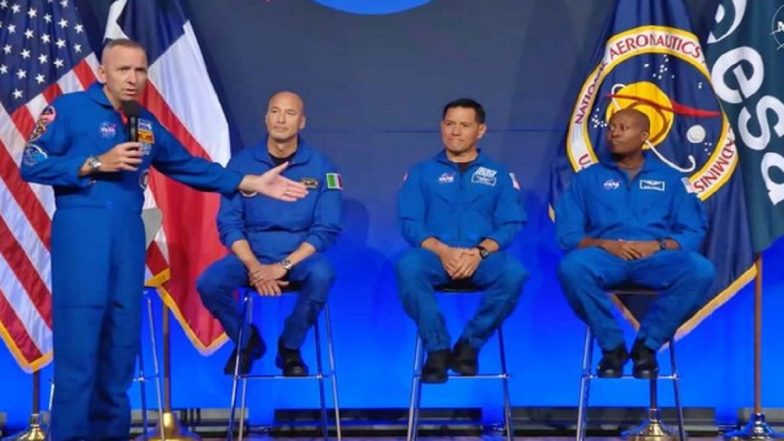
NASA has selected four experienced astronauts to play key leadership and support roles for the upcoming Artemis III mission, the first planned crewed lunar landing under the Artemis program. The agency announced that astronauts Randy Bresnik, Luca Parmitano, Frank Rubio and Andre Douglas will serve in critical operational positions as preparations continue for the historic mission aimed at returning humans to the Moon.
The announcement marks another step forward for Artemis III, which is expected to become the first mission since Apollo 17 in 1972 to land astronauts on the lunar surface. NASA’s Artemis II Astronauts Return After Venturing Where No Human Had Gone Before, Raising Hope for Humanity.
NASA Names 4 Astronauts for Artemis III Moon Mission
LIVE: Meet the crew of our next Artemis mission.
We're sharing the latest updates on Artemis III: https://t.co/UtesXxsNxm
— NASA (@NASA) June 9, 2026
Veteran NASA Astronauts Assigned Key Responsibilities
NASA said veteran astronaut Randy Bresnik will serve as Mission Management Team Chair for Artemis III. In this role, he will oversee mission planning and coordinate decision-making among various teams responsible for the mission's execution.
Luca Parmitano, an astronaut from the European Space Agency (ESA), has been appointed Lead Flight Director. He will be responsible for supervising mission operations and supporting real-time decision-making during the flight. NASA Orders ISS Crew to Shelter in SpaceX Crew Dragon Following New Air Leaks in Russian Zvezda Service Module.
Meanwhile, Frank Rubio, who holds the US record for the longest single spaceflight by an American astronaut, will serve as Chief Astronaut. His responsibilities will include representing the astronaut corps and contributing to mission readiness efforts.
NASA also named Andre Douglas, a member of the Artemis astronaut team, as Crew Support Astronaut. He will work closely with the Artemis III crew during training and mission preparations.
Artemis III to Mark Return of Humans to the Moon
Artemis III is a cornerstone of NASA's broader Artemis program, which seeks to establish a sustained human presence on and around the Moon. The mission is expected to carry astronauts to lunar orbit aboard the Orion spacecraft before landing crew members near the Moon's south pole.
NASA has stated that the mission aims to land the first woman and the first person of color on the lunar surface, expanding representation in human space exploration.
The agency is working with commercial and international partners on several elements of the mission, including lunar landing systems, spacesuits and infrastructure needed for long-term exploration.
Building on Artemis Program Milestones
The Artemis program has already achieved significant milestones. Artemis I, launched in 2022, successfully completed an uncrewed test flight around the Moon. Artemis II, currently in preparation, is expected to carry astronauts on a crewed lunar flyby mission before Artemis III attempts a lunar landing. Officials say lessons learned from these missions will be crucial in supporting future exploration efforts, including eventual crewed missions to Mars.
International Collaboration Remains Central
The involvement of ESA astronaut Luca Parmitano highlights the growing international nature of lunar exploration. NASA has expanded cooperation with space agencies and commercial partners worldwide as part of the Artemis initiative. The program is supported by the Artemis Accords, a framework that outlines principles for peaceful and cooperative exploration of the Moon, Mars and other celestial bodies.
Preparing for a New Era of Lunar Exploration
NASA continues to refine mission timelines and technical requirements as work progresses on the Space Launch System rocket, Orion spacecraft, lunar landing systems and supporting infrastructure. With the appointment of the four astronauts to leadership and support positions, the agency has taken another step toward one of its most ambitious goals: returning humans to the Moon and laying the foundation for future deep-space exploration.
(The above story first appeared on LatestLY on Jun 09, 2026 11:24 PM IST. For more news and updates on politics, world, sports, entertainment and lifestyle, log on to our website latestly.com).