













 Quickly
 Socially
 Trending
 Crypto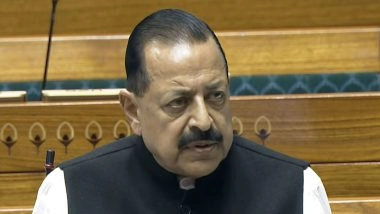
New Delhi [India], March 25 (ANI): Union MoS Science and Technology Jitendra Singh told the Lok Sabha on Wednesday that India is aggressively pursuing self-reliance in the exploration and production of rare earth materials to secure its transition toward green energy.
Addressing queries in the House, Singh underscored the global significance of these materials, stating, "The critical mineral and rare earth is a big topic in which all the nations and all the societies are interested." He explained that the government's approach involves a comprehensive strategy to strengthen the domestic supply chain.
Also Read | Ranveer Singh 'Kantara' Row: Karnataka High Court Asks Actor to Apologise in FIR Case.
According to the Minister, the rare earth subject is one that "deals with a larger ecosystem or a larger spectrum," which connects several high-priority national goals. Singh noted that "at one end of the spectrum is the quest to gain self-reliance in the field of nuclear energy, rare earth, permanent magnets," while the other end involves India playing a "leading role in the global arena."
The Minister provided specific updates on industrial progress, mentioning that a pilot project recently commenced in Hyderabad focusing on Neodymium-Iron-Boron Permanent Magnets. He also informed the House that a Samarium Cobalt Magnet Plant was launched in Visakhapatnam, marking a significant milestone.
Also Read | Akshay Kumar Reacts to Tensions Amidst Ongoing Wars, Shares a Message of Prayer and Hope.
"For the first time, after 70 years, by PM Modi, in Visakhapatnam, Vizag, a Samarium Cobalt Magnet Plant has been launched, through which 500 tonnes per year of permanent magnets will be produced," Singh said. He further explained that production capacities are set to scale up significantly in the coming years.
However, the Minister also addressed the challenges regarding the gap between domestic production and rising demand. He pointed out that while production will increase to 2,000 tonnes in the first phase and eventually to 5,000 tonnes in the third phase, it may still trail behind the country's rapid growth.
Singh stated that "the dilemma is that even now, our requirement is around 4,000 tonnes. By 2030, when our requirement will double to 8,000 tonnes, by then our production will be around 5,000 tonnes." He noted that this gap necessitates a further acceleration of resources and research to scale up clean energy sources.
The importance of these minerals extends beyond energy to include defence and emerging technologies. Singh highlighted that lithium and other rare earth elements are vital for electric vehicles, electronic gadgets, defence equipment, space exploration, and wind power systems.
He specifically linked these resources to the future of data and technology, stating that for the national mission on Artificial Intelligence and data preservation, "we will require 24x7 reliable sources of clean energy."
Singh highlighted that the government's resolve remains firm to sustain India's "recently acquired image of a torchbearer in the world as far as our transition to a green earth and clean energy is concerned." (ANI)
(The above story is verified and authored by ANI staff, ANI is South Asia's leading multimedia news agency with over 100 bureaus in India, South Asia and across the globe. ANI brings the latest news on Politics and Current Affairs in India & around the World, Sports, Health, Fitness, Entertainment, & News. The views appearing in the above post do not reflect the opinions of LatestLY)
 Share Now
 Google Trends



 Live Bot