













 Quickly
 Socially
 Trending
 Crypto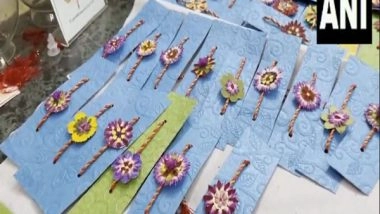
Lucknow (Uttar Pradesh) [India], August 8 (ANI): The National Botanical Research Institute (NBRI) in Lucknow, Uttar Pradesh, has introduced floral biodegradable rakhis ahead of the Raksha Bandhan celebrations.
These biodegradable rakhis are a unique and eco-friendly product made of natural and dried flowers and plant material.
Also Read | Jammu and Kashmir Statehood Hearing: Supreme Court To Hear Plea Seeking Restoration of J&K Statehood Today.
NBRI Director Ajit Kumar Shasany, on Thursday, said that the initiative was taken for women's empowerment. He added that the institute came up with the idea to convert its floral art into biodegradable rakhis.
"This concept has come up as we were making floral crafts in NBRI. We were doing it for women empowerment. A few days ago, we got an idea that we could convert the floral art into environmental friendly rakhi. We give various shapes to dried flowers. It is eco-friendly," Ajit Kumar Shasany told ANI.
These floral rakhis are available at the Institute campus for Rs 50.
Sharing an X post, CSIR-NBRI wrote, "Celebrate a Green Raksha Bandhan with CSIR-NBRI's Biodegradable Floral Rakhis! Crafted with love, tradition & sustainability by empowered women. Available for Sale | Rs 50 only Sale Section, Gate No. 3, Botanic Garden, CSIR-NBRI, Lucknow."
Raksha Bandhan, also known as Rakhi, is a traditional Hindu festival that celebrates the bond between brothers and sisters. On this occasion, sisters tie a rakhi around their brothers' wrists, and in return, brothers offer gifts as a symbol of love and protection.
NBRI is known for such unique patents.
According to the institute's website, "The CSIR-National Botanical Research Institute (NBRI) - is amongst one of the constituent research institutes of the Council of Scientific and Industrial Research (CSIR), New Delhi. Originally set up as the National Botanic Gardens (NBG) by the State Government of Uttar Pradesh (U.P.), it was taken over by the CSIR in 1953. Though initially engaged in research in the classical botanical disciplines, the NBG went on laying an increasing emphasis, in keeping with the national needs and priorities in the field of plant sciences, on its applied and developmental research activities." (ANI)
(The above story is verified and authored by ANI staff, ANI is South Asia's leading multimedia news agency with over 100 bureaus in India, South Asia and across the globe. ANI brings the latest news on Politics and Current Affairs in India & around the World, Sports, Health, Fitness, Entertainment, & News. The views appearing in the above post do not reflect the opinions of LatestLY)
 Share Now
 Google Trends



 Live Bot