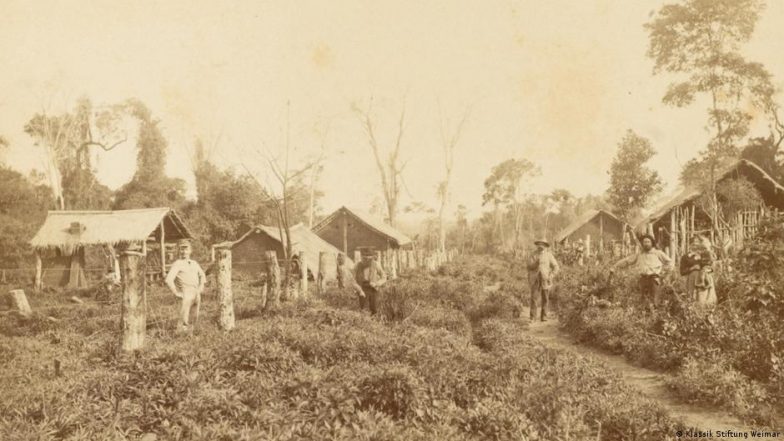
A new home for the "Aryan race." That was what German emigrants envisioned when they founded Nueva Germania in Paraguay in 1886. It later failed but still exists today.In the late 19th century, Berlin schoolteacher Bernhard Föster declared that German culture and virtues were under threat — and that the Jews were to blame. A fervent antisemite, he repeatedly faced trial in the German Empire for racist incitement. He faced disciplinary proceedings at his school and was even placed on a wanted list. He no longer saw a future for himself in his homeland. Instead, he dreamed of a new "Jew-free" Germania that would flourish "rejuvenated and full of strength" under his leadership.
Also Read | World News | Civilians Return Home in Southern Lebanon After Ceasefire, Remain Hesitant to Stay Permanently.
A utopia in South America
He already had an idea of where such a place might exist. "I will transplant German culture into 'new and promising soil'," he'd proclaimed — to Paraguay, where the Aguaray-mí and Aguaray-Guazú rivers meet. For two years, from 1883 to 1885, Förster traveled through the country on horseback, searching for a place where he could realize his utopia. "Of course, he was driven by his political or ideological beliefs," archaeologist Natascha Mehler tells DW. "From today's perspective, however, one might also say he was a classic social misfit who tried to build a new life for himself elsewhere."
Accompanying him on this new life journey was his wife Elisabeth, the sister of philosopher Friedrich Nietzsche. She affirmed her husband's vision: "We will breed an Aryan master race in the forests of South America. Only the strongest, the purest of blood, will join us. The Germany of old is corrupt, but the new Germania will last forever."
Promoting a 'paradise-like refuge'
For the country's first ever independent colony, the Paraguayan government made 20,000 hectares of land about 150 km north of the capital, Asunción, available to Förster. Only Germans were allowed to settle in "Nueva Germania." After the War of the Triple Alliance (1864–1870) between Paraguay and the three nations Brazil, Uruguay and Argentina, Paraguay had not only lost 50% of its territory but, even worse, around 70% of its population. Thus, settlers eager to invest in the country were welcomed with open arms.
In an agreement with the Paraguayan government, the Försters committed to settling at least 140 families within two years. Before leaving for Paraguay in 1886, Elisabeth and Bernhard Förster ran advertisements in newspapers and at public lectures to attract settlers — preferably artisans and farmers — and to raise funds.
Little interest in the new Germania
Yet the much-touted "paradise-like refuge" attracted scant interest. Förster only managed to persuade 14 families to join him. It's not known whether the settlers who followed Förster to Nueva Germania shared his racist ideology, although he did lecture them on topics such as "the purification and rebirth of the human race" or "the salvation of civilization" during their voyage from Germany.
"We know which plots of land they received and where they lived," says Natascha Mehler, but little is known about the emigrants' motives. "They were mostly people who had little to no money. They were certainly discontented in the German Empire, left behind by industrialization." Perhaps youngest sons left out of the inheritance, she suggests. "And so, they simply put their faith in Bernhard Förster's promises, scraped together their last savings, if you will, to buy a passage on the ship and acquire a plot of land, before setting off for Paraguay with their families."
Paradise in peril
The settlers, most of them Saxon artisans, quickly became disillusioned. They realized that Förster's promises of exceptionally fertile soil and a favorable climate did not reflect reality. "It's really unbearably hot and humid during the rainy season, and also swampy and damp due to the rivers," says Mehler, who conducted two field expeditions in the footsteps of the early colony. "During the dry season, the soil becomes very sandy and dry. This made farming difficult; extracting crops from the soil was laborious work."
Nueva Germania's harvests were meager; parasites and tropical diseases made life even harder for the settlers. While wealthier families had the means to relocate, most were forced to stay and continue the fight for survival. As one desperate settler wrote in a letter to relatives: "Beloved homeland of my loved ones, oh how I long for you. If I had stayed in Germany, I would have spared myself so much suffering … Courage and health are fading, mind and body are growing weary, and we colonists will likely meet our graves prematurely."
Luxury in the 'Försterhof'
Meanwhile, as one disappointed settler complained, Bernhard Förster and Elisabeth Förster-Nietzsche liked to portray themselves as a ruling couple and paid little attention to their fellow settlers. The couple lived at the heart of Nueva Germania, with other homesteads situated up to five kilometers apart. "Förster may have thought that people in isolation are less inclined to get together and criticize what was going on or even stage a revolt," says Mehler.
A failed utopia
The colony did not maintain its intended "racial purity" for long. Mehler believes that without the assistance of the indigenous Guaraní people in the region, the first generation of settlers in Nueva Germania would not have survived. Nevertheless, the utopian settlement was ultimately destined to fail. "They never managed to establish a stable financial foundation. All of Förster's letters to Germany, in which he pleaded for support, came to nothing. After all, it was not a colony granted by the emperor's favor, but a private venture. And it was clear that Förster was no financial expert either."
Friedrich Nietzsche declined any financial support to his sister and opposed his brother-in-law's antisemitic views. To persuade him, his sister promised to name an area of the colony after him "Friedrichshain." However, Nietzsche scoffed at the idea and suggested they name it "Lamaland," as "Lama" was his sister's nickname.
Two years after the colony was founded, only 40 families had settled in Nueva Germania, far fewer than the 140 promised in the agreement with the government. Bernhard Förster found himself deeply in debt and desperate. He passed away on June 3, 1889. While it's thought he may have committed suicide, this was never proven. Förster-Nietzsche had German newspapers report that her husband died as a result of his great efforts on behalf of the colony. She attempted to keep the colony running for a few more years but eventually returned to Germany.
The descendants and a new colony
Nueva Germania still exists today, with houses lining a wide dirt road that leads to the river, with murky water flowing sluggishly along the outskirts of the village. Approximately 2,000 people live in the village, many of whom speak German. When asked about the town's founding, the residents express surprise. They're not pleased that the media is focusing on their dark past.
"Sometimes I felt that they were thinking: 'We have completely different problems here. I need to ensure my tractor and my chicken farm are running smoothly and that my road won't wash away in the next rainy season. And yes, maybe my grandpa or my great-grandpa had some nationalist leanings, but for us today, all of that seems very distant'," says Mehler.
Through her research, Mehler discovered a striking parallel to the present day. "During the COVID-19 pandemic, many German anti-vaxxers declared Paraguay as their destination. We actually found a written source from Bernhard Förster, who vehemently opposed the introduction of mandatory smallpox vaccination in the German Empire. He wrote, 'Come with me to Paraguay; there's no mandatory vaccination there, so you can do whatever you want'."
Mehler was seated alongside anti-vaxxers on a flight to Asuncion. At the airport, she noticed promotional posters for "El Paraiso Verde" or "The Green Paradise," a German-speaking colony for anti-vaxxers and conspiracy theorists. "I was very surprised to see how dramatically history has repeated itself in just 140 years," says Mehler.
This article was originally written in German.
(The above story first appeared on LatestLY on Apr 17, 2026 03:50 PM IST. For more news and updates on politics, world, sports, entertainment and lifestyle, log on to our website latestly.com).