











 Quickly
 Socially
 Trending
 Crypto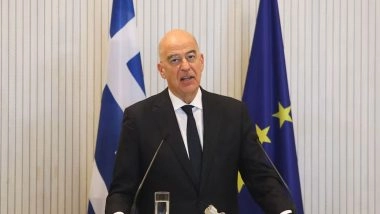
New Delhi [India], February 6 (ANI): Greek Defence Minister Nikos Dendias arrived in India on Friday for an official visit that will continue till February 9, at the invitation of his Indian counterpart Rajnath Singh.
During his stay in New Delhi, Dendias is scheduled to hold bilateral meetings with Defence Minister Rajnath Singh and External Affairs Minister S Jaishankar to discuss ways to strengthen bilateral defence cooperation and address regional security matters.
Also Read | Matt Batista Epstein Island Video: What Really Happened?.
As part of the visit, the Greek Defence Minister will also participate in a discussion at the India-EU Forum, focusing on international developments and security issues.
He will then travel to Bengaluru to explore opportunities for collaboration between the Greek defence industry ecosystem and its Indian counterpart.
Also Read | YouTuber Nico Grigg aka NicoIsCold Snuck Onto Epstein Island: Here's What He Found (Video).
The visit comes at a time when India-EU ties have received a major boost with the landmark Free Trade Agreement (FTA) between India and the European Union being finalised and signed after negotiations concluded on January 27, marking a pivotal milestone in one of India's most strategic economic partnerships.
Designed as a modern, rules-based trade partnership, the FTA addresses contemporary global challenges while enabling deeper market integration between the world's fourth and second-largest economies.
With a combined market estimated at over Rs 2091.6 lakh crore (USD 24 trillion), the agreement unlocks unprecedented opportunities for the two billion people of India and the EU.
The FTA delivers preferential market access for more than 99 per cent of India's exports by trade value, while preserving policy space for sensitive sectors and reinforcing India's developmental priorities.
Bilateral merchandise trade between India and the EU stood at approximately Rs 11.5 lakh crore (USD 136.54 billion) in 2024-25, with India exporting roughly Rs 6.4 lakh crore (USD 75.85 billion) to the EU.
Trade in services reached Rs 7.2 lakh crore (USD 83.10 billion) in 2024.
Despite robust growth, significant untapped potential remains given the size of both markets, and the FTA provides a clear pathway for India and the EU to emerge as each other's major economic partners.
The agreement transforms India-EU relations into a modern, multifaceted partnership, offering a stable and predictable environment for exporters and enabling Indian businesses, including MSMEs, to plan long-term investments and integrate into European value chains amid global uncertainties.
Building on this economic foundation, India has secured preferential access across 97 per cent of tariff lines, covering 99.5 per cent of trade value.
Notably, 70.4 per cent of tariff lines covering 90.7 per cent of India's exports will see immediate duty elimination in labour-intensive sectors such as textiles, leather and footwear, tea, coffee, spices, sports goods, toys, gems and jewellery, and certain marine products.
Another 20.3 per cent of tariff lines will achieve zero duty over three and five years, while 6.1 per cent will benefit from tariff reductions or tariff rate quotas (TRQs) for products including cars, steel, and certain shrimp and prawn items.
Key employment-generating sectors currently facing EU duties between 4 per cent and 26 per cent, together worth over Rs 2.87 lakh crore (USD 33 billion) in exports, will enter the EU market at zero duty from the date the FTA comes into force, significantly boosting competitiveness.
In return, India is offering duty elimination or reduction on 92.1 per cent of its tariff lines, covering 97.5 per cent of EU exports, with 49.6 per cent seeing immediate elimination and 39.5 per cent phased out over five, seven, and ten years.
The FTA is expected to drive growth in agriculture and processed foods through preferential access for tea, coffee, spices, grapes, gherkins, cucumbers, dried onion, fresh fruits and vegetables, while prudently safeguarding sensitive sectors such as dairy, cereals, poultry, and soymeal.
Product-specific rules of origin are aligned with existing supply chains, allow self-certification, and include special flexibilities for MSMEs, including quotas for shrimps, prawns, and downstream aluminium products.
In services, the EU has offered broader commitments across 144 sub-sectors, including IT and ITeS, professional services, education, and business services, while India has opened 102 sub-sectors covering EU priorities such as telecommunications, maritime, financial, and environmental services.
The agreement also establishes a robust mobility framework for Indian professionals, including intra-corporate transferees, contractual service suppliers, and independent professionals across dozens of sub-sectors, alongside commitments to conclude social security agreements within five years.
Indian traditional medicine practitioners will gain greater access to provide AYUSH services in EU member states, with future openness locked in for wellness centres and clinics.
Further strengthening the framework, the FTA enhances intellectual property protections in line with TRIPS, recognises India's Traditional Knowledge Digital Library (TKDL), and deepens cooperation on sanitary and phytosanitary (SPS) and technical barriers to trade (TBT) measures through digitisation and mutual recognition.
Sectoral gains are expected across engineering goods, marine products, leather and footwear, gems and jewellery, textiles and apparel, plastics and rubber, chemicals, medical instruments, and minerals, with tariff elimination or sharp reductions set to unlock access to massive EU import markets and generate substantial employment opportunities across India. (ANI)
(The above story is verified and authored by ANI staff, ANI is South Asia's leading multimedia news agency with over 100 bureaus in India, South Asia and across the globe. ANI brings the latest news on Politics and Current Affairs in India & around the World, Sports, Health, Fitness, Entertainment, & News. The views appearing in the above post do not reflect the opinions of LatestLY)
 Share Now
 Google Trends



 Live Bot