No Trading Day Protest on August 12: What Are Traders’ Demands?
Day traders are calling for a stock market boycott on August 12 over the new Closing Auction Session, securities transaction tax and frequent regulatory changes. The protest comes after CAS triggered unusual end-of-day price movements and Nifty-Sensex divergence. SEBI says the mechanism is designed to improve price discovery, transparency and stability for all market participants.

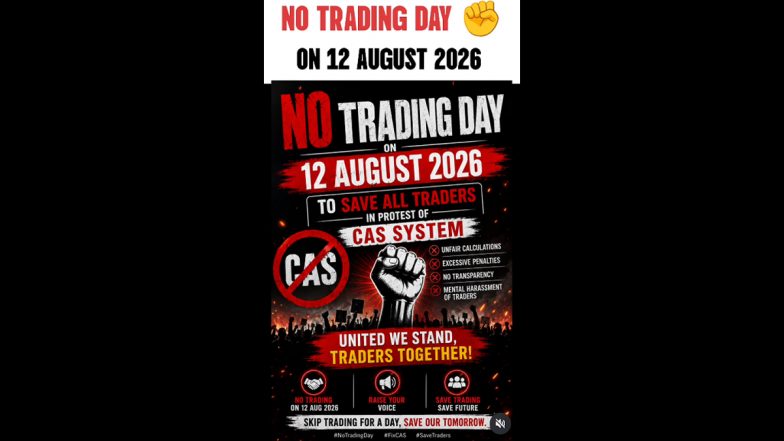
A proposed one-day trading boycott on August 12 has brought growing attention to the early problems surrounding India’s new Closing Auction Session (CAS), with day traders objecting to the mechanism, securities transaction tax (STT) and what they describe as frequent regulatory changes. The campaign comes barely a week after CAS was introduced for stocks with derivatives contracts, and as market participants continue to adjust to a new way of determining official closing prices.
The protest call is being circulated mainly through social media, with traders arguing that the new closing mechanism has created unexpected price movements and made it harder for retail participants to manage positions near the end of the trading day. At the same time, market analysts say the initial disruption may reflect an adjustment period as traders, brokers and institutions adapt to the new structure. No Trading Day Protest on August 12: Who Called for Stock Market Boycott and Why.
No Trading Day Protest on August 12
View this post on Instagram
View this post on Instagram
Why Traders are Calling for a Boycott
Several social media posts have called for a one-day protest. One trader on X with nearly 1.5 lakh followers wrote, "No trade day on Aug 12. Against STT (securities transaction tax). Against CAS."
Another post said, "One day trading boycott against regulations and rising taxes impacting retail traders." The campaign reflects a wider grievance among some retail traders over the cost of active trading and the pace of regulatory changes affecting the market. When Will Stock Market Close? New Timings for F&O Traders Effective From Today.
Traders have also alleged that the new mechanism has led to a wide divergence between the two leading indices, Nifty and Sensex, as well as differences in the closing prices of some stocks, causing substantial losses for them.
CAS Changes How Some Stocks Get Their Closing Price
The Closing Auction Session was introduced on August 3 for stocks that are also traded in the derivatives segment. Under the earlier system, the closing price of stocks in the equity cash segment was generally based on the Volume Weighted Average Price (VWAP) of trades executed during the final 30 minutes of the Continuous Trading Session.
Under CAS, continuous trading for stocks in the F&O segment ends earlier, followed by a separate auction process to establish the official closing price. NSE’s implementation documents confirm that the new mechanism took effect on August 3.
The change is significant because the closing price is used in a range of market calculations, including index values and derivative pricing. The new system therefore affects not only investors holding individual shares but also participants in the derivatives market.
Why SEBI Introduced the New Mechanism
SEBI has argued that the change is aimed at improving price discovery and reducing distortions around the market close.
The regulator said it had received feedback from global passive funds that Indian equities experienced significantly higher end-of-day volatility than markets in many other countries. According to SEBI, such volatility could affect mutual funds, passive funds, exchange-traded funds and retail investors.
SEBI has also argued that a closing auction can bring different categories of market participants into a common price-discovery process. The mechanism pools orders into an auction and determines a closing price based on the available demand and supply.
Closing auctions are already used in major markets in the US, Europe and Asia. SEBI’s stated objective is therefore not to give institutions preferential treatment, but to create a more stable and transparent closing-price mechanism.
Why the Transition Has Unsettled Traders
The concern among traders is less about the stated objective of CAS and more about how the mechanism has behaved in its first days.
Reuters reported that the introduction of CAS has contributed to sharp movements around the close and divergence between the Nifty 50 and Sensex. The difference is partly linked to the fact that the indices have different constituents, weightings and exposure to stocks affected by the new closing mechanism.
Bernstein has also said that India's index-options market faces near-term disruption from the new system. According to the brokerage, trading volumes during the final 15 minutes on the NSE have fallen substantially from their historical share of daily turnover.
For traders who base derivative positions on expected closing levels, these changes can alter the relationship between cash-market prices, index values and futures and options prices.
One of the main complaints from traders is that CAS could favour large institutions because they have greater resources, technology and liquidity to participate in an auction-based market.
That allegation, however, remains a trader grievance rather than an established finding that the new system structurally favours institutions.
SEBI's stated rationale is almost the opposite: the regulator says the auction gives all categories of market participants an opportunity to participate in price discovery and can reduce the influence of large trades executed immediately before the close.
The immediate question is therefore whether the early volatility is a temporary consequence of the transition or evidence that the mechanism needs modification.
The first sessions have exposed a practical challenge that goes beyond the regulatory design of CAS: traders need to understand a new sequence of market timings and price formation.
From August 3, stocks in the F&O segment moved to an earlier continuous-trading close, while equity derivatives trading was extended to 3:40 pm. NSE and brokers have issued detailed changes covering order handling, risk management and trading schedules.
NSE Clearing has separately specified risk-management procedures for orders carried forward from continuous trading into CAS, with the new provisions effective from August 3.
This means the transition is not simply a change in the closing-price formula. It also changes how traders manage positions and orders around the end of the trading session.
What the August 12 Boycott is Really About
The proposed boycott brings several separate grievances together: opposition to STT, concerns over CAS, complaints about frequent regulatory changes and broader dissatisfaction among sections of the retail trading community.
The campaign's significance will depend on how widely traders participate and whether the concerns translate into a sustained demand for changes to the new mechanism.
For now, SEBI and the exchanges have proceeded with the reform, while market participants are watching whether late-session volatility and index divergence settle as participation in the auction increases. Analysts expect some of the initial inefficiencies to diminish as traders and institutions become more familiar with the system.
The August 12 protest, therefore, is not only a challenge to one new trading rule. It has become an early test of how India's increasingly large retail trading community responds when a market-structure reform changes the mechanics of one of the most important moments of the trading day.
(The above story first appeared on LatestLY on Aug 11, 2026 03:37 PM IST. For more news and updates on politics, world, sports, entertainment and lifestyle, log on to our website latestly.com).