What Is the ‘Potential Source’ of Cyclospora Outbreak in Michigan?
Michigan health officials have identified lettuce and salad greens as a 'potential source' of a cyclospora outbreak that has caused more than 2,800 cases. No specific supplier or produce type has been confirmed, and the investigation continues. Officials are advising caution while examining possible links between leafy greens and the parasitic infection.

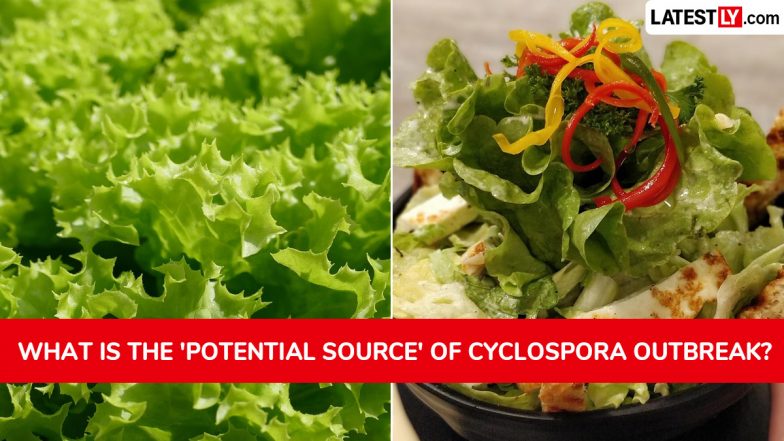
Michigan health officials have identified lettuce and salad greens as a “potential source” of a major cyclosporiasis outbreak that has sickened thousands of people across the state and beyond. The Michigan Department of Health and Human Services (MDHHS) said early findings suggest a possible link to leafy greens, while cautioning that no specific produce type, grower or supplier has been confirmed as the cause.
The outbreak has resulted in more than 2,800 reported cases, with Michigan accounting for the majority. Officials said the investigation remains ongoing and other food sources have not yet been ruled out. Cyclosporiasis is a parasitic infection that can cause symptoms including watery diarrhea, loss of appetite and weight loss. Cyclospora Parasite Outbreak in US: Symptoms, Prevention and Food Safety Tips.
Lettuce and Salad Greens Under Investigation
In a statement, Michigan health officials said: “No specific type of produce, grower, or supplier has been identified as the source.” The department has advised restaurants and commercial kitchens in south-eastern Michigan to take additional precautions when handling leafy greens, snow peas, certain herbs and raspberries.
Officials have recommended thoroughly washing produce and, where possible, cooking items before consumption. They have also advised consumers to purchase whole heads of lettuce instead of pre-washed, packaged greens, remove outer leaves and wash the remaining leaves carefully. Hantavirus in US: Rat Disease Spreads to Humans, Kills 4 People; Know Symptoms, Treatment and Prevention.
Michigan Reports Thousands of Cases
The Centers for Disease Control and Prevention (CDC) reported 843 confirmed cases and 1,500 suspected cases of cyclosporiasis across 31 states as of Friday. Eighty-six people have been hospitalized, and no deaths have been reported.
Michigan has been the hardest-hit state, reporting 2,640 cases, while neighbouring Ohio has reported 177 cases. Michigan’s chief medical executive, Dr Natasha Bagdasarian, told the Associated Press: “There is clearly a linked outbreak happening right now.”
Health officials say the investigation is complicated because cyclospora has a long incubation period. Symptoms typically appear about two weeks after infection, making it difficult for investigators to identify common food exposures among patients.
Why Tracking the Source Is Challenging
According to health experts, investigators rely on interviews with people who have confirmed infections to identify possible connections, such as whether patients ate at the same restaurant or purchased food from the same location. However, those interviews often occur weeks after infection, making it difficult for people to accurately remember what they consumed.
Barbara Kowalcyk, an associate professor at the George Washington University’s Milken Institute of Public Health and director of the university’s Institute for Food Safety and Nutrition Security, compared outbreak investigations to assembling a puzzle.
“It’s like putting a puzzle together. You start taking pieces out of your puzzle – it’s harder to see the whole picture, and that’s what we’ve done. We’ve taken pieces out of the whole puzzle.”
Concerns Over Public Health Resources
The outbreak has also renewed debate over public health funding and foodborne illness surveillance systems. Kowalcyk said reductions in funding for state and local health departments may have affected the speed and scale of outbreak investigations.
“Have the funding cuts to public health impacted the current activities related to the cyclospora outbreak? I think they have,” said Kowalcyk. “If you’re understaffed you might be interviewing [patients] after six to eight weeks.”
The Trump administration cut USD 11.4 billion in grants to state and local health departments in March 2025, according to the report. Michigan public health labs reportedly lost USD 5.5 million in funding. Experts said local health departments often rely on multiple funding sources, and reductions can affect staffing and response capacity during outbreaks.
Changes to Foodborne Illness Monitoring
The investigation has also drawn attention to changes in the federal foodborne illness monitoring system. In July 2025, the scope of the CDC’s FoodNet program was reduced. The program previously monitored eight foodborne pathogens, including cyclospora, but now focuses on shiga toxin-producing E. coli and salmonella.
FoodNet has historically helped coordinate foodborne illness information across states and contributed to national estimates on food-related illnesses.
Public health consultant Gail Hansen said: “Despite what the current HHS administration believes, ignoring a problem doesn’t make it go away.” The administration has defended the changes, saying foodborne pathogen investigations continue and that other surveillance systems monitor infections.
HHS senior press secretary Emily Hilliard said: “Under the leadership of Secretary [Robert F] Kennedy [Jr], FDA is currently investigating Cyclospora outbreaks using established epidemiologic, laboratory, and traceback tools in close coordination with CDC and state and local partners. Protecting the nation’s food supply is a core FDA responsibility, and the agency has the expertise, personnel, and resources necessary to detect, investigate, and respond to foodborne illness outbreaks and take regulatory action when warranted.”
She added: “To be clear, cyclospora tracking never stopped. CDC is actively working with 3,000 health departments to gather data.”
(The above story first appeared on LatestLY on Jul 16, 2026 06:23 PM IST. For more news and updates on politics, world, sports, entertainment and lifestyle, log on to our website latestly.com).