













 Quickly
 Socially
 Trending
 Crypto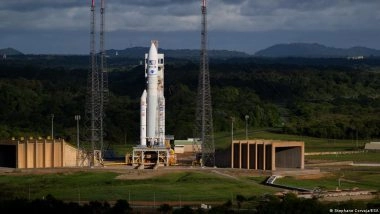
The European Space Agency's Juice probe has launched, on an eight-year journey to explore Jupiter's icy moons and the possibility of them harboring, or having once harbored, life.The spacecraft successfully launched from the Kourou spaceport in French Guiana at 09:14 local time (12:14 GMT/UTC) on Friday.
Also Read | PM Narendra Modi To Flag Off Kerala’s First Vande Bharat Express Train on April 25.
Juice, or Jupiter Icy Moons Explorer, is the European Space Agency's (ESA) biggest planetary mission to date.
The spacecraft will explore Jupiter's complex environment and shed light on whether life could exist on three of its moons.
The lift-off was postponed from Thursday to Friday after a threat of lightning at the launch site.
What's next after launch?
Once Juice separates from its Ariane 5 rocket just under half an hour after launch, ESA will assume control of the spacecraft after ground stations pick up the mission’s first words.
Juice’s 85-square meter solar arrays, which stretch out to the length of a basketball court, will unfold, to collect as much energy as possible near Jupiter.
It will take up to 17 days for Juice’s antennas and probes to be deployed.
Only then will Juice begin its eight-year journey to the gas giant, which is some 628 million kilometers from Earth.
The probe will use gravitational slingshots from flying close to planets to gain momentum for its journey — Juice will do a fly-by of Earth and Venus before swinging past Earth again in 2029. Juice will arrive at its destination, Jupiter, in 2031.
Why Jupiter's moons?
More than 400 years ago astronomer Galileo Galilei spotted four moons orbiting Jupiter ― the first natural satellites discovered circling around a planet other than Earth.
Three of the four Galilean moons ― Ganymede, Callisto and Europa ― are thought to have huge oceans of liquid water beneath their icy shells. This has made Jupiter's icy moons prime candidates in the search for life beyond Earth.
"With Juice we will explore conditions to see if life could have evolved and also to find out where to look," Hauke Hussmann from the Institute of Planetary Research in Berlin told DW.
Where exactly on Jupiter's moons find evidence of life might be most likely to be found will be a task of subsequent missions, according to Hußmann.
"Studying this gas giant planet and its moons in detail would also help our understanding of planets elsewhere in the Universe," said Professor Mark McCaughrean from ESA's senior advisors.
The first scientific results from the environment on Jupiter's moons are expected after 2031, when Juice is scheduled to arrive at Jupiter.
vh/msh (AFP, dpa)
(The above story first appeared on LatestLY on Apr 14, 2023 06:10 PM IST. For more news and updates on politics, world, sports, entertainment and lifestyle, log on to our website latestly.com).
 Share Now
 Google Trends



 Live Bot