Heatwave Alert: Maharashtra’s Brahmapuri Hottest in Country at 47.2 Degrees Celsius; Gradual Relief From Heat From May 29, Says IMD
An intense heatwave gripped central and northwestern India, with Brahmapuri, Maharashtra recording the nation's highest temperature at 47.2 degrees Celsius. Delhi reached 43.6 degrees Celsius, while parts of Rajasthan and Uttar Pradesh surpassed 45 degrees Celsius. The IMD predicts extreme heat will last up to seven days, with a western disturbance bringing relief by May 29.

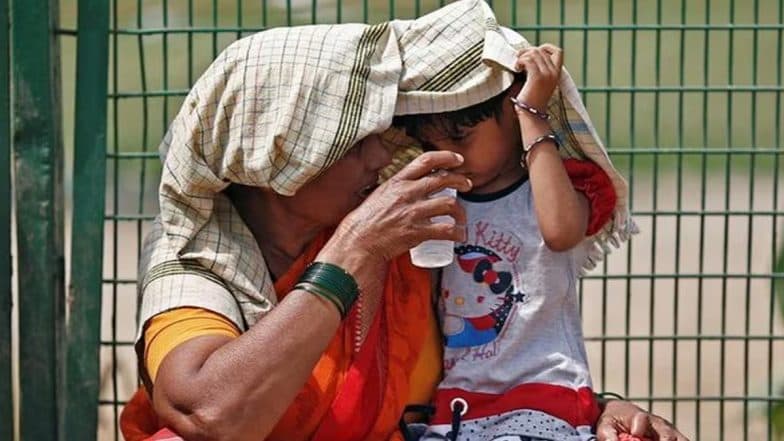
Severe heatwave conditions intensified across northwest, central, and parts of peninsular India on Sunday, May 24, with Brahmapuri in the Vidarbha region of Maharashtra recording the nation's highest temperature at 47.2 degrees Celsius. The India Meteorological Department (IMD) reported that while extreme temperatures are projected to persist for up to seven days across central and northwestern regions, a fresh weather disturbance is expected to bring gradual regional relief beginning May 29.
Maharashtra and Rajasthan Record Extreme Maximums
In Maharashtra, the Vidarbha region bore the brunt of the atmospheric system. Brahmapuri’s peak of 47.2 degrees Celsius stood at 4.6 notches above seasonal averages. Other regional urban centers hovered near the 45-degree mark, including Chandrapur at 45.6 degrees, Wardha at 45.5 degrees, Nagpur at 45.4 degrees, and Amravati at 45.2 degrees Celsius. Weather Forecast Today, May 24, 2026: Check Weather Updates, Rainfall and Heatwave Predictions for Mumbai, Delhi, Chennai, Bengaluru, Hyderabad, Kolkata and Shimla.
Simultaneously, desert plains across neighboring Rajasthan experienced prolonged thermal exposure, with temperatures fluctuating between 45 and 46 degrees Celsius. Sri Ganganagar registered as the state's hottest locality at 46 degrees Celsius, followed by Vanasthali at 45.1 degrees and Churu at 44.9 degrees Celsius. Regional monitoring hubs in Kota, Phalodi, and Bikaner each reached 44.8 degrees, while the state capital of Jaipur leveled at 43.6 degrees Celsius.
Delhi and Northern Plains Face Sustained Thermal Stress
The National Capital Region continued to experience significantly elevated temperatures, with Delhi's base observatory at Safdarjung logging a maximum of 43.6 degrees Celsius - 3.4 notches above the seasonal average. Internal variations across Delhi saw higher localized spikes, with both the Ridge and Ayanagar automated stations recording peak readings of 44.6 degrees Celsius, followed closely by Lodhi Road at 43.8 degrees and Palam at 43.7 degrees Celsius. In Punjab and Haryana, agrarian belts experienced similar conditions. Sirsa emerged as Haryana's hottest zone at 46 degrees Celsius, while Rohtak and Hisar documented highs of 45.3 degrees and 43.8 degrees Celsius, respectively. Urban centers like Gurugram reached 41.7 degrees, and the joint capital territory of Chandigarh recorded a high of 40.9 degrees Celsius.
High Temperatures Penetrate Central and Upper Uttar Pradesh
Further east, atmospheric data from Uttar Pradesh highlighted widespread heat coverage. Banda was recorded as the state's warmest district at 46.8 degrees Celsius, tracking 3.3 degrees above normal metrics. Major urban clusters including Prayagraj, Orai, and Jhansi each posted identical maximums of 45.6 degrees Celsius, while Agra reached 45.4 degrees. The capital city of Lucknow experienced suppressed diurnal cooling, with a maximum of 42.6 degrees Celsius and an elevated nighttime minimum of 28.7 degrees Celsius - more than three degrees above traditional baselines. Jammu Weather Update: Heatwave Pushes Temperature to 40°C, Rain Chances Persist Amid Humid Conditions.
Contrasting Conditions in Andhra Pradesh and Forecasted Relief
Southern regions reported dual weather patterns. The Andhra Pradesh State Disaster Management Authority issued a severe heatwave warning for the next three days across several districts. However, the agency noted that isolated peninsular pockets are simultaneously tracking incoming cloud cover, which is likely to trigger localized rainfall and thunderstorms. According to the IMD's central forecast, the broader heatwave will maintain its hold over Central and Northwest India for the next seven days, and over East India for the next three to five days.
However, meteorologists have identified an approaching western disturbance slated to alter regional tracking metrics by May 28 and 29. This system is projected to trigger strong thunderstorms, wind gusts ranging between 50 and 60 kmph, and light precipitation across sections of northern and western India. Officials expect the system "is likely to lower maximum temperatures by 2-3 degrees Celsius," breaking the current severe multi-state thermal cycle.
(The above story first appeared on LatestLY on May 24, 2026 10:28 PM IST. For more news and updates on politics, world, sports, entertainment and lifestyle, log on to our website latestly.com).