Why Madhya Pradesh High Court Commuted Death Sentence in Shahdol Toddler Rape-Murder Case
The Madhya Pradesh High Court commuted the death sentence of a man convicted of raping and murdering a toddler in Shahdol district, ruling the case did not meet the 'rarest of rare' threshold required for capital punishment, while upholding his underlying conviction. 'Human life is a precious gift of God', the court said.

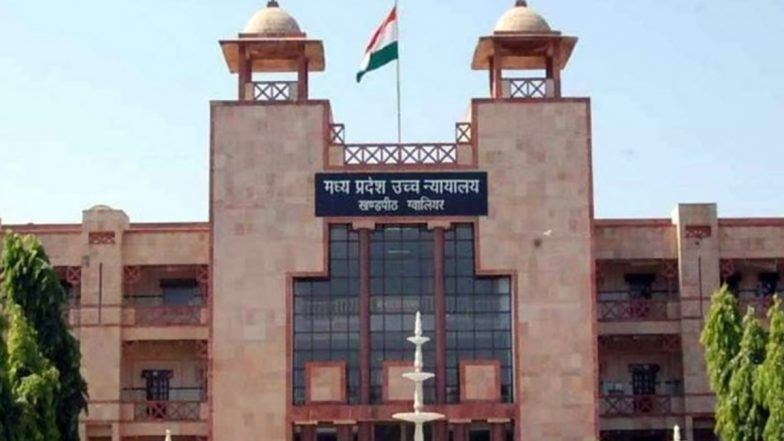
The Madhya Pradesh High Court has commuted the death sentence of a man convicted of raping and murdering a toddler in Shahdol district, ruling that the case did not meet the "rarest of rare" threshold required for capital punishment, while upholding his underlying conviction. A division bench comprising Justice Vivek Agarwal and Justice Avanindra Kumar Singh delivered the ruling while hearing a criminal reference for confirmation of the death sentence alongside appeals challenging the trial court's judgment.
The Special Judge under the POCSO Act in Budhar, Shahdol, had earlier convicted Ram Narayan alias Bhanu Dhimar under Sections 302, 201, and 506 Part-II of the IPC, read with Section 5(m)/6 of the POCSO Act, sentencing him to death, reports Law Beat. Can Husband's Focus on His Parents Justify Wife's Claim for Maintenance? Madhya Pradesh High Court Answers.
Prosecution Case and Trial Findings
According to the prosecution, the child's mother left her sleeping at Bhanu's house on the night of March 1, 2023, while she went to collect coal at a nearby colliery. Upon returning, she discovered her daughter bleeding with severe injuries. The child was taken to a hospital and later referred to Shahdol Medical College, where she died on March 7, 2023. The postmortem examination recorded a skull fracture alongside internal injuries, attributing death to a combination of head trauma and s*xual assault.
DNA profiling matched a recovered lower garment and bedsheet from the accused's house to the victim. While the trial court convicted Ram Narayan, it also convicted two other individuals, Rajkumar Dhimar and Pinky Dhimar, for criminal intimidation, while a fourth accused was acquitted after DNA matching yielded negative results.
High Court Observations and Legal Reasoning
Before the High Court, defence counsels argued discrepancies in medical statements and pointed to hostile prosecution witnesses, whereas the State defended the evidentiary chain. The bench observed that despite the severe nature of the crime, several mitigating factors warranted a reduction in sentence.
Highlighting that the 32-year-old convict had no prior criminal record, came from an economically weak background, faced social ostracisation due to an inter-caste marriage, and maintained normal jail conduct, the court concluded that the possibility of reformation could not be ruled out. Emphasising that "human life is a precious gift of God", the bench noted that the accused did not represent an ongoing menace to society necessitating capital punishment. Why Madhya Pradesh High Court Reduced a Man's Life Sentence to 7 Years for Killing His Pregnant Wife.
Final Verdict by Madhya Pradesh High Court
The High Court upheld the conviction of Ram Narayan but commuted his punishment from death to rigorous imprisonment for a minimum of 25 years without remission. Additionally, the court set aside the convictions of Rajkumar Dhimar and Pinky Dhimar under Section 506 Part-II IPC, acquitting them due to insufficient evidence.
(The above story first appeared on LatestLY on Sep 07, 2026 01:18 PM IST. For more news and updates on politics, world, sports, entertainment and lifestyle, log on to our website latestly.com).