Why PM Modi Urged Citizens To Work From Home and List of Countries That Slashed Office Days
PM Modi has advised a return to work-from-home and virtual meetings as a strategy for 'economic self-defense'. Unlike the pandemic, this shift aims to cut national fuel consumption and protect the Rupee amid high global oil prices. Pakistan and the Philippines have already mandated similar four-day workweeks to manage energy and currency risks.

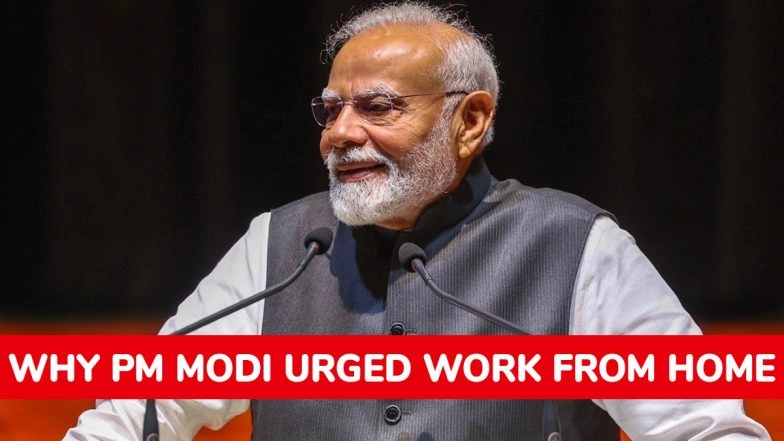
Mumbai, May 11: In a significant policy shift aimed at safeguarding the national economy against global volatility, Prime Minister Narendra Modi has appealed to citizens and businesses to revive "work-from-home" practices. Speaking in Hyderabad on May 10, PM Modi issued seven key appeals intended to reduce India's dependence on imported fuel and stabilise the economy as the ongoing West Asia conflict continues to disrupt global supply chains.
"During the pandemic, we developed systems for remote work and online meetings," Modi said. "Today, the demands of the times are such that restarting these systems is in the national interest." Why PM Modi Urged Citizens Not To Buy Gold for a Year: Economic Impact Explained.
PM Modi's 7 Appeals for Citizens
The Prime Minister’s suggestions were framed not as a mandatory lockdown, but as a voluntary movement to protect the country's foreign exchange reserves. The seven appeals include:
- Reviving Work-from-Home: Encouraging offices to adopt remote or hybrid models to cut down on daily commutes.
- Restraint in Fuel Use: Urging citizens to use petrol and diesel sparingly.
- Public Transport over Private Vehicles: Encouraging the use of Metro lines and buses.
- Adopting Carpooling: Reducing the number of individual vehicles on the road.
- Delaying Foreign Travel: Postponing non-essential international trips for at least one year.
- Avoiding Unnecessary Gold Purchases: Discouraging gold imports to help stabilize the Indian Rupee.
- Transitioning to Sustainable Energy: Moving toward electric vehicles (EVs) and natural farming to reduce chemical fertilizer imports.
Why Work From Home?
Unlike the 2020 lockdowns, the current push for remote work is a tactical move to lower the "national fuel bill." By reducing the millions of daily commutes in Tier-1 and Tier-2 cities, the government hopes to curb the consumption of imported petroleum. The Prime Minister noted that the infrastructure for digital collaboration - developed during the COVID-19 pandemic - is already in place and should be utilized to maintain productivity while reducing energy expenditure. ‘Ye Nakaami Ke Saboot Hain’: Rahul Gandhi Attacks PM Narendra Modi Over ‘Don’t Buy Gold, Use Less Petrol’ Appeal to Citizens.
Countries That Have Mandated Work-From-Home or Reduced Work Days
India is not alone in mandating or suggesting shifts in work culture to combat the current global energy shock. Several neighboring and regional countries have recently implemented similar or even stricter mandates:
- Pakistan: The government has introduced a four-day workweek for many public offices. Additionally, 50% of government staff have been mandated to work from home on a rotating basis to save on fuel and electricity.
- Philippines: Public officials have moved to a four-day workweek to reduce energy consumption by an estimated 10% to 20%.
- Indonesia and Myanmar: Indonesia now requires public-sector employees to work remotely on Fridays, while Myanmar has mandated remote work on Wednesdays.
- Thailand: Beyond encouraging remote work, the government has asked civil servants to wear short-sleeved shirts instead of suits to allow for higher air-conditioning temperatures in offices.
PM Modi's appeals highlight a growing concern over the "Hormuz shock," referring to disruptions in the Strait of Hormuz that have destabilized global supply chains. By acting as "guardians of the Rupee," citizens are being asked to help the government manage the current account deficit without resorting to more drastic economic measures.
While the Prime Minister’s suggestions remain voluntary for the private sector, they signal a significant shift in government policy, prioritizing economic resilience over "business as usual" during a period of global volatility.
(The above story first appeared on LatestLY on May 11, 2026 12:35 PM IST. For more news and updates on politics, world, sports, entertainment and lifestyle, log on to our website latestly.com).