Can TMC Merge With Congress? All You Need To Know About Political Party Merger Rules in India
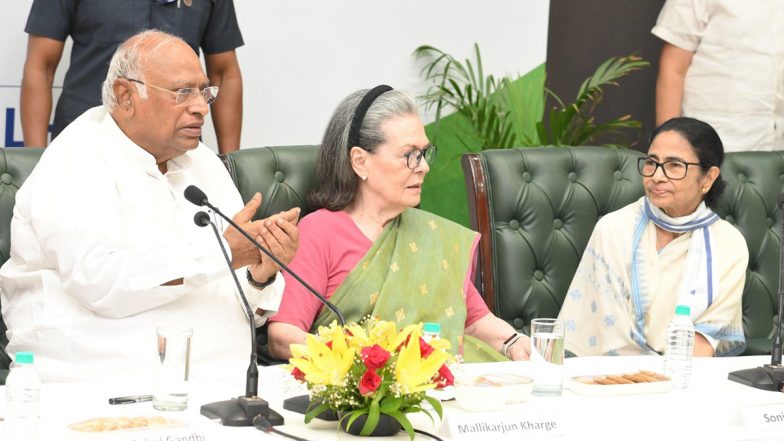
Speculation is rife that Mamata Banerjee could consider merging the Trinamool Congress with the Congress amid reports of growing dissent within her party. Fueling the buzz are her extended stay in New Delhi, nephew Abhishek Banerjee's meeting with Rahul Gandhi and her recent interaction with Sonia Gandhi, all seen as politically significant developments.

New Delhi, June 10: Intense political huddles within the INDIA bloc in New Delhi have triggered widespread speculation regarding a potential structural merger between the Trinamool Congress (TMC) and the Indian National Congress. While top leadership from both outfits have officially dismissed the reports as “rumour-mongering,” the development has put a spotlight on the stringent constitutional and statutory rules that govern the integration of political parties in India.
The speculation intensified following high-profile meetings between TMC chairperson Mamata Banerjee and Congress Parliamentary Party chief Sonia Gandhi, alongside a separate strategy session between TMC General Secretary Abhishek Banerjee and Leader of Opposition Rahul Gandhi. Though the interactions were publicly centered on strengthening opposition unity following the TMC's recent electoral setbacks and internal rebellion in West Bengal, experts note that any actual merger must cross high legal hurdles under India's anti-defection framework. Mamata Banerjee To Join Congress? Sonia Gandhi Proposes TMC-Cong Merger, Says Report.
The Constitutional Mandate: The Two-Thirds Rule
The primary mechanism regulating the merger of political parties is enshrined in the Tenth Schedule of the Constitution of India, commonly known as the Anti-Defection Law. Introduced via the 52nd Amendment in 1985, the law initially allowed for party "splits" if one-third of the legislators broke away.
However, to curb frequent political instability, Parliament passed the 91st Constitutional Amendment Act in 2003. This amendment completely deleted the provision recognizing minor splits, leaving a wholesale merger as the only viable legal shield against disqualification. What Did Sonia Gandhi Offer To Mamata Banerjee and Abhishek Banerjee for TMC-Congress Merger?
Under Paragraph 4 of the Tenth Schedule, an elected Member of Parliament (MP) or Member of the Legislative Assembly (MLA) is exempted from disqualification only if their original political party merges with another, and at least two-thirds of the members of the legislature party agree to the merger.
Paragraph 4, Tenth Schedule: A lawmaker will not face disqualification if their original political party merges with another, provided not less than two-thirds of the members of the legislature party have agreed to such a merger.
The Separation of Wings: Organisational vs. Legislative
In recent years, the execution of political mergers has faced severe scrutiny over the distinction between a party’s organizational wing (the office-bearers and general body) and its legislative wing (the elected MPs and MLAs).
Historically, some factions have bypassed the organizational leadership by gathering two-thirds of the elected lawmakers to claim a "merger" or a takeover of the original party. However, recent legal precedents and expert interpretations emphasize that a valid merger requires a dual-step process:
-
The Organisational Merger: The primary political party must first formally resolve to merge with or into the recipient party under its own constitution.
-
The Legislative Consent: Following the organizational decision, at least two-thirds of the elected representatives in the House must give their formal consent to join the new entity.
If fewer than two-thirds of the lawmakers agree to switch, those who cross over face immediate disqualification proceedings before the Presiding Officer (Speaker or Chairman) of the respective House.
The Role of the Election Commission
While the Presiding Officer of the House decides on the disqualification of individual legislators, the structural registration, symbol allocation, and recognition of the merged entity fall under the jurisdiction of the Election Commission of India (ECI).
Under the Representation of the People Act and the Election Symbols (Reservation and Allotment) Order, 1968, the ECI is the sole authority empowered to decide which faction retains the original party name and symbol in the event of a dispute or an incomplete merger. If a full merger is ratified by both the organizational and legislative wings, the ECI formally updates its records, and the outgoing party's symbol is either frozen or absorbed.
Context Behind the Current Speculation
The legal scrutiny comes at a turbulent time for the Trinamool Congress. Following a highly contested election cycle in West Bengal, the party has dissolved all its local organizational committees to manage internal dissent and counter a growing rebellion among its legislative wing.
Rebel lawmakers within the TMC have reportedly explored forming separate blocs, prompting senior party leaders to challenge dissidents to resign and seek a fresh mandate rather than engineering a backdoor defection. Consequently, political observers view the high-level coordination with the Congress as a strategic effort to stabilize opposition fronts, even as both parties maintain that their current relationship is strictly an alliance rather than an active legal merger.
(The above story first appeared on LatestLY on Jun 10, 2026 08:27 PM IST. For more news and updates on politics, world, sports, entertainment and lifestyle, log on to our website latestly.com).