Ambubachi Mela 2025 Dates and Start Time: Know Rituals, Cultural Significance and Divine Legend of Shakti Peetha Kamakhya Temple As the Annual Hindu Festival Begins in Guwahati
Ambubachi Mela is not just a festival, but a recognition of nature’s biological phenomenon. The goddess’ menstruation is considered a sign of creation and change. The auspicious festival starts with sacred bathing and Nitya Puja.

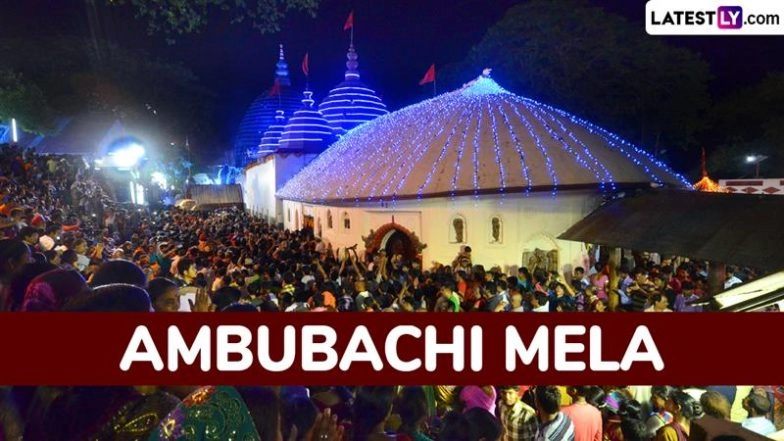
One of the most-awaited festivals in Assam, Ambubachi Mela 2025, has begun. The festival revolves around celebrating the annual menstruation course of Goddess Kamakhya. Thousands of devotees have arrived in Assam for the grand festivity. But what makes Kamakhya Temple’s Ambubachi Mela so special that each year, it attracts devotees worldwide? Situated on the Nilachal Hills in Guwahati, Assam, the Kamakhya Temple is a representation of divine feminine and spiritual power. Of the 51 Shakti Peethas, this holy place does not have an idol of the presiding deity, but she is worshipped in the form of a yoni-like stone over which a natural spring flows. In this article, let us understand the Ambubachi Mela 2025 dates, start timing, rituals, cultural significance and divine legend to honour the auspicious Hindu festival in Guwahati.
Ambubachi Mela 2025 Dates and Start Time
Ambubachi Mela 2025 started on June 22 and will continue until June 26. According to the Kamakhya temple authorities, the doors were closed at 02:56 PM on June 22 with the start of ‘prabritti’ and the worshipping will resume after 03:19 AM, the early hours of June 26, after ‘nribritti.’ During the four days of Ambubacha mela the Kamakhya Temple doors are closed.
During this time, grand festivities are held outside the temple, with devotees seeking divine blessings and Sadhus and Aghoris following deep spiritualism. Meanwhile, with the temple doors closed for a few days, it is believed that Goddess Kamakhya rests for these days as she undergoes menstruation during this time. The festival further urges one to think about the cycle of birth, rebirth and holiness of natural existence. Menstruation Festivals and Puberty Ceremonies in India: Tuloni Biya, Ritu Kala Samskaram, Manjal Neerattu Vizha and Other Sacred Rituals Honouring Women’s Menstrual Cycle.
Ambubachi Mela Rituals, Cultural Significance and Divine Legend
Assam’s Kamakhya Temple is considered one of the 51 Shakti Peethas. Mythological legends link its origin to the yoni of Goddess Sati, Lord Shiva’s consort, falling on Nilachal Hills, where the temple stands. Kamakhya is also mentioned as the most important Goddess of Tantric worship. The festival of Ambubachi Mela is held annually during the monsoon at the Kamakhya Temple in Guwahati. It is believed to be the period of the goddess’ annual menstruation, and the shrine is closed during this time. The festival is further associated with fertility, with the onset of monsoon and the common historical connection across cultures as a fertile woman. The name ‘Ambubachi’ in itself translates to ‘water flowing.’
Ambubachi Mela is not just a festival, but a recognition of nature’s biological phenomenon. The goddess’ menstruation is considered a sign of creation and change. The auspicious festival starts with sacred bathing and Nitya Puja. The temple is closed during these days, representing rest, cleansing, and respect for the woman's cycle. As the temple reopens, the temple is cleansed, and devotees are allowed to enter again. It is celebrated with fanfare, offerings and prayers.
Where taboos around menstruation in India result in shaming and prohibition, Ambubachi Mela offers a deep understanding of the biological change in a woman. The festival’s ‘Rakta Vastra’, a small piece of cloth believed to be stained with the blood mark of the Goddess, are distributed to the devotees and pilgrims and reflects on feminine power. Both women and men are allowed to participate in the celebration—a reminder of nature’s feminine power and spiritual awakening.
(The above story first appeared on LatestLY on Jun 23, 2025 01:46 PM IST. For more news and updates on politics, world, sports, entertainment and lifestyle, log on to our website latestly.com).