How Do Clear Aligners Work?
Before starting with the process of getting dental braces, from consultation to removal, it is worth understanding how teeth aligners, or invisible aligners, work, how much they cost, and who they are best suited for.

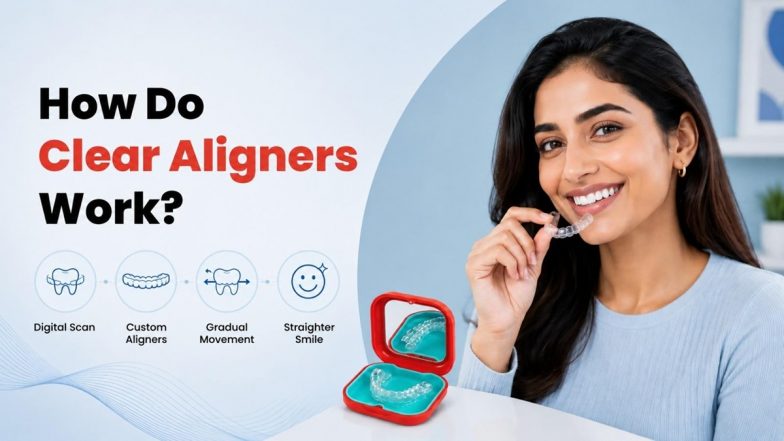
A 2025 study published in the Journal of Pharmacy and Bioallied Sciences reported that patients undergoing orthodontic treatment with teeth aligners (invisible aligners) expressed greater satisfaction with their treatment journey, particularly regarding comfort, appearance, and overall outcomes. Nowadays, many adults are choosing clear aligners to manage their severe or complex orthodontic issues.
As demand for discreet orthodontic treatment continues to grow, invisible aligners have become a popular choice for people who want to straighten their teeth without the visibility and lifestyle adjustments often associated with teeth braces.
Before starting with the process of getting dental braces, from consultation to removal, it is worth understanding how teeth aligners, or invisible aligners, work, how much they cost, and who they are best suited for.
How Do Clear Aligners Work To Straighten Teeth?
Invisible aligners, also known as teeth aligners, are a modern orthodontic treatment appliance used to straighten misaligned teeth, consisting of a series of clear, custom-made trays that fit closely over the teeth.
Each set of invisible aligners applies gentle, controlled pressure to specific teeth, guiding them into the desired position over time.
Who Is A Suitable Candidate For Invisible Aligners?
- Complex to severe crowding: If you have complex to severe orthodontic crowding, invisible aligners are perfect for you
- Gaps between teeth: If you have small to moderate spacing between your teeth, clear aligners can help improve it.
- Severe to Moderate Overbites: An overbite is a condition in which the upper front teeth overlap the lower front teeth more than normal. While a slight overlap is natural, an excessive overbite can affect the smile's aesthetics and, in some cases, contribute to uneven teeth. wear. Clear aligners can gradually reposition the teeth and improve the way the upper and lower arches meet.
- Crossbite: A crossbite occurs when one or more upper teeth sit behind the lower teeth rather than overlapping them properly. This can affect the front teeth, back teeth, or both and may lead to uneven tooth wear over time. Invisible aligners can help fix a crossbite.
While clear aligners can effectively treat many alignment concerns, some orthodontic conditions may require additional appliances for optimal results.
In such cases, brands like Toothsi also offer specialized solutions, including the patented Digital Twin Block and AMPA (Advanced Mandibular Positioning Appliance), which orthodontists may recommend for specific bite and jaw alignment issues.
These innovations help expand treatment options for patients with more complex orthodontic needs through personalized treatment planning.
How To Prepare For Your First Aligner Appointment?
Before you begin aligner treatment, there are a few things you must consider to understand what the treatment journey will look like and the essential steps you need to take to maintain your results.
1. Consistency Matters More Than Anything Else
- When you have undergone teeth aligner treatment, after your treatment, you must wear aligners for 20 to 22 hours a day (can be removed at the time of brushing, eating, and drinking)2. The First Few Days May Feel Different
- When you start your treatment journey with clear aligners, you might experience mild pressure or tightness with the initial sets, which usually indicates the aligners are working.
- Soreness is common for the first 2 to 3 days of each cycle, especially when switching trays. 3. Treatment Timelines Vary From Person to Person
- Treatment time depends on case complexity; severe to complex crowding or spacing usually moves faster than more complex bite problems.
- Compliance also affects outcomes because aligners that are not worn long enough do not move teeth on schedule.
- Some patients notice changes early, while others see results more gradually over several months.
- Follow-up monitoring matters because dentists may need to check progress, refine the plan, or add extra aligners if small adjustments are still needed.
Payment Plans For Teeth Aligner Treatments In India
The cost of invisible aligners ranges from ₹50,000 to ₹4,00,000, depending on the case complexity, treatment duration, and the number of aligners required.
Clear aligner provider brands such as Invisalign cost between ₹1,50,000 and ₹3,50,000, while brands like Flash Aligners cost between ₹60,000 and ₹95,000. In comparison, the price of clear aligners at Toothsi starts at ₹52,999, with student pricing from ₹42,999 and EMIs starting at approximately ₹1,499 per month.
By leveraging world-class in-house aligner manufacturing and a digital-first treatment model, Toothsi offers orthodontist-led clear aligner treatment at a significantly lower price point than many international brands, making aligner treatment accessible without requiring patients to pay 3 to 4 times more for comparable orthodontic outcomes.
The Importance Of Retainers After Aligner Treatment
Once the aligners are removed, the treatment journey is not completely over. Teeth have a natural tendency to shift back over time, especially if they are not supported after treatment, and this is where retainers are suggested as an essential part of finishing an aligner journey.
Now, as readers, you might have thoughts like:
- Why do teeth naturally tend to shift after aligner treatment?
Once the aligner treatment is completed, teeth are held in place by tissues that need time to stabilize after movement. Without support, they can slowly drift out of position again.
- Why do we need retainers?
Retainers help keep the teeth in their new alignment and protect the results achieved during treatment. Retainers are advised, as they help to maintain a straight smile for the long term and reduce the risk of relapse.
Wrapping Up
Aligners have transformed the way people approach smile correction plans and aligner treatments. Teeth aligners offer a discreet and convenient alternative to traditional braces. However, achieving the best results depends on more than just choosing aligners; it requires a professional assessment, consistent wear, diligent oral hygiene, and proper retainer use after treatment. Patients looking to get aligner treatment can visit the best aligner provider in India, such as Toothsi, with over 3 lakh improved smiles, flexible EMI options, and thousands of positive patient reviews across India. They show how modern aligner treatment can be both accessible and clinically supported.
(All articles published here are Syndicated/Partnered/Sponsored feed, LatestLY Staff may not have modified or edited the content body. The views and facts appearing in the articles do not reflect the opinions of LatestLY, also LatestLY does not assume any responsibility or liability for the same.)