Is That an iPhone? 1937 Painting Resurfaces With Bizarre Time Travel Theory
A 1937 painting by Umberto Romano has resurfaced online after social media users claimed an Indigenous man depicted in the artwork appears to be holding a modern smartphone. Theories that the image proves time travel have spread online, but historians believe the mysterious rectangular object is more likely a mirror, a common trade item in the 17th century.

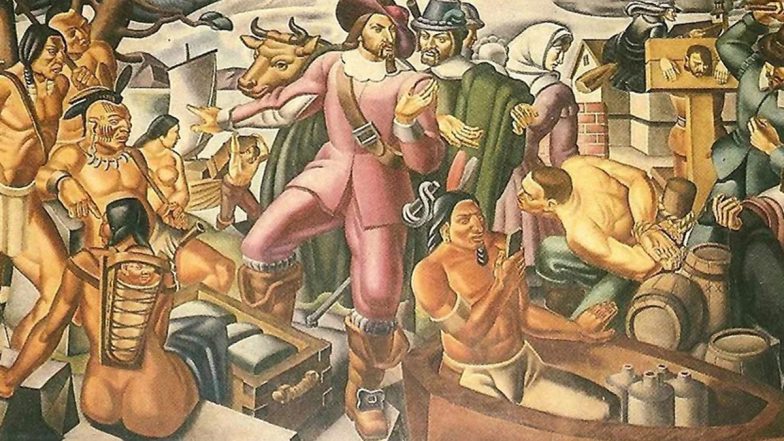
A nearly 90-year-old painting has resurfaced online and sparked a bizarre theory that it may contain evidence of time travel. Umberto Romano’s 1937 work, Mr Pynchon and the Settling of Springfield, shows an Indigenous man holding a small rectangular object that some social media users say looks remarkably similar to a modern smartphone.
The painting depicts events surrounding the establishment of Springfield, Massachusetts, in the 17th century. While online users have questioned whether the object could be a phone or even an iPhone, historians have offered a considerably less futuristic explanation: it is likely a mirror, an item that was commonly traded in the colonies during that period, Daily Mail reported. Renoir Museum Heist: Thieves Steal 3 Paintings Worth USD 10 Million From French Riviera Museum, 1 Dropped During Chase.
Mr. Pynchon and the Settling of Springfield
iPhone discovered in 1937 painting (see red arrow).
Source: Mr. Pynchon and the Settling of Springfield by Umberto Romano, Commonwealth of Massachusetts State Office Building, formerly the original Post Office, Springfield, Massachusetts, https://t.co/AOKxtB2BY1 pic.twitter.com/YTvoSn0sdM
— Cliff Pickover (@pickover) March 17, 2026
Why The Painting Is Going Viral
The detail drawing attention is an Indigenous man positioned prominently in the foreground of the painting. He appears to be holding a dark, rectangular object with lighter or reflective edges while looking toward its upper portion. To modern viewers, the posture can resemble someone looking at a smartphone.
One person said: 'Now that one actually looks like a cell phone.' Another viewer asked: 'Is that an iPhone?' The unusual appearance of the object has revived speculation that Romano may have unintentionally, or deliberately, depicted an item that would not exist for centuries. However, there is no evidence that the painting depicts a smartphone or that it provides evidence of time travel. Raja Ravi Varma’s ‘Yashoda and Krishna’ Sells for INR 167 Crore, Sets New Record in Indian Art Market.
Historians Say The Object Is Likely A Mirror
Historians have generally identified the object as a European trade mirror. Mirrors were known trade goods in 17th-century North America, making their presence in a scene involving English colonists and Indigenous people historically plausible.
The man's pose also provides a clue. He appears to be holding the object up and looking into it, which is consistent with someone examining a reflection. Historian Daniel Crown made the same interpretation in 2017, identifying the mysterious object as a European trade mirror.
That explanation also fits the broader context of Romano's painting, which portrays exchanges between English settlers and Indigenous communities rather than a scene featuring unexplained technology.
What Does The Painting Actually Depict?
Mr. Pynchon and the Settling of Springfield was created by Italian-born American artist Umberto Romano in 1937. The mural was one of six New Deal-era works depicting the history of Springfield, Massachusetts, where Romano grew up.
The painting depicts William Pynchon, one of the founders of present-day Springfield, interacting with Indigenous people in a representation of the settlement's early history. Pynchon acquired land that would become Springfield from the Agawam Native Americans in 1636. The artwork includes several figures representing the interactions between English colonists and Indigenous communities. Other elements show people, animals and goods associated with the settlement.
Unlike the supposed smartphone, those objects are broadly consistent with the historical setting.
The mural was not simply intended to portray one isolated moment. According to historical information about the work, Romano consulted local historian Harry Andrews Wright and author Esther Forbes while developing the mural. The goal was to depict the region's development between 1636 and 1936.
The painting therefore functions as a broad visual account of Springfield's history rather than a literal snapshot of one particular day. Romano created the mural with students as part of the Federal Arts Project, a government program established during the Great Depression that employed visual artists. The mural was created for the Springfield Main Post Office, now the Commonwealth of Massachusetts State Office building.
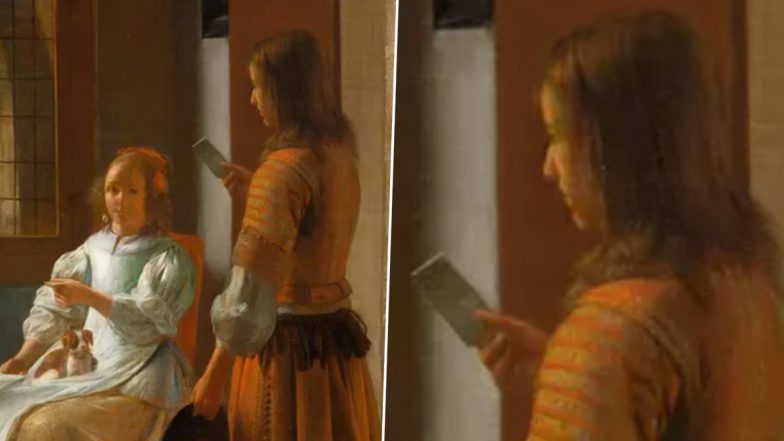
The Romano painting is not the only historical artwork to become part of online time travel theories. A 19th-century painting by Austrian artist Ferdinand Georg Waldmüller, The Expected One, has similarly attracted attention because a woman walking along a path appears to be looking down at a small rectangular object.
Conspiracy theorists have compared her posture to the way people today walk while looking at their smartphones. The object, however, could simply be a book or another item appropriate to the period. An ancient Greek sculpture has also been repeatedly cited online as supposed evidence of advanced technology in antiquity.
The Grave Naiskos of an Enthroned Woman with an Attendant, dating to around 100 BC, has been claimed by some internet users to depict a laptop, with alleged USB ports. Again, such interpretations are speculative and are not accepted as evidence that time travelers visited the ancient world.
Viral ‘Time Traveler’ Claims Add To The Theory
The renewed attention around Romano's painting comes amid a wider stream of internet content involving alleged time travelers. Several individuals have appeared in viral interviews claiming to have traveled from the future or saying that governments possess time-travel technology.
One masked man who identified himself as Alexander Smith claimed in a recording to be a former CIA member from 1981 who was recruited to travel to the year 2118. Smith also claimed that time travel technology had existed for decades and would become available to the public beginning in 2028. He further alleged that 2028 would be "the same year in which the government discloses the existence of intelligent extraterrestrials," claiming authorities had possessed knowledge of aliens "for some time previous" to the announcement. There is no evidence supporting these claims.
Why The Smartphone Theory Persists
The appeal of the theory largely comes from the object's resemblance to technology familiar to people today. The dark rectangular shape, reflective border and the figure's apparent focus on the object can make the image look surprisingly contemporary when viewed outside its historical context.
But resemblance alone does not establish what the artist intended to depict. The presence of mirrors as trade goods, combined with the subject's posture and the historical setting, provides a straightforward explanation for the object without requiring a time-travel hypothesis.
The painting's renewed popularity demonstrates how historical artwork can take on new meanings when viewed through a modern technological lens. For social media users, the mysterious object may look like a smartphone. For historians examining the painting in its 17th-century context, however, a trade mirror is a far more plausible explanation. There is currently no credible evidence that Mr Pynchon and the Settling of Springfield documents a time traveler or a smartphone in colonial-era America.
(The above story first appeared on LatestLY on Sep 09, 2026 10:06 AM IST. For more news and updates on politics, world, sports, entertainment and lifestyle, log on to our website latestly.com).