How Gravitational Pull of Sun and Moon Triggers ‘Slow Earthquakes’ on Earth
A new study in JGR Solid Earth reveals how the gravitational pull of the Sun and Moon triggers slow earthquakes through resonance, despite exerting stress comparable to a gentle hand press. Using rate-and-state friction models, researchers showed how tidal rhythms align with fault response times, offering crucial data to assess future megathrust earthquake risks.

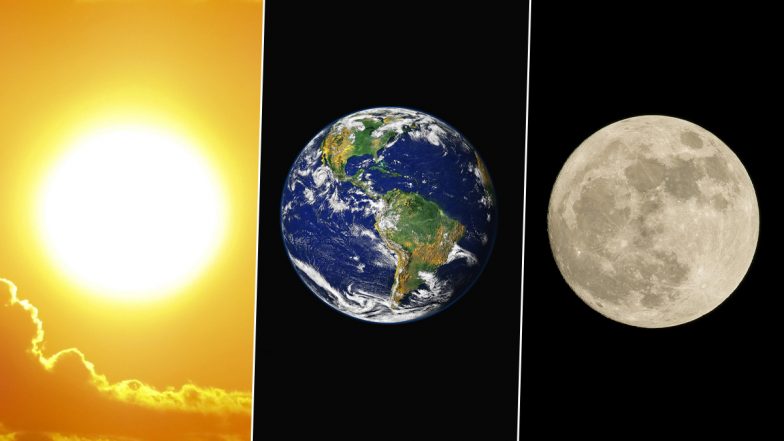
The gravitational tug of the Sun and Moon does not merely govern ocean tides; it also exerts constant tidal stresses on Earth's solid crust and rock, triggering imperceptible "slow earthquakes" along tectonic fault lines. In a new study published in the journal JGR Solid Earth, a team of geo-planetary scientists has modeled these tidal perturbations, demonstrating that minute gravitational forces can trigger slow slip events through planetary-scale resonance.
"Although these stresses are very small, typically of the order of a few kilopascals and comparable to the pressure from a gentle hand press, they have been observed to trigger slow earthquakes on some faults," the researchers stated. The breakthrough simulation demonstrates how a minor external force can nudge a delicately balanced tectonic fault into motion, analogous to running a wet finger around the rim of a wine glass to produce a sustained resonant tone. Scientists Detect Radio Signals Originating From Exoplanet Beta Pictoris b in Potential Milestone Discovery.
Spring-Block Simulations and Rate-and-State Friction
To analyze the slipping, sliding, and grinding that occurs at tectonic plate interfaces, the research team deployed numerical simulations using a spring-block model governed by rate-and-state friction. This computational framework models an isolated fault patch while tracking changing frictional resistance based on two primary factors: fault velocity (rate) and microscopic contact time between rock faces (state).
The researchers focused on faults that slide at a stable rate but remain sensitive to minor external disturbances. When a subtle gravitational tidal stress accelerates fault velocity, the frictional resistance across the fault interface decreases. This reduction amplifies the displacement, generating sufficient slip in the model to trigger both slow-slip events and faster seismic movements. UFO Caught on Video? 'Mystery' Object Appears on SpaceX Starship Livestream, Grok Dismisses Alien Theories.
Resonance and Natural Response Timescales
The nature of the seismic event depends primarily on the fault's frictional properties as it responds to two variables: the amplitude (strength) and the period (duration) of the tidal perturbation. While low amplitudes allow a fault to continue sliding quietly, exceeding a critical threshold causes the fault to slip and rumble if the period falls within a specific operational window.
Seismic movement is activated when the duration of the tidal perturbation aligns with a fault's "natural response timescale"—the duration required for the fault interface to react to stress changes and modify its frictional resistance. This resonance can trigger a slow event even if the perturbation is slight, "much like pushing a swing at the right rhythm makes it move higher," the researchers say. The findings align with real-world observations, such as tremors in southwest Japan and the Cascadia subduction zone in the Pacific Northwest, which often peak at 12- and 24-hour tidal intervals, though perturbations can also generate more chaotic seismic activity.
Timing Patterns and Assessing Megathrust Earthquake Risks
The study evaluated three potential timing mechanisms for tide-induced seismic events: peak tidal stress, maximum tidal stressing rate (when pressure rises fastest), or random occurrences. The simulation confirmed that both peak stress and maximum stress rate trigger seismic slips, with the exact outcome determined by the phase of the tidal cycle and the fault's mechanical properties.
Because researchers have detected slow earthquakes across the exceptionally active subduction zones of the Pacific Rim, the team notes that these events "provide valuable insights into stress accumulation and release along plate interface, and are therefore highly relevant for assessing the rupture potential and spatial extent of future megathrust earthquakes." By matching known tidal cycles to detected seismic signals, seismologists can reverse-engineer fault properties, offering a vital framework to aid long-term forecasting of catastrophic megathrust quakes and associated tsunamis.
(The above story first appeared on LatestLY on Sep 29, 2026 05:07 PM IST. For more news and updates on politics, world, sports, entertainment and lifestyle, log on to our website latestly.com).