What Is Donald Trump’s Iran War Exit Plan? Why Strait of Hormuz Could Replace Nuclear Deal
US President Donald Trump is reportedly considering ending the Iran conflict without securing a nuclear deal if Tehran fully reopens the Strait of Hormuz. But Iran has demanded an end to the US naval blockade, withdrawal of American forces, sanctions relief, release of frozen assets and war reparations, complicating Washington’s efforts to find a quick, face-saving exit.

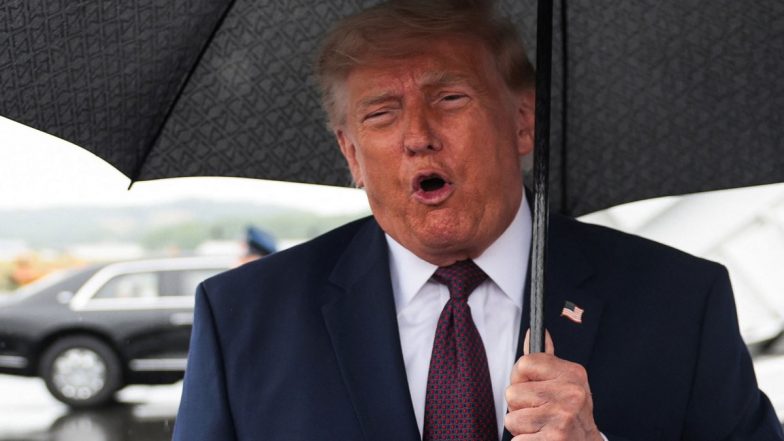
US President Donald Trump is weighing an exit from the Iran conflict that could allow him to declare victory without securing a new nuclear agreement, with the reopening of the Strait of Hormuz emerging as a possible condition for ending the war, according to The Wall Street Journal. The approach has become more difficult after Tehran laid out sweeping demands, including an end to the US naval blockade, withdrawal of American forces and financial compensation.
The Strait of Hormuz has become a central point of leverage in the conflict. Iran's ability to disrupt shipping through the strategic waterway has affected commercial traffic and global energy markets, while the Trump administration has faced pressure to restore the flow of oil and gas. Tehran's latest demands have raised doubts over whether Washington and Tehran can reach a quick settlement. Is US Running Out of Air Defence Missiles? Patriot and THAAD Stockpiles Hit by Iran War, Says Official.
Donald Trump’s Exit Strategy Runs Through Hormuz
Iran's ability to restrict traffic through the narrow strait using missile and drone attacks has given Tehran significant leverage. The disruption has slowed commercial shipping and contributed to volatility in global oil markets.
Trump has repeatedly said in recent weeks that the strait was fully open, but those declarations have proved premature. Tehran shut the waterway after the war began in February and has insisted that American warships and its allies should not be permitted to pass through it. Iran War to End 'Pretty Soon': Donald Trump Says Tehran Can't Sustain Conflict for Much Longer (Video).
Iran has also sought to collect revenue from commercial vessels using the route. US officials have said Washington rejects both Iranian restrictions and any attempt to impose tolls on shipping.
The latest developments have complicated Trump's effort to make the reopening of Hormuz the centrepiece of a possible exit from the conflict. The WSJ reported that Trump had privately told senior aides he could walk away without obtaining a nuclear agreement if Tehran fully restored passage through the strait.
Iran Sets Out Broad Conditions
The situation deteriorated further after Iran presented a broad list of conditions for reopening the waterway.
Mohammad Bagher Zolghadr, secretary of Iran's Supreme National Security Council, said the US would have to permanently end the war, lift its naval blockade, withdraw American forces, remove all sanctions, release Iran's frozen assets and pay war reparations.
He also demanded an end to US threats and insults and a halt to American military action against Iran's militia allies across the region, according to Iran's state news agency IRNA.
The demands represent a significantly higher price for reopening the strait and make an immediate agreement more difficult.
Trump Looks for a Way to Declare Victory
Domestic political considerations are also shaping the administration's calculations. With the US midterm elections approaching and petrol prices higher than before the conflict began, Trump has been looking for a way to demonstrate that the military campaign achieved its objectives.
In recent days, Trump told reporters he had been prepared to launch the biggest military attack since World War II, but said US allies persuaded him not to do so. He also said a deal with Iran was "imminent", although no agreement has emerged.
On Friday, Trump appeared to suggest that victory had already been achieved even without a nuclear agreement. He shared a social media post linking to an article titled "Donald Trump Won the Iran War".
Vice President JD Vance, meanwhile, said the administration would continue pressuring Tehran to make long-term changes in its relationship with Washington.
"And if not, that's fine, too, we're just going to keep on applying the pressure we can apply, and getting as much oil and gas out of the Middle East so that Americans can enjoy lower gas and energy prices." "We're in the middle of the game," Vance said.
Nuclear Deal May Take a Back Seat
The nuclear issue has remained at the centre of US-Iran tensions since April, when the White House warned that Tehran would never be allowed to obtain a nuclear weapon.
Trump initially sought to make nuclear negotiations part of an agreement with Iran. As talks became more difficult, however, the administration placed greater emphasis on restoring maritime traffic through the Strait of Hormuz.
According to The Wall Street Journal, Trump has privately told senior aides in recent weeks that he believes Iran may be unable to restart its nuclear programme during his presidency after the US destroyed three major Iranian nuclear facilities in May 2025.
Trump has also argued in meetings that US intelligence capabilities would detect any attempt by Iran to rebuild the facilities or secretly develop a nuclear weapon. He believes the threat of renewed US military action would act as a lasting deterrent.
Trump has also downplayed concerns about Iran's buried uranium stockpile. "We've already got the nuclear material, because it's so far underground," Trump said during a July summit of the North Atlantic Treaty Organization. "Nobody's going to be able to get it except us."
The calculations could allow Trump to shift the focus away from securing a nuclear agreement if Iran agrees to restore shipping through the strait and the threat from its nuclear programme remains contained.
Money Could Become a Major Obstacle
Financial concessions are likely to be one of the biggest obstacles to any agreement.
Iran is seeking billions of dollars in war reparations and wants its frozen overseas assets released. Trump has previously said his administration would not allow American taxpayers' money to be handed to Iran.
US officials cited by The Wall Street Journal said, however, that reaching an agreement could prove difficult without Washington agreeing to unfreeze at least some Iranian assets, potentially subject to conditions.
Another potential point of contention is whether the US would grant sanctions waivers allowing Iran to sell oil on international markets.
Such waivers could give Tehran access to additional revenues while helping restore energy flows disrupted by the conflict. But agreeing to them could also expose the Trump administration to criticism from lawmakers and political supporters who favour maintaining maximum pressure on Iran.
Why Hormuz Matters
The Strait of Hormuz is one of the world's most important energy corridors. Any prolonged disruption to shipping through the waterway can affect oil and gas supplies, freight costs and fuel prices well beyond the Middle East.
That gives Iran considerable negotiating leverage while also increasing the pressure on Washington to find a way to restore freedom of navigation.
The latest Iranian demands, however, suggest that Tehran may be seeking more than a simple reopening of the waterway. The conditions include military, economic and political concessions that would significantly alter the terms of the conflict.
What Happens Next?
For Trump, the challenge is balancing the need to end the conflict with the political requirement to present the outcome as a success.
For Iran, the reopening of Hormuz provides leverage to seek sanctions relief, financial compensation and a reduction in the US military presence in the region.
The two positions remain far apart. While Washington wants the waterway reopened without accepting Iranian control or tolls, Tehran has tied full reopening to a much broader package of demands.
That leaves the Strait of Hormuz at the centre of the next phase of the conflict, with the possibility of a diplomatic settlement dependent not only on the nuclear issue but also on whether the two sides can bridge their differences over shipping, sanctions, military deployments and financial compensation.
(The above story first appeared on LatestLY on Aug 09, 2026 08:18 PM IST. For more news and updates on politics, world, sports, entertainment and lifestyle, log on to our website latestly.com).