What Is Section 301 of the US Trade Act? Why India Could Face a 12.5% Additional US Tariff
As India and the United States continue negotiations on a proposed bilateral trade agreement (BTA), the Office of the United States Trade Representative (USTR) has identified India among countries that allegedly lack adequate measures to prevent the import of goods produced using forced labour.

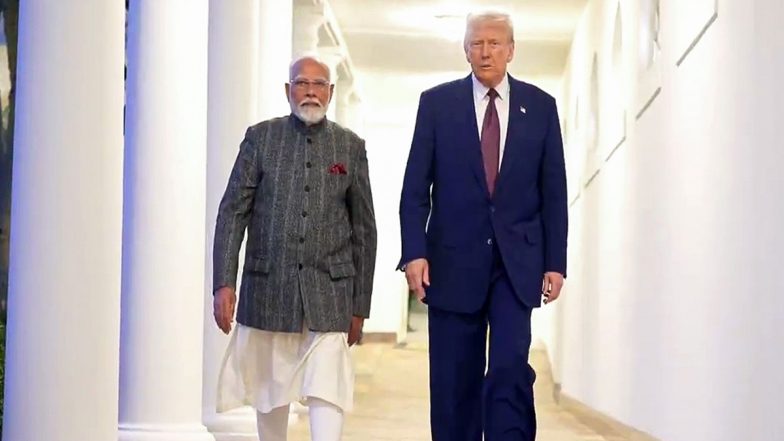
New Delhi, June 3: As India and the United States continue negotiations on a proposed bilateral trade agreement (BTA), the Office of the United States Trade Representative (USTR) has identified India among countries that allegedly lack adequate measures to prevent the import of goods produced using forced labour. The findings were released as part of multiple investigations conducted under Section 301 of the US Trade Act of 1974, raising concerns over the possibility of additional tariffs on imports from affected countries.
What Is Section 301 of the US Trade Act of 1974?
Section 301 is a provision under the US Trade Act of 1974 that authorises the United States Trade Representative (USTR) to investigate the trade policies, practices and actions of foreign governments. The purpose is to determine whether such measures are unfair, discriminatory or place an unreasonable burden on US trade and commerce. US Proposes 12.5% Tariff on 60 Countries, Including India, Over Forced Labour To Produce Imported Goods.
If the USTR concludes that a country's policies adversely affect American businesses or workers, the US administration can take corrective action. These measures may include imposing higher tariffs, restricting imports or introducing other trade-related penalties.
Why Has India Been Named in the USTR Investigation?
According to the USTR, India is among 54 economies that have allegedly failed to impose and effectively enforce a prohibition on the importation of goods produced with forced labour.
The agency stated that countries with existing bans on such imports, or those that commit to implementing similar restrictions under reciprocal trade arrangements, could face an additional tariff of 10%. Countries that do not meet these conditions may be subjected to a higher tariff of 12.5%. India-US Trade Deal: Washington Issues Updated Trade Framework Fact-Sheet, Drops Pulses and Agriculture References; Says India ‘Intends’ to Buy 500 Billion USD of US Products.
The USTR has indicated that it intends to pursue responsive trade actions based on the findings of the investigations.
What Did the USTR Say?
US Trade Representative Ambassador Jamieson Greer said that the failure of key trading partners to address imports linked to forced labour creates an uneven global trading environment.
According to the USTR, such practices force American workers and businesses to compete on what it describes as an unfair playing field, prompting the need for stronger trade enforcement measures.
How Could Section 301 Impact India?
The latest development comes at a crucial time as India and the United States are attempting to finalise the first phase of a bilateral trade agreement.
Any additional tariffs imposed under Section 301 could affect the competitiveness of Indian exports in the US market. New Delhi is particularly focused on ensuring that Indian products maintain a favourable tariff position compared with competing exporting nations.
India has also expressed concerns regarding ongoing Section 301 investigations, including probes related to alleged structural overcapacity in sectors such as steel, aluminium, solar modules and processed food.
What Is the Status of India-US Trade Deal Talks?
Commerce and Industry Minister Piyush Goyal recently said that most aspects of the proposed bilateral trade agreement have already been finalised, with negotiations now focused on resolving minor outstanding issues.
According to Goyal, nearly all provisions of the agreement have been settled, and discussions are currently centred on legal and technical adjustments, including changes resulting from recent developments in US trade policy.
A US trade delegation is currently in New Delhi for a fresh round of discussions aimed at advancing the agreement. However, analysts believe the finalisation of the deal may depend on greater clarity regarding Washington's future tariff framework and the outcome of ongoing Section 301 investigations.
Why Section 301 Matters
Section 301 remains one of the most powerful tools available to the US government for addressing perceived unfair trade practices. As India and the United States move closer to a trade pact, the outcome of these investigations could play a significant role in shaping future trade relations between the two countries and determining the tariff environment for Indian exports.
(The above story first appeared on LatestLY on Jun 03, 2026 11:19 AM IST. For more news and updates on politics, world, sports, entertainment and lifestyle, log on to our website latestly.com).