France Weather: Megafire Triggers Rare Fire Clouds, Pyrocumulonimbus Makes Wildfires Harder To Control (Video)
France's megafire has created a rare weather phenomenon called pyrocumulonimbus, or fire clouds, making wildfire control more difficult. These fire-generated storm systems produce powerful winds and lightning that can spread flames and create new outbreaks. Experts warn that rising temperatures and drought conditions may increase the risk of such extreme wildfire events.

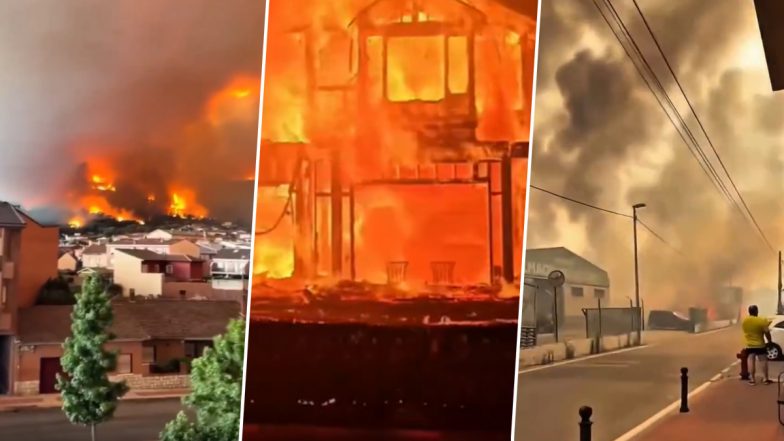
A massive wildfire in southwest France has produced a rare weather phenomenon known as pyrocumulonimbus, or fire clouds, creating additional challenges for firefighters battling one of the country's most severe wildfire events in recent history. The fire-generated storm clouds have produced their own winds and lightning, allowing flames to spread unpredictably and creating new fire risks.
The fires in France's Gironde region near Bordeaux have forced tens of thousands of people to evacuate, while Spain is also battling major wildfires. French officials say one blaze has been contained, but another larger fire continues to burn as emergency teams work to regain control. Tour de France Final Stage Shortened: Wildfires Devastate 98,000 Hectares of Wooded Terrain in France.
France Megafire Video
ALERT IN EUROPE!
Fires in Spain and France have merged into a MEGAFIRE. More than 60 cities have already been evacuated. ⚠️ pic.twitter.com/8GBtNdVndP
— France Safety Travel (@francesafetytra) July 28, 2026
What Are Fire Clouds Or Pyrocumulonimbus?
Pyrocumulonimbus, commonly known as pyroCb or fire clouds, are massive storm clouds created by extreme wildfires. Unlike ordinary thunderstorms that form through atmospheric processes, fire clouds develop when intense heat from a wildfire causes smoke and hot air to rise rapidly into the atmosphere.
As the smoke plume rises, the air cools and moisture condenses, forming a cloud. Under the right conditions, the cloud can develop into a pyrocumulonimbus system capable of generating lightning and strong winds. Wildfires Rage Across France and Spain, Forcing Over 250,000 to Evacuate.
Experts say the phenomenon works similarly to a natural heat engine. Jean-Baptiste Filippi, a researcher at the National Center for Scientific Research (CNRS), compared the process to a condensing boiler, where rising heat drives moist air upward, releasing more energy as condensation occurs. He told Le Monde that this process is occurring in France's Gironde region.
France Records Rare Fire Cloud Phenomenon
Fire clouds have previously been documented during extreme wildfires in countries including the United States, Canada and Australia. They were observed during Australia's devastating 2019-2020 bushfires and more recently during major fires in Siberia linked to Arctic heatwaves.
However, France's national firefighters federation said it had never previously recorded a pyrocumulonimbus event in the country.
The wildfire near Saumos, southwest France, began on July 22 and has burned more than 420 square kilometres of forest and scrubland. The blaze has damaged or destroyed more than 240 homes and forced around 220,000 people to evacuate in Gironde.
French officials said the fire generated a pyrocumulonimbus cloud two days after it began. The cloud weakened overnight as humidity increased but later developed again several times. Sophie Brocas, the prefect of Gironde, described the phenomenon as unprecedented.
"Yesterday evening (July 27), we faced another firestorm, the same incredible, unprecedented, unknown phenomenon as the one we saw on Friday, when we realised we were entering a new dimension."
Brocas added that it was: "a completely unpredictable phenomenon, combining both fire and the storm it itself creates, with lightning strikes sparking new fires and winds fanning the flames."
How Fire Clouds Make Wildfires More Dangerous
Fire clouds can dramatically change wildfire behaviour because they create their own weather systems. The powerful winds generated by pyrocumulonimbus clouds can rapidly alter the direction of flames, create multiple fire fronts and spread burning embers into unaffected areas.
Rick McRae, an adjunct professor from the University of New South Wales’ bushfire research group, said: "These things, they get up to roughly 10,000 cubic kilometres of the atmosphere, so they have a big impact."
French firefighters said the phenomenon makes traditional firefighting methods much more difficult. A spokesperson for France’s National Firefighters Federation (FNSPF) told The Independent:
"[It is] unlike a standard fire that spreads in a conical pattern. The result is that it spreads in every direction and develops multiple fire fronts. We don’t know how the blaze will spread; the fire front is constantly shifting."
The spokesperson added: "We cannot fight it directly. It’s a David-versus-Goliath scenario." Christophe Chantepy, a specialist at the National Forests Office in France, told Le Monde: "It (a fire cloud) is dangerous because it creates its own weather conditions. It is more powerful, erratic, and therefore unpredictable. Spot fires are much more likely, with burning embers [flaming plant debris] that can be thrown out of the convection column."
Fire Clouds Can Affect Climate And Air Quality
Scientists say pyrocumulonimbus clouds are also concerning because they can push large amounts of smoke high into the atmosphere. When wildfire smoke enters the lower atmosphere, it is usually removed within days. However, smoke injected into the stratosphere can remain for months or even years.
Experts compare major fire clouds to moderate volcanic eruptions because of their ability to spread smoke particles over large distances. The smoke can travel across continents and potentially influence air quality and climate patterns far from the original wildfire.
Climate Change And Rising Fire Cloud Risk
Scientists say climate change is contributing to conditions that allow extreme wildfires and fire clouds to develop.
The EU's Copernicus Climate Change Service has warned that rising temperatures, prolonged droughts and repeated heatwaves are creating drier landscapes that provide more fuel for intense fires.
Europe has been warming faster than the global average, with hotter and drier conditions increasing the likelihood of extreme wildfire events.
While scientists say more research is needed to establish long-term trends, experts warn that pyrocumulonimbus events could become more frequent as extreme heat conditions continue. The most significant challenge, researchers say, is that fire clouds are not merely a result of wildfires, they can influence how those fires spread and evolve.
(The above story first appeared on LatestLY on Jul 29, 2026 11:41 AM IST. For more news and updates on politics, world, sports, entertainment and lifestyle, log on to our website latestly.com).