Humpback Whale Caught on Camera Grieving Stillborn Calf in Rare Video
A rare video recorded off Australia’s Gold Coast shows a female humpback whale repeatedly returning to her stillborn calf on the seafloor after giving birth. Researchers say the behavior is the first documented case of postmortem attentive behavior toward a stillborn calf in humpback whales, while cautioning that grief cannot be confirmed.

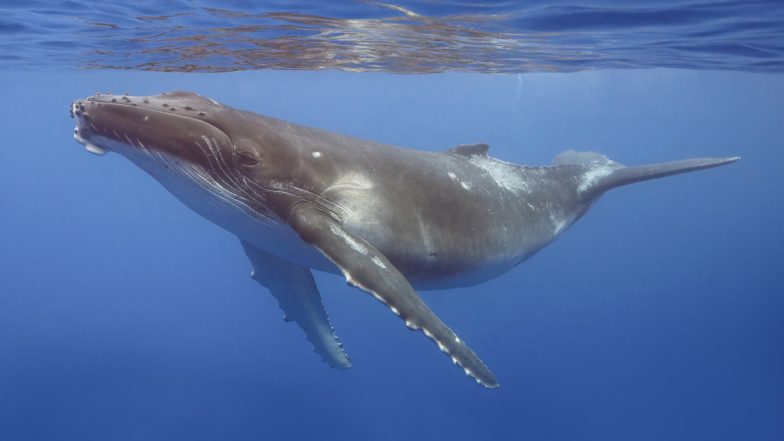
A female humpback whale was filmed repeatedly returning to her stillborn calf on the seafloor off Australia’s Gold Coast in July 2025, in what researchers describe as the first documented case of postmortem attentive behavior toward a stillborn calf in the species. The footage was recorded in July 2025 and was described in a study published Wednesday, Sept. 16, 2026, in the journal Discover Animals, Live Science reported.
The footage shows the mother hovering above the motionless body, approaching it repeatedly and appearing to check on the newborn. Researchers observed the behavior for around two hours and said the mother remained close to the calf for at least 90 minutes. While the behavior may indicate a strong maternal response, the researchers caution that it cannot conclusively establish that the whale was experiencing grief. Humpback Whales Make Record Australia-Brazil Lifetime Swims.
Humpback Whale Caught on Camera Grieving Stillborn Calf
Humpback Whale Caught on Camera Grieving Stillborn Calf: A Rare Observation
"It is extremely rare to witness," study first author Olaf Meynecke, a marine ecologist at Griffith University in Australia, told Live Science in an email. "Only about 20 births of humpback whales have been observed to date and described in literature," none of which involved a stillborn calf.
Unlike the babies of toothed whales and porpoises, newborn humpback whales don't have enough blubber to float, so they sink without the help of an adult whale. This might partly explain why scientists had not witnessed a stillbirth in this species until now, Meynecke said, as the lifeless body sinks to the seabed immediately after birth and is almost impossible to spot from a distance.
The researchers described the mother's actions as "postmortem attentive behavior." The term refers to an animal remaining near, touching or otherwise interacting with a deceased member of its species.
How The Calf Was Discovered
The video was taken after study co-author Andrew Mulville, who was on a private boat that morning, noticed two adult humpback whales milling about at the surface of the water.
One of the whales adopted a vertical position with its tail pointing up. Moments later, Mulville saw the remains of an amniotic membrane, the inner layer of the placental bag that envelops a fetus, floating on the water.
The whale had obviously just given birth, but there was no sign of the calf. So Mulville and others on the boat followed the female underwater with a GoPro camera. They found the calf dead on the seafloor, while the mother displayed what the study authors interpreted as "postmortem attentive behavior," or grieving.
Mother Remained Near The Calf
"She was repeatedly diving down for short times and swimming next to the calf, then resting next to it on the floor for about a minute, even moving the pectoral fin over the calf, then diving up again," Meynecke said. This behavior lasted for at least 90 minutes and possibly days, although the researchers left the scene after about two hours of observation.
The mother did not attempt to carry the calf to the surface. Researchers said this may have been because she recognized that the calf had died during birth. That response differs from observations involving some toothed whales, which have been documented pushing dead or stillborn calves toward the surface.
Another Whale Was Present
The second adult whale observed near the mother was an "escort" supporting the pregnant female as she prepared to give birth, Meynecke said. Based on its size and appearance, the escort was likely a female of a similar age to the mother, although the researchers could not confirm its s*x.
Male and female escorts are common among humpback whales. They can travel alongside females and their calves during migration and may accompany females during pregnancy. The adult whales were also seen in the area over the following two days, although researchers could not establish with certainty whether they were the same individuals observed during the birth.
Can Scientists Confirm Grief?
The researchers say the behavior provides evidence of a strong maternal response, but they stop short of scientifically confirming grief.
Grief is difficult to establish in wild animals because researchers cannot directly measure an animal's emotional experience. Remaining close to a dead calf could reflect maternal attachment, caregiving instincts or another behavioral response rather than grief as humans understand it.
The observation is nevertheless significant because similar postmortem behaviors have been documented more extensively among toothed whales, while comparable observations among baleen whales are much rarer.
A Rare Window Into Whale Behavior
"It provides a rare window into the behavioural response of baleen [filter-feeding] whales toward a deceased member of their species but also in this case of a mother toward her calf," Meynecke said.
"It provides important insight into the complex behaviours of the species and aligns with other observations of care taking, assisting distressed whales or even protecting other species from predators."
The researchers say more observations will be needed to determine how humpback whales generally respond to the death of calves and whether postmortem attentive behavior is widespread within the species.
For now, the footage offers an unusually detailed look at the behavior of a humpback whale mother immediately after the loss of her calf, while also highlighting how little scientists still know about the species' responses to death.
DISCLAIMER: This article is strictly for informational and educational purposes to raise awareness about the said topic. LatestLY DO NOT host, distribute, or provide links to sexually explicit content, leaked videos, or pirated material. Any search terms or keywords mentioned are solely for the purpose of explaining the viral trend and its associated dangers. We strongly condemn the circulation of non-consensual intimate imagery (NCII) and advise all readers to refrain from searching for or sharing such content, as doing so may lead to severe legal consequences.
(The above story first appeared on LatestLY on Sep 17, 2026 12:05 PM IST. For more news and updates on politics, world, sports, entertainment and lifestyle, log on to our website latestly.com).