
World News | China's Data Warfare Exposed in Taiwan Election Meddling
Get latest articles and stories on World at LatestLY. Leaked documents from Chinese firm GoLaxy reveal a massive Beijing-led operation to monitor and influence Taiwan's politics. Using AI, "knowledge graphs," and millions of records, the system profiles leaders and tracks public opinion to exploit divisions, raising major concerns over election interference and advanced information warfare.

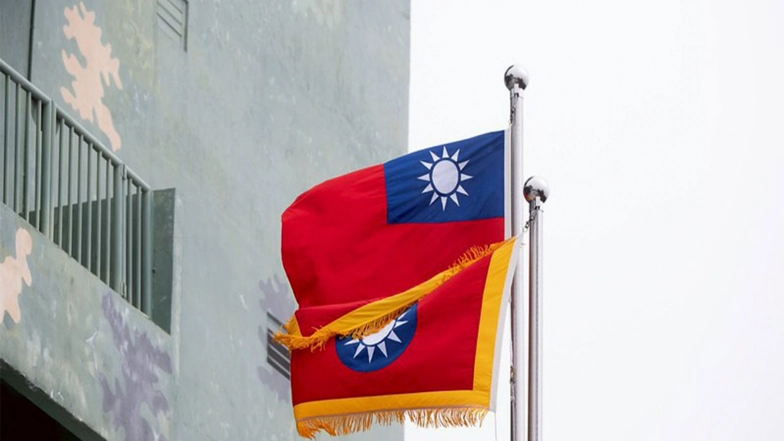
Taipei [Taiwan], March 20 (ANI): Leaked documents from Chinese tech firm GoLaxy have uncovered an extensive and calculated effort by Beijing to monitor, profile, and influence Taiwan's political environment, raising serious concerns over interference in democratic processes. The operation involved building a massive data-driven system designed to track public opinion and exploit political divisions during election cycles, as reported by The Taipei Times.
According to The Taipei Times, the documents, reviewed by Taipei-based Doublethink Lab, show that Chinese actors compiled a detailed database of Taiwanese political figures. This repository includes sensitive personal and professional data such as affiliations, education, religious beliefs, and residential backgrounds.
Also Read | Has Israel Appointed Yariv Levin as Interim Prime Minister to Replace Benjamin Netanyahu? Here's the Truth.
Prominent leaders, including President William Lai and former president Tsai Ing-wen, were among those listed, alongside thousands of influential individuals from civil society, academia, and business sectors.
Central to the project is a sophisticated "knowledge graph" mapping Taiwan's political networks. It connects parties, leadership structures, and geographic data, allowing analysts to identify influence hubs and ideological alignments. The system categorises politicians into camps based on their perceived stance toward China, enabling targeted strategies to exploit internal divides.
The scale of surveillance is vast. The leaked material indicates the database includes millions of social media entries, news reports, and even 23 million household records sourced from restricted channels.
This integration allows for advanced "virtual-real mapping," blending online narratives with real-world identities to forecast behaviour and shape discourse.
Ahead of Taiwan's 2024 elections, the campaign intensified. A weekly monitoring report tracked over 600,000 online interactions, analysing shifts in narrative around key candidates and identifying moments of heightened media exposure.
The data suggests coordinated attempts to influence voter perception and strategically target political figures, as cited by The Taipei Times.
The project also leveraged artificial intelligence, creating digital personas capable of mimicking language patterns and cultural nuances. These virtual actors engaged users across platforms in multiple languages, subtly steering conversations and amplifying divisive narratives.
Separately, media watchdogs have warned that China is expanding its global propaganda reach through state-run outlets, further highlighting concerns about Beijing's growing information warfare tactics and their implications for democratic societies, as reported by The Taipei Times. (ANI)
(The above story is verified and authored by ANI staff, ANI is South Asia's leading multimedia news agency with over 100 bureaus in India, South Asia and across the globe. ANI brings the latest news on Politics and Current Affairs in India & around the World, Sports, Health, Fitness, Entertainment, & News. The views appearing in the above post do not reflect the opinions of LatestLY)