What Is MAT Credit? All You Need To Know As Finance Minister Nirmala Sitharaman Cuts Minimum Alternate Tax Rate to 14%
In the Union Budget 2026, FM Nirmala Sitharaman proposed reducing the Minimum Alternate Tax (MAT) from 15 per cent to 14 per cent and treating it as a final tax from April 1, 2026. This landmark shift aims to simplify corporate tax by ending the complex MAT credit carry-forward system, which previously allowed firms to offset taxes for 15 years.

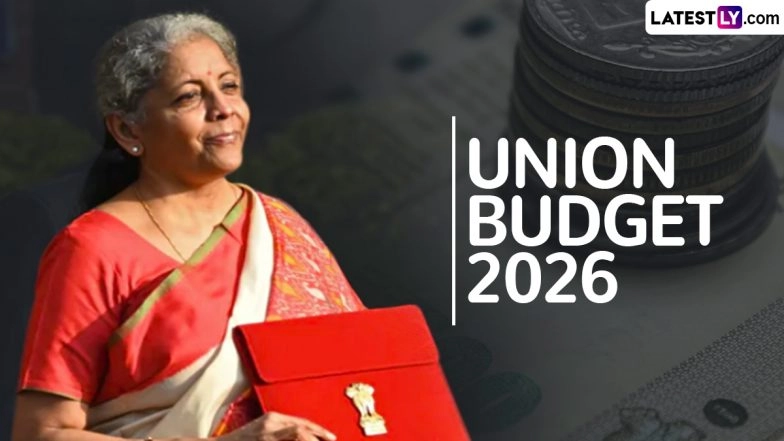
New Delhi, February 1: As Finance Minister Nirmala Sitharaman presented the Union Budget 2026 on Sunday, February 1, significant updates to corporate tax structures were unveiled, including a proposal to lower the Minimum Alternate Tax (MAT) rate from 15 per cent to 14 per cent. For many businesses, the most critical aspect of this regime is the MAT Credit - a tax benefit that ensures companies are not unfairly penalised for paying "minimum" taxes today when they have earned incentives for the future. By allowing firms to "bank" excess tax paid, the MAT credit serves as a vital bridge between a company’s financial book profits and its actual taxable income.
What Is MAT Credit?
The Minimum Alternate Tax (MAT) was originally introduced to bring "zero-tax companies" - those that report high book profits to shareholders but pay little to no tax due to various exemptions - into the tax net. What Is Nirmala Sitharaman Education Qualification? Know Her Age, Early Life and Professional Background.
MAT To Be Made Final Tax
News Alert | Budget 2026: MAT to be made final tax; rate reduced to 14 pc, from current 15 pc: FM Sitharaman#Budget2026WithPTI #UnionBudgetWithPTI pic.twitter.com/SY2wvYNdD6
— Press Trust of India (@PTI_News) February 1, 2026
Nirmala Sitharamam Cuts MAT Rate to 14 Per Cent
#BudgetWithHT | FM @NSitharaman announced a revamp of the Minimum Alternate Tax regime, cutting the MAT rate to 14%.
From April 1, 2026, MAT will become a final tax, with the MAT credit mechanism discontinued.
Track LIVE: https://t.co/98wymwyvqM pic.twitter.com/LBDPrcnJtz
— Hindustan Times (@htTweets) February 1, 2026
MAT Credit is the mechanism that allows a company to recover the "extra" tax it pays under MAT. Specifically, it is the difference between the tax paid under MAT and the tax that would have been payable under the regular provisions of the Income Tax Act. For example, if a company's regular tax is INR 10 lakh but its MAT liability is INR 15 lakh, the excess INR 5 lakh is recorded as a MAT credit.
How the Credit Works: Carry Forward and Set-Off
The primary value of MAT credit lies in its ability to be used in future years. Under current regulations (Section 115JAA):
-
Carry Forward: Companies can carry forward this credit for up to 15 assessment years.
-
Set-Off Rules: The credit can only be utilized in a year when the company's "regular" tax liability exceeds its MAT liability.
-
Utilisation Limit: The amount of credit that can be set off is limited to the difference between the regular tax and the MAT for that specific year.
Union Budget 2026: Shift Toward Finality
In a notable move during the 2026 Budget speech, the government proposed rationalising the MAT structure. Along with the rate cut to 14 per cent, there is an increasing policy push to make MAT a "final tax" in certain high-growth sectors. From April 1 this year, MAT will become a final tax, with the MAT credit mechanism being discontinued. This aims to simplify compliance by reducing the long-term tracking of credits, though for many established manufacturers, the 15-year credit window remains a crucial "tax shield" that protects their cash flows during expansionary periods. Budget 2026 Live News Updates: No Change in Income Tax Slabs, Nirmala Sitharaman Concludes Her Speech.
Why It Matters for Businesses
MAT credit is not a refund; it is an asset on a company’s balance sheet that reduces future cash outflows for taxes. For capital-intensive industries - such as infrastructure and power - where heavy depreciation and initial incentives often lead to high MAT payments in early years, these credits are essential for maintaining long-term financial viability.
(The above story first appeared on LatestLY on Feb 01, 2026 12:58 PM IST. For more news and updates on politics, world, sports, entertainment and lifestyle, log on to our website latestly.com).