India Meets One UNESCO Education Spending Target, Misses Another: What the Numbers Show
India remains just above UNESCO's minimum GDP benchmark for education, but the sector's share in government spending has slipped below the prescribed threshold. Education accounts for 4.1% of GDP but 14.2% of total public expenditure, down from 15.7% in 2015 and below the 15% benchmark, UNESCO's 2026 SDG 4 scorecard has shown.

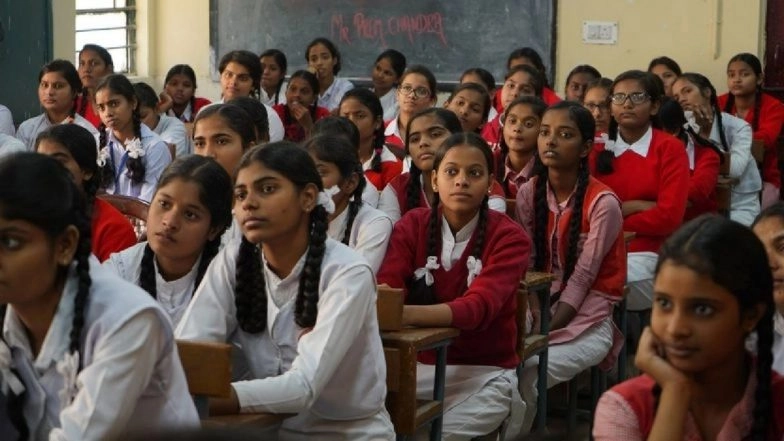
India remains just above UNESCO's minimum GDP benchmark for education, but the sector's share in government spending has slipped below the prescribed threshold. Education accounts for 4.1% of GDP but 14.2% of total public expenditure, down from 15.7% in 2015 and below the 15% benchmark, UNESCO's 2026 SDG 4 scorecard has shown, according to a Times of India report.
Secondary School Completion Rates Remain A Concern
The funding picture assumes significance because India continues to lag on secondary school completion. Its latest lower secondary (Classes VI-VIII) completion rate is 86% as against its 99% national benchmark for 2025, while upper secondary (Classes IX-XII) completion rate is 51% as against 84%. UNESCO classifies progress at both levels as slow. ‘Gen Z Was Misled’: Dharmendra Pradhan Reveals What Happened Before His Resignation.
India Meets Only One Of Two Global Benchmarks
Under the Education 2030 framework, countries committed to spending 4-6% of GDP and/or 15-20% of public expenditure on education. The scorecard uses the lower thresholds as minimum benchmarks. India meets one. Its spending on education has remained at 4.1% of GDP since 2015, but its share of public expenditure has declined 1.5 percentage points to 14.2%. From Smriti Irani to Dharmendra Pradhan: A Look at the NDA Government's Education Ministry's Transitions.
How India Compares With Other Emerging Economies
Among major emerging economies, China too meets one benchmark, at 4% of GDP (11.9% of public spending), while figures for Brazil are 5.6% and 12.9%. South Africa meets both, at 6% and 19.1%, while Indonesia, Bangladesh and Pakistan meet neither.
The pattern is common among developed economies too. The US, UK, Germany and France meet the GDP threshold but not the public expenditure benchmark, while Sweden and Switzerland meet both.
UNESCO noted that richer countries tend to meet the GDP benchmark but not the public expenditure threshold because they raise more revenue, while education often accounts for a larger share of budgets in poorer countries.
Global Snapshot: Only 19% Of Countries Meet Both Benchmarks
Latest data show 39 of 205 countries, or 19%, meeting both benchmarks, while 72, or 35%, meet neither. Another 64 countries, including India, spend above 4% of GDP but below 15% of public expenditure. Among high-income countries, 11% meet both benchmarks and 50% follow India's pattern.
India's Schooling Gaps Remain Wide Despite Scale
India, however, has larger unmet schooling needs. Lower secondary completion has risen from 81% in 2015 to 86% but remains 13 percentage points below its 99% benchmark. Even UNESCO's "feasible" 2025 benchmark of 90% is four points above the latest rate.
This is despite programmes operating at scale. UNESCO's India profile says Samagra Shiksha supports about 15.6 crore learners, while PM-Poshan covers around 11.8 crore children in 11.2 lakh government and aided schools.
A Global Trend Away From Education Spending Benchmarks
The trend is part of a broader global concern. The scorecard concludes that, on average, countries are "moving away" from the public education expenditure benchmarks of at least 4% of GDP or 15% of total public expenditure.
(The above story first appeared on LatestLY on Aug 09, 2026 09:44 AM IST. For more news and updates on politics, world, sports, entertainment and lifestyle, log on to our website latestly.com).