How To Apply for a PNG Connection? Know Cost, Security Deposits, and Installation Time
Learn how to apply for a PNG connection in 2026. This guide covers the step-by-step process for shifting from LPG to Piped Natural Gas, including security deposits (INR 5,000-INR 10,000), document requirements, and top providers like IGL and MGL. Transition to a continuous, safer gas supply and eliminate the hassle of cylinder refills.

Mumbai, March 25: In response to recent LPG supply fluctuations triggered by geopolitical tensions in West Asia, the government is accelerating the shift toward Piped Natural Gas (PNG) for residential and commercial use. Households located in areas with existing pipeline infrastructure are being encouraged to transition away from traditional cylinders to a continuous, metered supply. While the availability of PNG remains concentrated in major hubs like Delhi-NCR, Mumbai, and parts of Gujarat, the application process has been digitised across most major providers to facilitate a faster rollout.
The transition to PNG is managed by various City Gas Distribution (CGD) companies authorised by the Petroleum and Natural Gas Regulatory Board (PNGRB). Major operators include Indraprastha Gas Limited (IGL) in Delhi, Mahanagar Gas Limited (MGL) in Mumbai, and Adani Total Gas or Gujarat Gas in western regions. For residents in cities like Bengaluru or Patna, GAIL Gas Limited serves as the primary provider. The shift is often cited as a more convenient and cost-effective alternative to LPG, as it eliminates the need for booking refills and offers an uninterrupted fuel flow. India PNG Push: Government Notifies Order To Boost Natural Gas infrastructure, Improve Access to Piped Natural Gas.
How To Apply for a PNG Connection?
-
Verify Local Availability
Before starting an application, consumers must confirm if their specific colony or apartment complex is "gas-ready." Most providers offer an online search tool where users can enter their PIN code or address to check if the internal pipeline network has been laid.
If the pipelines are already present in the building, the connection process is significantly shorter. In newer residential areas where the network is still under expansion, the wait time for a connection may extend beyond the standard delivery window. India’s Piped Gas Surge: Over 3.5 Lakh PNG Connections Issued in March, Says Government.
-
Documentation and Application
Applications can be submitted through the official website of the local gas distributor or at designated customer service centers. To complete the registration, applicants typically need to provide:
- Identity Proof: Aadhaar card, PAN card, or Voter ID.
- Address Proof: Electricity bill, telephone bill, or Ration card.
- Property Documents: Ownership papers or a valid rent agreement (for tenants).
- Once the documents are uploaded and the initial processing fee is paid, the company assigns a unique consumer ID to track the installation progress.
- Understanding Connection Costs
The primary cost for a new PNG connection is the refundable security deposit. For instance, IGL currently charges a refundable deposit of INR 7,000 for new domestic connections. This fee generally covers the installation of up to 15 meters of internal piping and the gas meter.
While deposit structures vary slightly by city and provider, most range between INR 5,000 and INR 10,000. Some companies offer installment schemes where the security deposit is recovered through monthly gas bills to reduce the upfront financial burden on the consumer.
-
Inspection and Activation
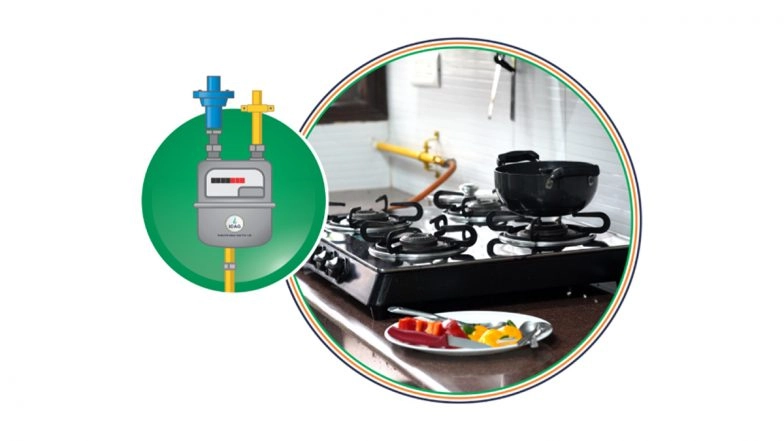
After the application is approved, the gas company conducts a technical site inspection to determine the safest route for the pipeline into the kitchen. If the site is deemed feasible, technicians install the copper or GI pipes, the gas meter, and a specialised brass valve.
In established areas, the connection is usually activated within 7 to 15 days. A final safety check is performed to ensure there are no leakages before the supply is turned on. Once operational, users are billed bi-monthly or monthly based on actual consumption recorded by the meter.
PNG offers several advantages over LPG, including a continuous supply that is not affected by delivery delays or strikes. According to Indian Oil (IOCL), the pipeline network operates on positive gas pressure and is often "looped" to provide redundancy, ensuring that supply remains constant even during maintenance.
However, access remains uneven across India. While Tier-1 cities and the industrial belts of Gujarat have extensive coverage, the rollout in Tier-2 cities and southern India is still in the gradual infrastructure-laying phase. Consumers in these regions are advised to monitor the PNGRB website for updates on when their locality will be commissioned for gas supply.
(The above story first appeared on LatestLY on Mar 25, 2026 06:09 PM IST. For more news and updates on politics, world, sports, entertainment and lifestyle, log on to our website latestly.com).