Finance Ministry Clarifies UPI Rules: P2P Payments Free, 96% Merchant Transactions Unaffected
The government has clarified that the new UPI framework will not impose charges on users making person-to-person (P2P) payments, while around 96% of person-to-merchant (P2M) UPI transactions will also remain unaffected.

The government has clarified that the new UPI framework will not impose charges on users making person-to-person (P2P) payments, while around 96% of person-to-merchant (P2M) UPI transactions will also remain unaffected. The clarification comes after the introduction of a new framework allowing Merchant Discount Rate (MDR) on specified merchant transactions above ₹2,000.
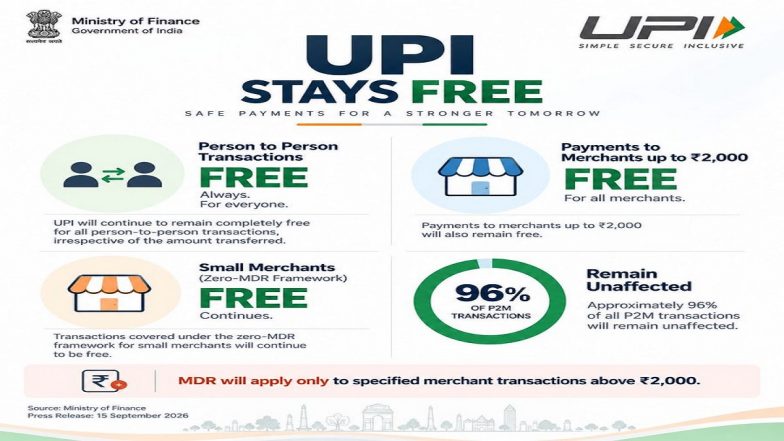
The Finance Ministry said all P2P UPI transactions will remain completely free, regardless of the amount transferred. Payments made to merchants up to ₹2,000, as well as transactions covered under the zero-MDR framework for small merchants, will also continue without MDR.
The latest clarification follows the government's broader effort to establish a sustainable revenue framework for UPI while keeping the payment system free for consumers. New UPI Transaction Rates 2026: Check Proposed MDR Fees, Caps and Exemptions.
No UPI Charges on Person-to-Person Payments
According to the Finance Ministry, the new framework has no impact on person-to-person transactions. Whether a user transfers ₹500, ₹5,000 or a higher amount to another individual, the transaction will continue to be free of MDR.
This means users will not have to pay a separate UPI transaction fee simply because the amount transferred exceeds ₹2,000. The government had earlier clarified that amendments to the Payment and Settlement Systems Act were an enabling provision and did not themselves impose a charge on UPI users.
96% of Merchant UPI Transactions to Remain Unaffected
The Finance Ministry said approximately 96% of P2M transactions will remain unaffected under the new framework. Payments to merchants of up to ₹2,000 will remain free. The zero-MDR framework applicable to eligible small merchants will also continue to protect those transactions from MDR. MDR will apply only to specified merchant transactions above the applicable ₹2,000 threshold.
The government has therefore sought to distinguish between consumer-facing UPI charges and MDR paid within the merchant payment ecosystem.
What Is MDR and Who Gets the Money?
MDR, or Merchant Discount Rate, is a fee associated with processing certain merchant payments. The Finance Ministry clarified that MDR is not a tax and is not a charge collected by either the government or NPCI. UPI Payments New Rule Explained: What Happens to Payments Above INR 2,000 From October 15.
Finance Ministry Clarifies UPI Rules
👉 UPI Continues to Remain Free for Peer to Peer Transactions and 96% of Merchant Transactions
👉 The new UPI framework introduced has no impact on any person to person transactions
👉 UPI will continue to remain completely free for all person-to-person transactions,… pic.twitter.com/lYVzehs6lU
— Ministry of Finance (@FinMinIndia) September 15, 2026
Instead, the amount is distributed among participants in the digital payments ecosystem, including banks and payment application providers. The objective is to help fund the infrastructure, technology, security and continued expansion required to operate the UPI ecosystem at scale.
₹2,000 Threshold for Specified Merchant Transactions
Under the framework announced by NPCI, MDR will apply to specified P2M UPI transactions above ₹2,000. Reports on the new structure indicate that the MDR for general merchant transactions will be 0.4%, subject to a maximum of ₹300 per transaction, with the framework taking effect from October 15, 2026.
Certain categories, including railway, telecom, insurance and fuel payments, have been reported to have a separate flat MDR structure for transactions above the threshold. Importantly, the government has said the MDR is intended to apply within the merchant payment ecosystem rather than becoming a direct transaction fee for consumers.
Why Has the Government Introduced the New UPI Framework?
The framework has been introduced under the Payment and Settlement Systems Act, 2007, following deliberations by the UPI Steering Committee. The government says the objective is to ensure the long-term sustainability of UPI, while protecting consumers and small merchants from additional costs.
UPI has become one of India's largest digital payment systems, with transaction volumes continuing to expand rapidly. NPCI's official data portal tracks UPI transactions by volume, value, P2P/P2M category and participating entities. The government has previously said that UPI needs a sustainable ecosystem to support technological upgrades, infrastructure and resilience against emerging risks.
What the New UPI Rules Mean for Users
For ordinary UPI users, the key takeaway is that sending money to another person will remain free. For merchant payments, transactions up to ₹2,000 covered by the applicable zero-MDR framework will remain free, while MDR will apply only to specified transactions above the threshold. The Finance Ministry's latest clarification is aimed at addressing concerns that the new framework would result in a blanket UPI charge or a tax on digital payments. It does not introduce a universal fee on UPI transactions.
DISCLAIMER: This article is strictly for informational and educational purposes to raise awareness about the said topic. LatestLY DO NOT host, distribute, or provide links to sexually explicit content, leaked videos, or pirated material. Any search terms or keywords mentioned are solely for the purpose of explaining the viral trend and its associated dangers. We strongly condemn the circulation of non-consensual intimate imagery (NCII) and advise all readers to refrain from searching for or sharing such content, as doing so may lead to severe legal consequences.
(The above story first appeared on LatestLY on Sep 16, 2026 12:04 AM IST. For more news and updates on politics, world, sports, entertainment and lifestyle, log on to our website latestly.com).