Will Sending Money to Friends or Paying at Shops Cost Extra Under the New UPI Rules?
The Finance Ministry clarified that UPI transactions remain free for customers. Starting October 15, a 0.4 per cent MDR applies only to merchant payments above INR 2,000, excluding everyday users. 'UPI continues to be free for customers. Sending money to friends, paying at shops, or scanning a QR code - all remain without charges,' the Finance Ministry said.

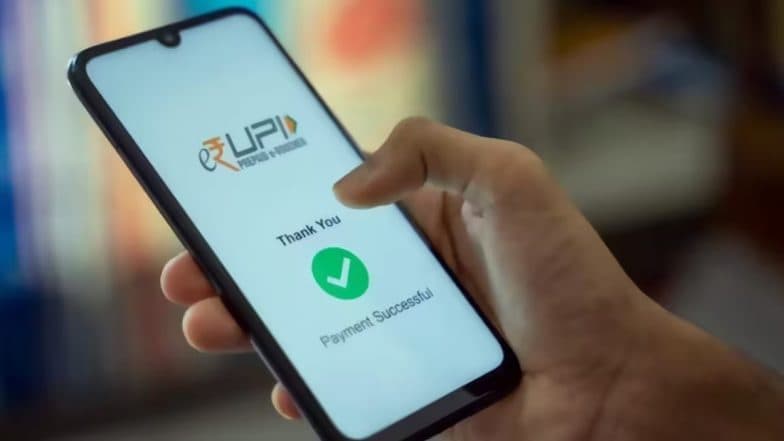
The Ministry of Finance has clarified that Unified Payments Interface (UPI) transactions will continue to be free for customers, even as a new Merchant Discount Rate (MDR) framework for certain higher-value merchant payments comes into force from October 15. In a detailed post on X (formerly Twitter), the ministry stated that sending money to friends, paying at shops or scanning a QR code will not attract any charges for users. Person-to-person (P2P) transfers remain free regardless of the amount.
Key Details of the New Framework
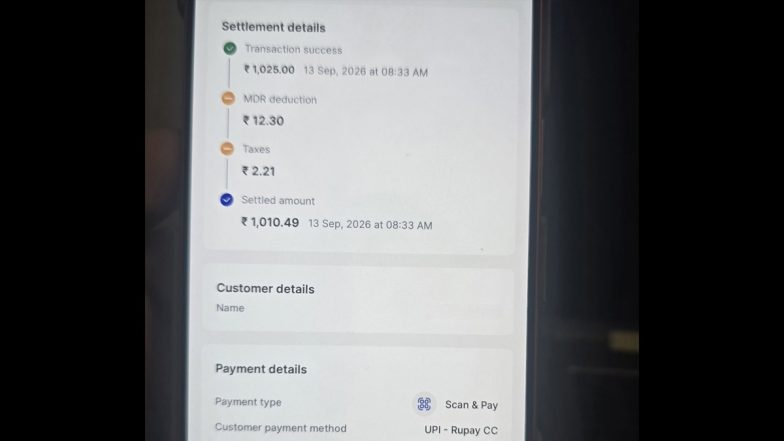
Under the rules issued by the National Payments Corporation of India (NPCI), a 0.4 per cent MDR will apply only to person-to-merchant (P2M) UPI transactions above INR 2,000. The fee is to be paid by merchants, not customers, and is capped at INR 300 for transactions of INR 75,000 and above. UPI Payments New Rule FAQs: Who Pays, How Much and Which Transactions Are Exempt?
UPI Remains Free for Consumers, Says Finance Ministry
🔰 UPI Remains Free for Consumers
UPI continues to be free for customers. Sending money to friends, paying at shops, or scanning a QR code — all remain without charges.
Key Facts:
✅ No charges on P2P: Person-to-Person transfers are always free, regardless of amount.
✅ Small… pic.twitter.com/PyQ7hotNMN
— Ministry of Finance (@FinMinIndia) September 16, 2026
Over 95 per cent of merchant payments fall below the INR 2,000 threshold and will remain free. Small merchants receiving up to INR 1 lakh per month through UPI QR codes under the person-to-person merchant (P2PM) category will continue to face zero charges on all their UPI receipts. Essential services such as railways, fuel, telecom, bill payments and insurance will attract a flat fee of INR 5 per transaction above INR 2,000. Mutual fund and securities payments will face a lower rate of 0.02 per cent, also capped at INR 300.
Safeguards for Customers
Banks have been instructed to ensure merchants do not pass the MDR cost on to customers. UPI apps are prohibited from levying any platform or hidden charges on users. The ministry emphasised that the MDR is a charge within the merchant payment ecosystem and is not a tax or a fee collected by the government or NPCI. It will be distributed among banks and payment service providers to support the system.
Rejection of External Pressure Claims
The ministry rejected suggestions that the change resulted from foreign influence. It said India’s UPI policy decisions are made independently, with the aim of building a self-sustaining, inclusive and affordable digital payments ecosystem. New UPI Payment Charges 2026: What Will Remain Free and What Will Attract MDR?
Rejection of External Pressure Claims
UPI, launched in 2016, has grown into the world’s largest real-time interoperable payment system. It processed 24.5 billion transactions in August 2026 alone. The ministry said a small fee on high-value merchant transactions will help fund better infrastructure and cybersecurity, support for small merchants in Tier III–VI towns and rural areas, and efforts to expand UPI adoption. The new framework is intended to make the system self-sustainable while protecting everyday users and small businesses. The Reserve Bank of India has backed the move as a step toward the long-term sustainability of India’s digital payments ecosystem. The changes take effect on October 15.
DISCLAIMER: This article is strictly for informational and educational purposes to raise awareness about the said topic. LatestLY DO NOT host, distribute, or provide links to sexually explicit content, leaked videos, or pirated material. Any search terms or keywords mentioned are solely for the purpose of explaining the viral trend and its associated dangers. We strongly condemn the circulation of non-consensual intimate imagery (NCII) and advise all readers to refrain from searching for or sharing such content, as doing so may lead to severe legal consequences.
(The above story first appeared on LatestLY on Sep 16, 2026 11:49 PM IST. For more news and updates on politics, world, sports, entertainment and lifestyle, log on to our website latestly.com).