DFS Rejects UPI User's Claim of MDR Being Passed On to Customers, Says This
The Department of Financial Services dismissed viral claims that UPI's Merchant Discount Rate (MDR) is passed on to customers, clarifying that the screenshot was from the merchant side and involved credit card transactions. 'Any applicable MDR is borne by the merchant, not the customer,' DFS said. Scroll below to know more.

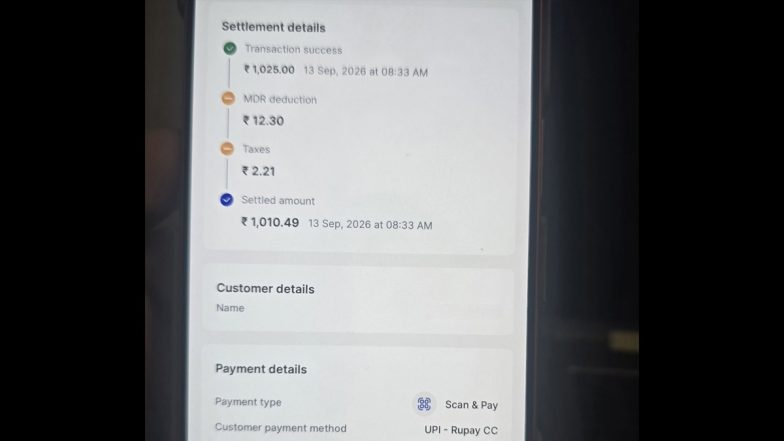
The Department of Financial Services (DFS) has strongly dismissed social media claims that the newly structured Unified Payments Interface (UPI) Merchant Discount Rate (MDR) is resulting in extra charges being passed directly onto regular retail customers. The clarification follows a viral online post containing settlement screenshots that sparked public concern regarding transaction fees. A user shared a screenshot showing MDR charged on UPI transaction and said, "MDR gets passed to the customers".
Government Clarification on Settlement Data
Addressing the viral claims on X (formerly Twitter), the DFS pointed out that the data circulating online stems strictly from merchant-facing interfaces rather than consumer applications. UPI MDR on Payments Above INR 2,000 to Stay; Govt Rules Out Reversal.
Any Applicable MDR Is Borne by the Merchant, Not the Customer
Some facts with respect to the screenshot of settlement details posted above are as follows:
- The screenshot appears to be taken from a “merchant” side and not of a customer making a UPI payment. So, there is no argument of customer paying the MDR.
- UPI “payments form bank…
— DFS (@DFS_India) September 16, 2026
"The screenshot appears to be taken from a 'merchant' side and not of a customer making a UPI payment. So, there is no argument of customer paying the MDR," the department stated.
Key Distinctions in Payment Instruments
Authorities further emphasised the critical structural difference between direct bank-account transfers and transactions executed via credit channels:
- Direct UPI Transfers: Standard peer-to-merchant transactions executed directly from bank accounts operate under distinct guidelines.
- Credit-Linked UPI Payments: The specific screenshot in question indicated a "RuPay CC – Credit Card" transaction, which involves short-term credit instruments funded by issuing banks rather than a standard cash-account debit. Finance Ministry Clarifies UPI Rules: P2P Payments Free, 96% Merchant Transactions Unaffected.
"Further, RuPay Credit Cards linked to UPI follow the rules applicable to credit card transactions which involve short-term loans funded by issuing banks," the DFS noted. To protect small businesses, transactions up to INR 2,000 made via RuPay Credit Cards at small merchants (with an annual turnover below INR 20 lakh) carry zero MDR. "Any applicable MDR is borne by the merchant, not the customer," the department clarified.
DISCLAIMER: This article is strictly for informational and educational purposes to raise awareness about the said topic. LatestLY DO NOT host, distribute, or provide links to sexually explicit content, leaked videos, or pirated material. Any search terms or keywords mentioned are solely for the purpose of explaining the viral trend and its associated dangers. We strongly condemn the circulation of non-consensual intimate imagery (NCII) and advise all readers to refrain from searching for or sharing such content, as doing so may lead to severe legal consequences.
(The above story first appeared on LatestLY on Sep 16, 2026 07:34 PM IST. For more news and updates on politics, world, sports, entertainment and lifestyle, log on to our website latestly.com).