Mark Zuckerberg Gives Statement on AI Slowdown, Regulation and Industry Division; Know What He Said
Meta CEO Mark Zuckerberg has highlighted divisions within the AI industry over regulation and the pace of development. He argued that market forces, liability risks and user trust encourage companies to prioritise AI alignment and safety. Zuckerberg also backed independent evaluators and said Meta has focused most compute resources on serving users.

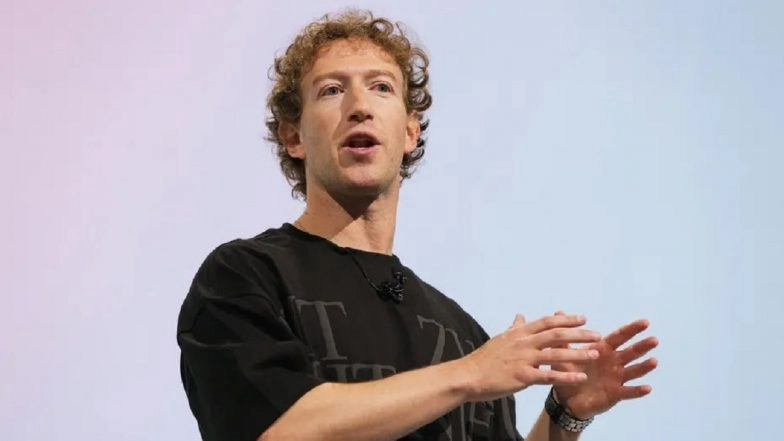
Meta Chief Executive Officer Mark Zuckerberg has publicly highlighted a profound division within the global technology industry concerning the regulation and development trajectory of artificial intelligence. In a comprehensive publication, Zuckerberg addressed competing philosophies on how fast frontier systems should advance, directly challenging rival firms that advocate for regulatory deceleration.
As per a report by The Times of India, the Meta executive responded to calls from developers like OpenAI and Anthropic to pause capability enhancements until safety alignment standards catch up. Zuckerberg contended that market forces and user expectations naturally incentivize developers to prioritize alignment and consumer trust over restrictive precautionary controls. Elon Musk, Sam Altman, Rishi Sunak and Others React to Anthropic CEO Dario Amodei Call for Slowing Down AI Frontier Models.
AI Alignment and Corporate Accountability
Focusing on operational responsibility, Zuckerberg emphasized that commercial entities face immense liability risks if their models cause harm, which serves as a powerful organic deterrent against reckless deployment. He noted that software users will naturally reject misaligned or unhelpful digital agents, making trust a critical commercial differentiator.
Highlighting internal risk mitigation, Zuckerberg pointed to Meta's decision to delay the public release of its Muse model for several months to ensure robust security foundations. He argued that technology laboratories should take independent, proactive measures to secure their models rather than demanding broad regulatory pauses across the sector.
Independent Oversight and Compute Allocation
Beyond internal safety protocols, Zuckerberg advocated for wider industry adoption of independent evaluators to audit emerging models. He stated that building a diverse ecosystem of external advisors helps establish higher operational benchmarks across the technology landscape.
Furthermore, the Meta chief outlined strategies for responsible resource management, noting that dedicating the majority of compute power toward direct user utility rather than recursive self-improvement ensures a safer development trajectory. These measures aim to balance rapid technological progress with robust consumer protection frameworks.
Mark Zuckerberg’s Complete Post Text
Last month I wrote about how we can build a positive and safe future for everyone:
Every lab has the responsibility and incentive to move at the pace required to train its models safely, and the ability to take its own actions to ensure that happens.
The reality is:
People won't want to use agents that are misaligned with them and that don't do what they ask, so labs have a strong natural incentive to make their models more aligned. There is a lot of debate about slowing progress on capabilities until alignment catches up. My view is that trust and alignment are quickly becoming the most important capabilities that will differentiate agents and models. Any lab that doesn't focus on alignment will fall behind.
Labs face significant liability if their models cause harm, so they have a strong incentive to prevent this as well. Meta delayed shipping Muse for several months to focus on safety and security. We didn't call for everyone else to do this before we would. We just did it as part of our day-to-day work because it was clearly the right thing for people and for us. I'm proud of the security foundations we've built.
Engaging independent evaluators and advisors is industry best practice. MSL already does this today in several areas because it helps produce better work. Other labs can just do this too. In general, it would be helpful for there to be a larger and more diverse ecosystem of evaluators.
Committing the significant majority of compute towards serving people rather than racing towards recursive self-improvement is one of the best ways to ensure we develop this technology safely. Meta has made this commitment and other labs can do this as well.
I believe the key to building a positive future for everyone is maintaining the right balance of power. This is within our power to do.
Ultimately, the intensifying debate over artificial intelligence governance reveals a fundamental philosophical split across the global technology sector. While prominent research institutions advocate for coordinated development pauses and strict external oversight until safety alignment mechanisms are fully proven, industry leaders like Meta Chief Executive Officer Mark Zuckerberg contend that organic market forces, legal liabilities, and corporate accountability remain the most effective drivers of secure innovation. 'AI More Dangerous Than Nukes': Elon Musk Reflects Back to His 2014 Post Warning How AI Could Pose Greater Risk.
As commercial entities continue to scale autonomous digital infrastructure, balancing rapid technological capability with robust user trust will ultimately dictate the future trajectory of artificial intelligence adoption worldwide.
(The above story first appeared on LatestLY on Sep 20, 2026 12:37 PM IST. For more news and updates on politics, world, sports, entertainment and lifestyle, log on to our website latestly.com).