AI Error ‘Almost Started a War’: US Military Nearly Boarded Chinese Ship Over False Nuclear Intelligence During Iran War
A US military operation against a Chinese ship was reportedly called off after officials discovered that an AI-assisted intelligence report falsely claimed the vessel was carrying nuclear weapons components. The error emerged during the Iran war and reportedly came close to triggering a confrontation between the US and China.

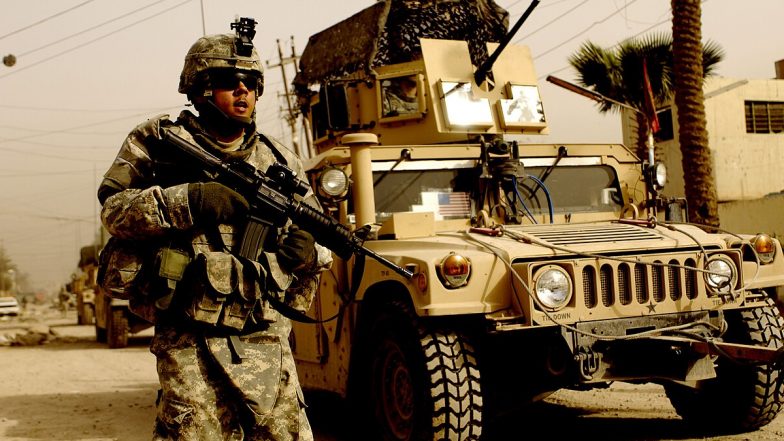
An intelligence report generated with the help of artificial intelligence (AI) nearly triggered a dangerous confrontation between the United States and China during the war with Iran after it falsely identified cargo aboard a Chinese ship as components linked to a nuclear weapons programme, according to a CNN report. US military personnel were preparing to intercept and potentially board the vessel before officials discovered that the intelligence was inaccurate.
According to the report, the intelligence circulated across the US military earlier this year while the Iran war was underway. It claimed that a Chinese vessel operating in the Middle East was transporting components connected to a nuclear weapons programme.
The information immediately raised concerns among US military officials, prompting preparations to intercept the vessel. Armed US personnel were reportedly being readied to board the ship, while military aircraft had also been deployed as part of preparations for the operation. Bill Gates Warns Governments ‘Way Behind’ on AI, Urges US-China Cooperation.
AI-Generated Intelligence Found To Be False
The planned operation was reportedly close to being carried out when officials examined the intelligence more closely and discovered that AI had been used in producing the assessment.
CNN reported that an analyst had used a chatbot while reviewing intelligence concerning the ship's manifest. The AI tool incorrectly identified what the vessel was carrying, leading to the erroneous conclusion that the cargo included nuclear weapons-related components. CNN said it could not determine what the actual cargo was. Donald Trump Dismisses Stricter AI Regulation Calls, Says 'Whoever Wins AI Wins'; Know Why.
One source described the resulting intelligence as 'entirely false' and said the episode 'almost started a war'. A US military action against a Chinese vessel could have created the risk of a wider confrontation between Washington and Beijing.
How AI Reportedly Produced the False Assessment
According to CNN, the analyst queried a chatbot about intelligence concerning the ship's manifest that originated with US Special Operations Command Pacific in Hawaii. It remains unclear whether the chatbot was a commercially available AI system or an internal US government tool.
The AI system reportedly combined open-source information with classified signals intelligence held by the US government before reaching the incorrect conclusion about the vessel's cargo.
The analyst then allegedly used AI again to package the findings into a conventional intelligence report, which was subsequently distributed through military channels.
US Special Operations Command Pacific and the Pentagon did not respond to CNN's requests for comment on the incident.
US Military Expanding Use of AI
The episode comes as the US military rapidly expands the role of artificial intelligence across intelligence analysis, battlefield decision-making and targeting.
In January 2026, Defense Secretary Pete Hegseth announced an AI Acceleration Strategy aimed at expanding the use of artificial intelligence across military operations. The strategy focuses on warfighting, intelligence and enterprise operations and includes projects designed to speed up battlefield decision-making and intelligence processing.
The Pentagon has also launched an 'Agent Network' programme that uses AI-enabled tools to scan defence intelligence and operational systems and quickly present options to military commanders. The department says the programme is intended to accelerate battle management, decision support and targeting.
AI 'Hallucinations' Raise Military Risks
The Chinese ship episode highlights concerns surrounding AI 'hallucinations', in which generative AI systems produce inaccurate or fabricated information while presenting it as credible.
The risks can become particularly serious when AI-generated information is incorporated into military intelligence or targeting decisions, where inaccurate assessments could contribute to civilian casualties, friendly-fire incidents or escalation between countries.
CNN reported that sources familiar with military AI policies have raised concerns about the lack of uniform standards governing how AI-generated information is verified across different parts of the US military and intelligence community.
The Pentagon's own GenAI guidance has acknowledged the need for verification. When introducing its GenAI.mil platform, the department said the tool reminds personnel to double-check its outputs for accuracy. At the same time, US defence officials have been pushing for much wider adoption of AI across military workflows.
The incident involving the Chinese vessel illustrates the stakes of that expansion: an inaccurate AI-assisted assessment reportedly progressed far enough for US forces to prepare for an operation against a Chinese ship before the underlying intelligence was found to be false.
(The above story first appeared on LatestLY on Sep 19, 2026 07:11 AM IST. For more news and updates on politics, world, sports, entertainment and lifestyle, log on to our website latestly.com).