Blue Moon 2026: Rare 'Blue Moon' To Light Up the Night Sky on May 31
A rare calendar 'Blue Moon' will light up the night sky on Sunday, May 31, marking the month's second full moon and bringing 2026's total to 13. This celestial event also coincides with a 'Micromoon' at lunar apogee, making the moon appear slightly smaller and dimmer than usual as it passes its furthest orbital point from Earth.

- Read in
- हिंदी
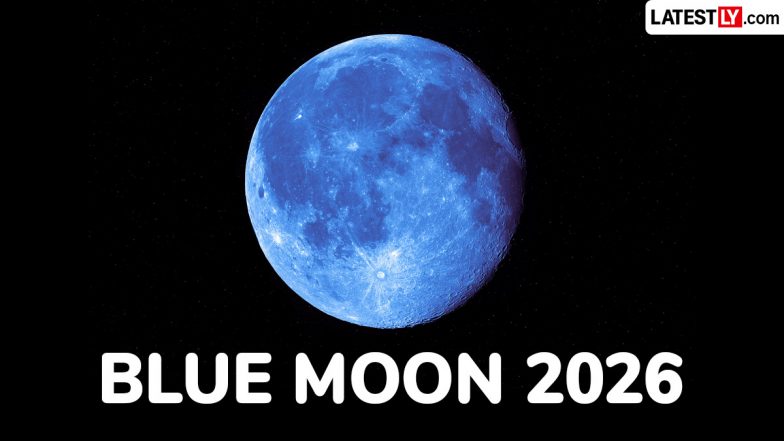
A rare celestial event is set to occur on Sunday, May 31, as a "Blue Moon" illuminates the night sky. This phenomenon marks the appearance of a second full moon within a single calendar month, following the month's initial full moon on May 1. The occurrence will result in 13 full moons for the year 2026, rather than the standard 12.
The Science Behind a Blue Moon
A calendar-based Blue Moon happens because of a slight misalignment between the lunar cycle and the Gregorian calendar. The Moon takes approximately 29.5 days to complete one full cycle of phases from new moon to full moon. Because most calendar months span 30 or 31 days, the timing occasionally aligns to allow two full moons to fall within a 30-day window. Blue Origin New Glenn Rocket Explodes During Ground Test; Jeff Bezos Assures Everyone Involved Is Safe; Elon Musk Reacts.
Despite the colloquial phrasing, the name is purely an indicator of timing and does not denote a change in physical appearance. Under normal atmospheric conditions, the Moon will retain its standard pearly white or grey hue. The optical phenomenon of the Moon actually appearing blue is entirely distinct and only occurs when specific environmental factors, such as thick smoke or volcanic ash, filter out red wavelengths of light in the upper atmosphere.
A Coinciding 'Micromoon' Phenomenon
The event on May 31 carries added significance for astronomers as it coincides with a "Micromoon". This happens when a full moon peaks while the lunar body is at apogee - its farthest distance from Earth along its elliptical orbit. Because of this increased distance, the Blue Moon will appear roughly six to seven per cent smaller and slightly dimmer than an average full moon. Astronomers note that while the size reduction may be difficult to detect with the naked eye, a sensory phenomenon known as the "Moon Illusion" may still make the lunar disc appear strikingly large when it is positioned near the horizon shortly after moonrise. UFO-Linked General William Neil McCasland Met US Space Force Personnel Hours Before Disappearance, Audio Reveals.
Blue Moon Viewing Timelines
It must be noted that the blue Moon on May 31 will rise in the east. However, it will appear lower in the sky and just to the right of the constellation Virgo. As a monthly calendar event, Blue Moons are relatively uncommon, taking place roughly once every two to three years. The last time skywatchers witnessed a monthly Blue Moon was in August 2023, and the next instance following this week's event is projected for December 2028. The event requires no special equipment or telescopes, making it entirely accessible to the general public. Depending on local geographic positions, the optimal viewing window begins just after sunset as the moon crosses the horizon, provided regional weather conditions remain clear.
(The above story first appeared on LatestLY on May 29, 2026 10:30 AM IST. For more news and updates on politics, world, sports, entertainment and lifestyle, log on to our website latestly.com).